
Part 3: Born in Bethlehem, Son of David

Although both Matthew and Luke report that Jesus was born in Bethlehem, they call him “Jesus of Nazareth” throughout their gospels. It was surely not the Jewish custom to name a person after a birthplace that was merely en route, but after their permanent family home, which in this case, as both gospels tell us, was Nazareth.
Part 3: Born in Bethlehem, Son of David
By Robert Stackpole, STD
In this weekly web series, Dr. Robert Stackpole, emeritus director of the John Paul II Institute of Divine Mercy, leads us step-by-step through the life of the Founder of Christianity, from Bethlehem to Galilee to Jerusalem. Along the way, we pause to consider in-depth the historical debate over the gospel stories of the virginal conception and nativity of Jesus, his message of the Kingdom, his embrace of persecution and death on the Cross, and his glorious bodily resurrection from the dead. Finally, we plunge into the great mystery of the Incarnation, and show how it actually shines through the whole gospel story from beginning to end.
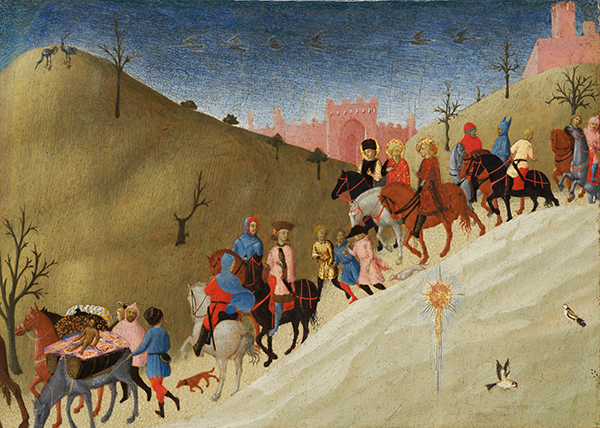
Two of the evangelists, St. Matthew and St. Luke, open their gospels with accounts of the Nativity of Jesus, including (as we saw last time) a prophetic star and the coming of the wise men, and also angels appearing to shepherds in the night sky to herald the birth of the newborn king, and even remarkable accounts of the miraculous conception of Jesus in the womb of Mary his mother while she was a virgin.
Many New Testament scholars today seriously doubt that much of this can be taken as historical reportage. Surely, if anything in the gospel records smacks of myth and legend, it is these colorful stories of the conception and birth of the Son of God, laced as they are with angelic visitations, and miraculous signs and wonders.
But what does the evidence actually suggest?
Matthew and Luke
The accounts of the Nativity by Matthew and Luke are obviously very different from each other. For example, Luke tells of the Annunciation of the angel Gabriel to the Virgin Mary, the Roman census, angelic messengers appearing to shepherds abiding in the fields, and the finding of the baby Jesus in Bethlehem “wrapped in swaddling clothes, and lying in a manger” (Lk 2:12).
Matthew, on the other hand, tells us of St. Joseph’s dreams, a special star, the coming of the wise men, the flight into Egypt, and the slaughter of the innocents.
Obviously, these two accounts of the Nativity are drawn from completely independent sources. On the other hand, they also manifest important similarities:
- In theology: in both accounts, Jesus is said to be conceived by the Holy Spirit in the womb of the Virgin Mary.
- In lineage: he was born to Mary and Joseph, the latter at least a descendant of King David.
- In geography: Jesus was born in Bethlehem of Judea.
- In chronology: his birth took place during the reign of the tyrant Herod the Great (who died somewhere between 4 and 1 BC).
Dual-attestation of these four basic claims lends an initial probability that they have an historically factual basis. Three of them, however, remain controversial among historians working in the field.
Jesus of Bethlehem?
To begin with, and surprising as it may seem, some historians doubt that Jesus actually was born in Bethlehem (claim #3, above).
Princeton scholar James H. Charlesworth, for example, raises the question of whether or not Jesus was really born in Bethlehem, since Jesus is never called “Jesus of Bethlehem,” but always “Jesus of Nazareth.” Mark 1:9 states “Jesus came from Nazareth of Galilee,” so Charlesworth considers that “If Jesus came from Nazareth, he may have been born there” [1] (cf. Mt 21:11, Mk 6:1, Jn 1:45-46).
The only strong evidence he presents in favor of this possibility, however, is that “Nicodemus is unable to reply to the charge that Jesus cannot be a prophet or the Messiah, because no prophet is to come from Galilee, which includes Nazareth” (Jn 7:52). [2] Evidently, Nicodemus was unaware of any tradition that Jesus actually was born in Bethlehem of Judea. Charlesworth concludes, “It is impossible to be certain where Jesus was born … but the vast amount [sic] of independent evidence … indicates that Jesus most likely grew up and was born in Nazareth, the home of his fathers.” [3]
Charlesworth quotes with approval the assessment of the evidence by one of his students:
[The student said,] "If we try to understand Matthew’s mentality, we come to know that Matthew has a special intention and motivation for his writings. He strives to inform his readers that Jesus fulfilled everything that is written in the Old Testament. So he claims that Jesus was born in Bethlehem to fulfill Micah 5:1. John and Mark, in contrast, are more coherent in their teachings and theology than Matthew, so it seems to me that Nazareth is the more probable place of his birth.”
To what extent did this student show amazing honesty with history without sacrificing theology and Christology? [4]
This student may indeed have shown “amazing honesty” and sincerity — but only by attributing amazing dishonesty to the author of St. Matthew’s gospel. The student also does not exhibit knowledge of all the pertinent facts. For example, that St. Matthew was under no pressure to invent a birth of Jesus specifically in Bethlehem to fulfill Old Testament prophecy is abundantly clear from the very next sentences in Charlesworth’s own book (although Charlesworth fails to make the connection himself):
An examination of early Jewish texts indicates that the Messiah may be born in Bethlehem or elsewhere. He may even come directly from heaven or some other region. Certainly the Messiah does not have to be born in Bethlehem. [5]
Reza Aslan came to a similar conclusion about this issue in his book Zealot (2014):
The passage from the gospel of John [Jn 7:25-44] … is a perfect example of the general confusion that existed among the Jews when it came to the messianic prophecies. For even as the scribes and teachers of the law confidently proclaimed that Jesus could not be the messiah because he is not, as the prophecies demand, from Bethlehem, others in the crowd argue that the Nazarean could not be the messiah because the prophecies say “When the messiah comes, no one will know where he is from” (Jn 7:27). [6]
Temporary residence
Moreover, St. Matthew is not the only Evangelist who reports that Jesus was born in Bethlehem: St. Luke attests to this fact as well, and in Luke’s gospel the designation of Bethlehem as Jesus’ birthplace is not tied to any prophecy. Rather, according to St. Luke, Bethlehem was just the temporary residence of Mary and Joseph, who had journeyed there for the Roman census.
This also explains why, although both Matthew and Luke report that Jesus was born in Bethlehem, they continue to call him “Jesus of Nazareth” throughout their gospels: because it was surely not the Jewish custom to name a person after a birthplace that was merely en route, but after their permanent family home, which in this case, as both gospels tell us, was Nazareth. Finally, none of the early Christian writers outside of the gospels report that Jesus was born in Nazareth, and none of the early Jewish polemicists (who attacked so many other aspects of the gospel accounts) cast doubt on his birth in Bethlehem. In short, the preponderance of the historical evidence still strongly supports Bethlehem as the birthplace of Jesus Christ.
Further corroboration of St. Luke’s Nativity accounts include the fact that there really were shepherds who tended flocks on the outskirts of Bethlehem in those days, and caves in the hillsides that were used as stables for animals (which is why an early Christian tradition holds that Jesus was born in a cave). Even the Christmas tradition that places an ox and an ass beside the stable stands to reason: if there was no room for Mary and Joseph in the “inn” in Bethlehem, so that Jesus had to be born elsewhere, and was laid in a “manger” (see Lk 2:7 and 2:16), then he was most likely born in a stable for sheltering animals.
With regard to claim #2, above, while the two gospels present different genealogies for Jesus, both claim that he was born into the family headed by Joseph, which made Joseph his legal father, and therefore under Jewish law made Jesus a legitimate member of the House of David.
Next: Part 4: Did the Roman Census Really Happen?
Previous article.
Notes
[1] James H. Charlesworth, The Historical Jesus: An Essential Guide (Nashville: Abingdon, 2008), p. 67.
[2] Ibid., p. 66.
[3] Ibid., p. 73.
[4] Ibid., p. 66.
[5] Ibid.
[6] Reza Aslan, Zealot (New York: Random House, 2014), p. 32.
{shopmercy-ad}
You might also like...
What is the connection between Pope Leo XIV and one of the great holy wonder-workers or miracle workers in the history of our faith, St. Nicholas of Tolentino? He was was an Augustinian friar (like Pope Leo) and considered the patron of the Holy Souls in Purgatory.
On the feast day of St. James, Apostle, July 25, we share another example of how Jesus keeps His promises.
In the early 19th century, high in the mountains of Lebanon, Youssef Makhlouf dreamed of giving his life to Christ in a radical way. He became St. Charbel Makhlouf, OLM, whose feast we celebrate on July 24.