
Part 5: The Historical Basis for the Story of the Virginal Conception of Jesus

An early Christian tradition claims that St. Luke became acquainted with Mary personally, and received much of his material from her. Indeed, at two points in his book he hints at his source when he writes: “And Mary kept all these things, pondering them in her heart” (Lk 2:19, 51).
Part 5: The Historical Basis for the Story of the Virginal Conception of Jesus
By Robert Stackpole, STD
In this weekly web series, Dr. Robert Stackpole, emeritus director of the John Paul II Institute of Divine Mercy, leads us step-by-step through the life of the Founder of Christianity, from Bethlehem to Galilee to Jerusalem. Along the way, we pause to consider in-depth the historical debate over the gospel stories of the virginal conception and nativity of Jesus, his message of the Kingdom, his embrace of persecution and death on the Cross, and his glorious bodily resurrection from the dead. Finally, we plunge into the great mystery of the Incarnation, and show how it actually shines through the whole gospel story from beginning to end.
Read the series from the beginning.
So, we return to a question we have yet to answer: what about the most stupendous claim that Matthew and Luke make about the origins of Jesus of Nazareth, namely, that he was miraculously conceived in the womb of his mother Mary by the Holy Spirit? Is this tale a mere legend (even if, as we have seen, most of the other aspects of the story of the Nativity of Christ can be shown not to be)?
Historians ask: where did the virginal conception story originate? Is it simply a myth, like the incredible stories of the miraculous births of many ancient demi-gods and heroes?
Mary's testimony
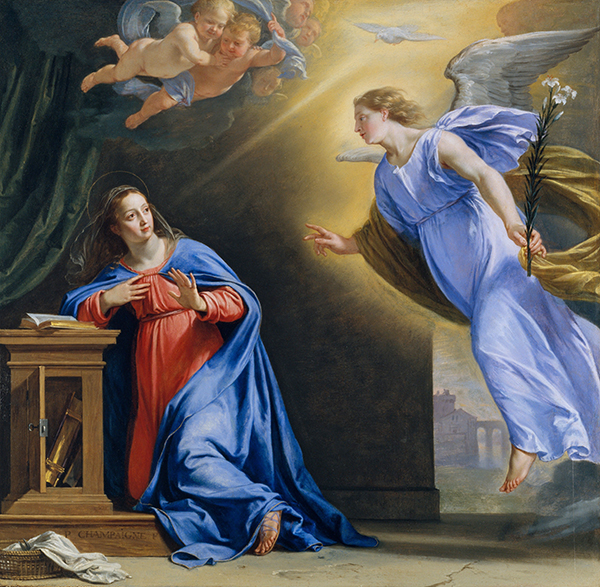
The only reliable source for such a claim would be the testimony of Mary herself. An early Christian tradition claims that St. Luke became acquainted with Mary personally, and received much of his material from her. Indeed, at two points in his book he hints at his source when he writes: “And Mary kept all these things, pondering them in her heart” (Lk 2:19, 51).
Luke could have met Mary personally when he accompanied St. Paul on some of his visits to Jerusalem (perhaps on his last visit there, recorded by St. Luke in the first person in Acts 21), or when they visited Ephesus (see Acts 19). The preface to St. Luke’s gospel (Lk 1:1-4) suggests that the story of the virginal conception of Jesus was already in circulation in the Christian community when Luke wrote (arguably, ca. 60-63 AD), for it was evidently among those “things that have happened among us” of which “Theophilus” already had been “informed” (Lk 1:4). St. Luke’s account of the Nativity immediately follows this preface.
In short, the story almost certainly predates the writing of his gospel, and likely comes from the testimony of the Blessed Virgin Mary herself.
Isaiah and Matthew
Some scholars claim that St. Matthew invented his account of the virginal conception just to fulfil the prophecy of Isaiah 7:14, which he quotes: “Behold, a virgin shall conceive and bear a son, and his name shall be called Emmanuel” (Mt 1:23). But this is highly improbable.
First of all, that passage from Isaiah was not generally regarded by Matthew’s contemporaries as a Messianic prophecy. As far as we know, no one at the time expected the Messiah to be born of a virgin, so Matthew was under no pressure to invent such a miraculous origin for Jesus. This also means that the frequent charge that Matthew was misled by the Greek Septuagint translation of the book of Isaiah (which states “Behold a virgin shall conceive,” whereas the original Hebrew has the more general word “almah,” here, “young maiden” [1]), is also beside the point: again, if the passage was not necessarily a Messianic prophecy, why would Matthew feel he had to invent a virginal conception for Jesus based on the Septuagint in order to strengthen his case that Jesus really was the long expected Messiah?
It seems more likely that Matthew reached for the Greek Septuagint translation of the Old Testament in order to try to make sense of a story that had been passed on to him in the early Christian community about Jesus’ miraculous origin. For the Israelites, everything significant about the Messiah was assumed to be contained prophetically somewhere in the Hebrew Scriptures. Moreover, Matthew wrote of this miraculous conception in such a brief and matter-of-fact way, without ever referring to it again in his gospel, that it seems more likely that he was simply reminding his readers of a familiar fact, rather than concocting a brand new myth or legend.
In his Nativity story, St. Luke does not even mention the prophecy in Isaiah 7:14. All things considered, it seems more likely that St. Matthew recorded, and interpreted as a fulfilment of prophecy, a pre-existing virginal conception story (i.e., a tale already circulating in the early Church community), than that he invented the story to fit with Isaiah 7:14.
Historical reliability
In short, the claim that Jesus was born of the Virgin Mary almost certainly antedates the writing of both of these gospels, pushing it back to the earliest years of the Christian movement (and it seems likely that Luke received his account from Mary herself).
This marks a major point in favor of the historical reliability of the account. There was hardly time for such an amazing legend to arise and circulate in just the first decade or two of the life of the Church, especially when so many were still alive who knew Mary of Nazareth and the apostles, and who could corroborate or cast doubt on such an extraordinary claim.
Next: Part 6: The Alleged Pagan Origins of the Virginal Conception Accounts.
Previous article.
Note
[1] The distinction between the Greek Septuagint version of Isaiah 7:14 and the Hebrew original is not as sharp as some suggest. After all, in those days an almah (a young maiden, a young unmarried woman) was ordinarily presumed to be a virgin, and this Hebrew word is used elsewhere in the Old Testament with that very connotation; for example, in Genesis 24:43 almah is applied to Rebecca, who was already explicitly said to be a virgin (betulah) in Genesis 24:16.
{shopmercy-ad}
You might also like...
What is the connection between Pope Leo XIV and one of the great holy wonder-workers or miracle workers in the history of our faith, St. Nicholas of Tolentino? He was was an Augustinian friar (like Pope Leo) and considered the patron of the Holy Souls in Purgatory.
On the feast day of St. James, Apostle, July 25, we share another example of how Jesus keeps His promises.
In the early 19th century, high in the mountains of Lebanon, Youssef Makhlouf dreamed of giving his life to Christ in a radical way. He became St. Charbel Makhlouf, OLM, whose feast we celebrate on July 24.