















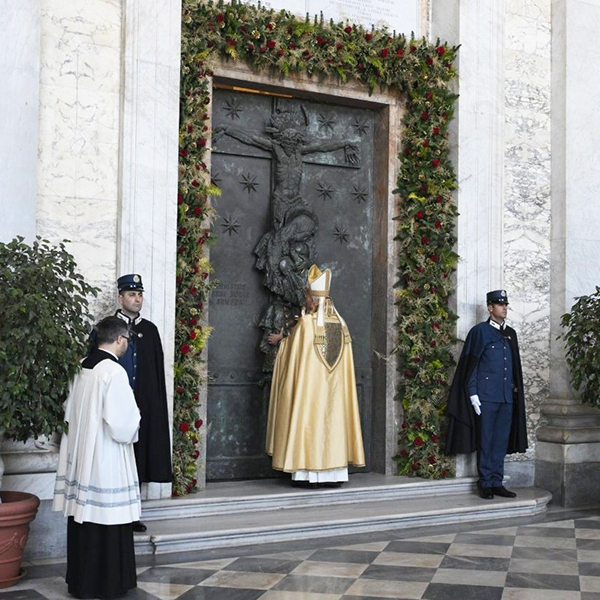
U.S. Cardinal James M. Harvey, archpriest of Rome's Basilica of St. Paul Outside the Walls, reaches in to close the basilica's Holy Door Dec. 28, 2025, as the Jubilee Year was about to end. (CNS photo/Lola Gomez)
Jubilees are always privileged times to live the ABCs of Mercy: to Ask for God’s mercy by going on pilgrimage to Rome or other holy sites to receive the Jubilee indulgences and graces; to Be merciful to others by forgiving debts owed us, both financial and spiritual, as well as the other works of mercy; and to Completely trust in God’s mercy.
By Chris Sparks
As the Jubilee Year concludes, Holy Door by Holy Door being closed till the final one, in St. Peter’s Basilica, is shut on the feast of the Epiphany, Jan. 6, it’s worth reminding ourselves how closely tied every single Jubilee is to the Divine Mercy.
Let us count the ways.
Reminder: What is a jubilee?
Our Catholic jubilees owe a lot to the Jewish jubilees of Scripture, as we explained during the 2016 extraordinary Jubilee Year of Mercy:
The Law of Moses prescribed a special year for the Jewish people (Lev 25:10-14). The trumpet with which this particular year was announced was a goat’s horn, called yobel in Hebrew, and the origin of the word “jubilee.” The celebration of this year also included the restitution of land to the original owners, the remission of debts, the liberation of slaves, and “rest” for the land, which was left fallow. In the New Testament, Jesus presents himself as the One who brings the old Jubilee to completion, because he has come to “preach the year of the Lord's favor” (Lk 4:18-19; see also Is 61:1-2).
Fast-forward to Pope Boniface VIII in the year 1300, who revived the jubilee tradition as a year of settlement between adversaries, conversion, and a time to receive the Sacrament of Reconciliation. Jubilees encourage solidarity, hope, justice, and commitment to serve God with joy and in peace with our brothers and sisters.
A Jubilee Year is, above all, the year of Christ, who brings life and grace to humanity (see “What is a Holy Year?”).
All of that means that a jubilee, like so much else in the Church, has both a this-worldly and a supernatural side when it’s properly, fully celebrated.
The Jubilee Year of Hope was the 27th jubilee since 1300. The next will be observed in 2033, marking the 2,000th anniversary of the Crucifixion and Resurrection of Jesus.
Live the ABC’s
Jubilees are always privileged times to live the ABCs of Mercy: to Ask for God’s mercy by going on pilgrimage to Rome or other holy sites to receive the Jubilee indulgences and graces; to Be merciful to others by forgiving debts owed us, both financial and spiritual, as well as the other works of mercy; and to Completely trust in God’s mercy. A Jubilee year, properly celebrated, brings true freedom from debt, both financial and the debt we incur through our sins. It heals relationships, sets aside old grievances, and allows prodigals to return home.
Has that been your experience of the Jubilee this year? If not, it’s a good time for an examination of conscience. What has gotten in the way of God’s grace in your life this year? What has gotten in the way of being forgiven or offering forgiveness? Do you need to acknowledge any sins, to ask pardon from God or from man, or to do penance?
Or is your difficulty on the other end of the spectrum? Do you need to forgive yourself? Do you need to step back from unsuitable, excessive, or unsustainable penances? Are you scrupulous, holding yourself to blame unjustly, viewing yourself too harshly?
Either way, if this Jubilee has felt like less than the occasion of joy, grace, and hope it is meant to be, why not plan in this New Year to make an examination of conscience? Then call your parish and arrange to sit down with your pastor to talk through and discern together your state of soul. You can discuss with him a plan for welcoming God’s grace into your life, extending grace to others, and trusting that, between the grace of the Sacraments and the promises God has given to us attached to living mercifully, we can be put in right relationship with God and neighbor.
Jesus’ promises
Remember Jesus’ promises to St. Faustina:
I have opened My Heart as a living fountain of mercy. Let all souls draw life from it. Let them approach this sea of mercy with great trust (Diary, 1520).
On the cross, the fountain of My mercy was opened wide by the lance for all souls — no one have I excluded! (1182).
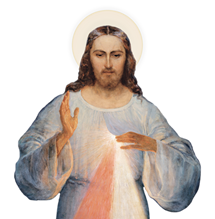
I am offering people a vessel with which they are to keep coming for graces to the fountain of mercy. That vessel is this image with the signature: "Jesus, I trust in You" (327).
The graces of My mercy are drawn by means of one vessel only, and that is — trust. The more a soul trusts, the more it will receive (1578).
I never reject a contrite heart (1485).
Sooner would heaven and earth turn into nothingness than would My mercy not embrace a trusting soul (1777).
So as this Jubilee comes to an end, renew your hope! Recommit yourself to love of God and neighbor. Welcome the blessings God gives us through our Catholic faith. Practice the message and devotion of Divine Mercy.
Jesus, I trust in you!
Saint Faustina, pray for us!
{shopmercy-ad}
