














Pope Leo XIV waves to the crowd before leading his General Audience in St. Peter's Square on Ash Wednesday. (CNS photo/Vatican Media)
"Dear friends," Pope Leo XIV writes, "let us ask for the grace of a Lent that leads us to greater attentiveness to God and to the least among us. Let us ask for the strength that comes from the type of fasting that also extends to our use of language, so that hurtful words may diminish and give way to a greater space for the voice of others. Let us strive to make our communities places where the cry of those who suffer finds welcome, and listening opens paths towards liberation, making us ready and eager to contribute to building a civilization of love."
By Chris Sparks
[Jesus said,] Tell aching mankind to snuggle close to My merciful Heart, and I will fill it with peace. Tell [all people], My daughter, that I am Love and Mercy itself. When a soul approaches Me with trust, I fill it with such an abundance of graces that it cannot contain them within itself, but radiates them to other souls (Diary of Saint Maria Faustina Kowalska, 1074).
I write this on Ash Wednesday, launching out into Lent in 2026, the first Lent we will live under Pope Leo XIV, a Lent in a time of the 250th anniversary of the USA’s founding, a Lent in a time of division, of anger, of fear, and of much confusion.
But there is always hope.
Divine Mercy and Mary Immaculate
I write this in a time when the Gospel remains the same as it ever has been, when the Divine Mercy message and devotion (with all its many graces, promises, and insights) is more relevant, more necessary, more important than ever.
I write this in a time when we badly need to be reminded that we are all children of God and of the Blessed Mother, Mary Immaculate, Patroness of the U.S.A., she who appeared on this continent as Our Lady of Guadalupe in 1531. Under that last title, she is the Empress of the Americas, the Patroness of the Unborn, the Star of the New Evangelization, and Queen and Mother to the whole American continent, north and south.
Indeed, when the Great Mercy Pope, St. John Paul II addressed an encyclical to the New World (Ecclesia in America, The Church in America) offering us magisterial teaching, counsel, and direction for the third millennium, he addressed the whole New World as America, and spoke to us of our mother, Our Lady of Guadalupe (see especially 11-12).
Leonine living
Given all of that, I want to spotlight a number of recent teachings from our Holy Father that show us how to live Lent, how to be a sign of contradiction that brings unity — in other words, how to be living members of the Body of Christ. And that’s the goal of Lent, isn’t it?
First, consider "Life in Abundance," Pope Leo's new Holy Father’s letter on sport, occasioned by the ongoing Winter Olympics in Italy. Now I am the last person on earth to be writing about sports, let me first acknowledge, but the letter has a lot of good and important things to say about the Olympics and sports more generally as a model of competition that leads to peace rather than to war, to mutual love and neighborliness rather than mere dominance or exploitation.
“In a world thirsting for peace, we need tools that can put an ‘end to the abuse of power, displays of force and indifference to the rule of law,'" Pope Leo writes. "Even today, sport continues to play a significant role in most cultures. It offers a privileged space for relationship and dialogue with our brothers and sisters belonging to other religious traditions, as well as with those who do not identify with any religious tradition."
He’s right. Give it a prayerful read.
Lenten message
Next, "Listening and Fasting: Lent as a Time of Conversion," is the Holy Father’s Lenten message. It's a beautiful summons to accept God’s mercy, be merciful, and completely trust in God’s mercy — you should definitely pray over it. He summons us all to disarm our speech, to set aside words as weapons and instead use words as light, as healing, as peace:
I would like to invite you to a very practical and frequently unappreciated form of abstinence: that of refraining from words that offend and hurt our neighbor. Let us begin by disarming our language, avoiding harsh words and rash judgement, refraining from slander and speaking ill of those who are not present and cannot defend themselves. Instead, let us strive to measure our words and cultivate kindness and respect in our families, among our friends, at work, on social media, in political debates, in the media and in Christian communities. In this way, words of hatred will give way to words of hope and peace.
This will be a challenge for me, and yet if I am to serve the Divine Mercy, how can I avoid this?
Pope Leo concludes:
Dear friends, let us ask for the grace of a Lent that leads us to greater attentiveness to God and to the least among us. Let us ask for the strength that comes from the type of fasting that also extends to our use of language, so that hurtful words may diminish and give way to a greater space for the voice of others. Let us strive to make our communities places where the cry of those who suffer finds welcome, and listening opens paths towards liberation, making us ready and eager to contribute to building a civilization of love.
Important anniversary
And speaking of the Divine Mercy, the General Superior of the Marian Fathers, Fr. Joe Roesch, MIC, shared with us big news on Ash Wednesday:
At the General Audience today in St. Peter's Square, the Pope at the end gives greetings to different groups of pilgrims. He said this in Italian to the Polish speaking pilgrims:
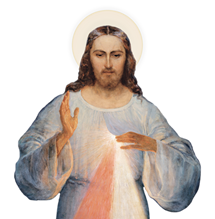
I cordially greet the Polish people. February 22 marks the 95th anniversary of the first apparition of Merciful Jesus to Saint Faustina Kowalska. Since then, a new chapter has begun in the spread of devotion to Divine Mercy through the Chaplet and the painting "Jesus, I Trust in You." May Lent be a time of encounter with Christ through the Sacrament of Penance and works of mercy. My blessing to all!
Blessings indeed!
Elsewhere in his General Audience, Pope Leo spoke of the universal (Catholic) mission of the Church, of the love of God for all peoples and therefore of the place all peoples have in the life and ministry of the Church:
… what counts is being together because we are drawn by the Love of Christ, who broke down the wall of separation between people and social groups (cf. Eph 2:14). For Saint Paul, mystery is the manifestation of what God wanted to achieve for the whole of humanity, and is made known in local experiences, which gradually widen to include all human beings and even the cosmos.
The condition of humanity is one of fragmentation that human beings are unable to repair, even though the tendency towards unity dwells in their heart. The action of Jesus Christ enters into this condition through the power of the Holy Spirit, and overcomes the powers of division and the Divider himself. Gathering together to celebrate, having believed in the proclamation of the Gospel, is experienced as an attraction exerted by the cross of Christ, which is the supreme manifestation of God’s love. It is feeling called together by God: this is why the term ekklesía is used, that is, an assembly of people who recognise that they have been summoned together.
… It is through the Church that God achieves the aim of bringing people to him and uniting them with one another. Union with God finds its reflection in the union of human beings. This is the experience of salvation.
Mercy for all nations
In this Lent, in this anniversary, in this fraught time where our brothers and sisters in Christ as well as our brothers and sisters in Adam are suffering so much in so many ways, it’s worth reminding ourselves of an essential lesson of our Christian faith: Jesus said to love your neighbor. He never said only love your neighbor who agrees with you.
That’s why our works of mercy as a Church and as individuals are normally directed at the community. Christians don’t test the faith of the people who make use of our food pantries or our water projects in Africa, like Water 4 Mercy. Christians don’t check on the faith of the people who receive our donations of clothing or the homeless folks who take shelter with us. There is no test of creed for the sick who come to our hospitals.
Heck, even when it would seem differences of faith would most matter, like at our schools or our other educational endeavors, many of our Catholic schools persistently welcome students of all faiths, of all backgrounds.
The love and mercy of Jesus, transmitted through the Body of Christ, is the love “of your heavenly Father, for he makes his sun rise on the bad and the good, and causes rain to fall on the just and the unjust” (Mt 5:45).
So this Lent, let us recommit ourselves to ask for the mercy of God, be merciful to our neighbors (all of our neighbors), and to completely trust in Divine Mercy.
{shopmercy-ad}
