

















Hard as it may be for some historians to admit, the gospel accounts of most of the nature miracles are fairly well grounded in historical fact.
Part 17: On the Nature Miracles of Jesus
By Robert Stackpole, STD
In this weekly web series, Dr. Robert Stackpole, emeritus director of the John Paul II Institute of Divine Mercy, leads us step-by-step through the life of the Founder of Christianity, from Bethlehem to Galilee to Jerusalem. Along the way, we pause to consider in-depth the historical debate over the gospel stories of the virginal conception and nativity of Jesus, his message of the Kingdom, his embrace of persecution and death on the Cross, and his glorious bodily resurrection from the dead. Finally, we plunge into the great mystery of the Incarnation, and show how it actually shines through the whole gospel story from beginning to end. Read the series from the beginning.
Many New Testament historians today are willing to concede that Jesus must have performed “miraculous” cures of some kind or other, since the historical evidence for them is so strong (see the previous five articles in this series). But they “draw the line” at the so-called “nature miracle” stories: the claim of the gospels that Jesus fed the multitudes with just a few loaves and fishes, turned water into wine, walked on water, and calmed the storm at sea.
Presuppositions at work
For example, in The Historical Jesus: an Essential Guide, James H. Charlesworth writes:
The mighty works attributed to Jesus in the Gospels can be divided between the nature miracles and healing miracles. The former point to Jesus and his elevated stature; thus, Jesus walks on water and can control storms. The attention is drawn to Jesus. These stories seem to develop out of myths and legends that were created in the [post-30 AD Christian] community to laud and elevate Jesus. [1]
Notice the presuppositions at work here: if the miracle story lauds and elevates Jesus, and draws attention to Him (rather than, presumably, to His message about the Kingdom of God), then it is most likely the product of myth and legend.
However, the healing miracles of Jesus also called attention to Him, and made people wonder who this Man from Nazareth really was (and Jesus did not object to this wonder and questioning: see Mt 11:2-6, and Mk 2:1-12). Furthermore, there are multiple testimonies to Jesus’ nature miracles, especially the calming of the storm at sea (Mt 8:23-27, Mk 4:36-37, Lk 8:22-25) and the multiplication of loaves and fishes to feed multitudes (e.g., Mt 14: 13-21, Mk 6:32-34, Lk 9:10-17, Jn 6:1-14).
Indeed, there are more testimonies to these two nature miracles than to most of the healing miracles!
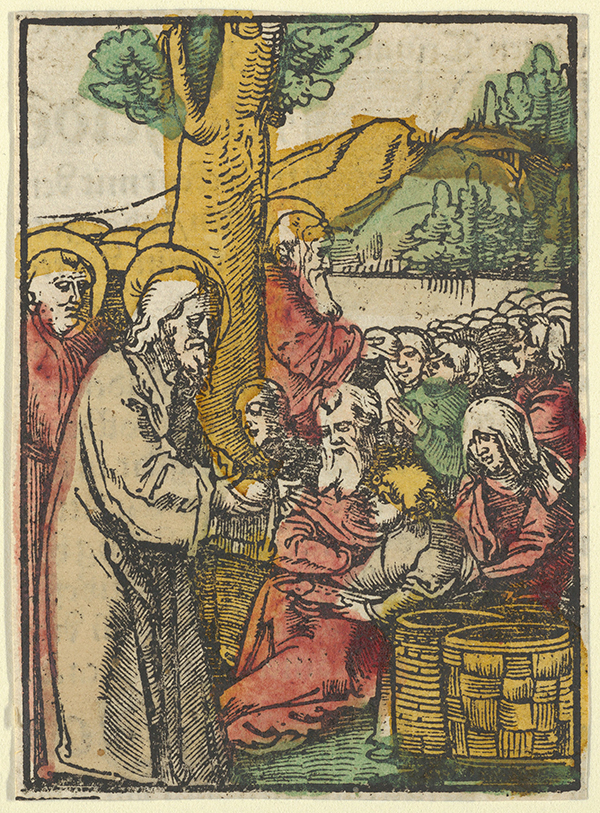
Feeding of the Multitudes
The Feeding of the Multitudes story actually conveys a significant Kingdom-message, a message that was not entirely missed by some of its Jewish eyewitnesses. Immediately after this miracle, Jesus had to put His disciples into boats and disperse the crowd, and St. John’s account tells us why: because the people were in a Messianic fervor, and about to “take him by force and make him king” (Jn 6:14-15; cf. Mt 14:22 and Mk 6:45). Catholic scholar Roch Kereszty explains:
The Jewish belief that the Messiah would be a new Moses (Dt. 18:15) was coupled with the expectation that the Messiah would renew the manna miracle of Exodus. From among several texts, [biblical scholar] Ignace de la Potterie mentions the Syrian Apocalypse of Baruch:
“And it will happen that when all that which should come to pass in these parts has been accomplished, the Anointed One will begin to be revealed … And it will happen at that time that the treasure of manna will come down again from on high, and they will eat of it in those years because these are the ones who will have arrived at the consummation of time."
It seems that the historical fact behind the multiplication of the loaves story is a prophetic sign action of Jesus, by which he intended to show the very nature of the kingdom. The kingdom is like a banquet to celebrate communion with God and with one another, and the source of this communion is the food that the Messiah himself provides in miraculous abundance. [2]
Some commentators point out that there are actually two versions of the Feeding of the Multitudes by Jesus: in one He feeds 5,000 people, and in another He feeds 4,000, and Mark and Matthew include both stories in their gospels. It is argued that this shows that the gospel writers had conflicting accounts of the same incident that were passed down to them, and did not know what to do with them, so they included both as if they were two separate events.
Two things here. First, if that was what the gospel writers did, then we have even more evidence that Jesus at least once fed a crowd of people with just a handful loaves and fishes, for we would not only have multiple attestation in its favor (the story occurs in all four gospels) but further attestation within two of the gospels themselves (Matthew and Mark).
Second, alternatively, as Robert Hutchinson pointed out in his book Searching for Jesus:
[T]he feeding of the five thousand appears to be primarily among the Jews, and the Greek text uses a term for “basket” common in Palestine (kophinos), while the feeding of the four thousand occurs in a series of passages in which Jesus is moving among Gentiles, and the word for container used to collect the extra fish is spyris, a different word. … [I]t is very probable that Jesus fed, miraculously or not, large groups of people on more than one occasion. [3]
"Come unto Me"
Finally, contra Charlesworth, there is at least one sense in which Jesus surely did want to “draw attention” to Himself, a sense which Charlesworth overlooks: Jesus asked people to place their complete trust in Him (e.g., “Come unto me,” Mt 11:28-30, Lk 10:21-22; and see the story of the healing of the Centurion’s servant, Mt 8: 5-13, Lk 7: 1-10). This coheres quite well with the message of the stories of calming the storm, and walking on water, where a central theme is the call for complete personal trust in Jesus.
Kereszty suspects that unexamined philosophical presuppositions may be at work in the tendency to dismiss the accounts of the nature miracles, in particular “a still powerful … tendency that restricts ‘intervention of God’ to human subjectivity, and excludes it from the impenetrable web of necessary cause-effect relationships in nature.”
Hard as it may be for some historians to admit, therefore, the gospel accounts of most of the nature miracles are fairly well grounded in historical fact.
Next: Part 18: On the Transfiguration of Jesus.
Previous article.
Notes
[1] James H. Charlesworth, The Historical Jesus: An Essential Guide (Nashville: Abingdon, 2008), p. 81.
[2] Roch Kereszty, O.Cist., Fundamentals of Christology (New York: St. Paul’s Books and Media, 2002 edition), p. 119-120.
[3] Robert Hutchinson, Searching for Jesus (Nelson Books, 2019), p.16.
{shopmercy-ad}
