
















No one has yet pieced together a convincing explanation for the empty tomb, the appearances of the risen Jesus, and the sudden explosion of courageous faith and witness by his disciples just a few weeks after he was crucified — other than the explanation given in the New Testament. The historical evidence for Easter, therefore, can serve as a challenge both to atheists and agnostics alike to rethink their presuppositions and broaden their worldview, in order to make room for realities that they have hitherto dismissed or ignored.
Part 35: Theological doubts about the Resurrection
By Robert Stackpole, STD
In this weekly web series, Dr. Robert Stackpole, emeritus director of the John Paul II Institute of Divine Mercy, leads us step-by-step through the life of the Founder of Christianity, from Bethlehem to Galilee to Jerusalem. Along the way, we pause to consider in-depth the historical debate over the gospel stories of the virginal conception and nativity of Jesus, his message of the Kingdom, his embrace of persecution and death on the Cross, and his glorious bodily resurrection from the dead. Finally, we plunge into the great mystery of the Incarnation, and show how it actually shines through the whole gospel story from beginning to end. Read the series from the beginning.
Finally, some scholars put forward what we might call “theological” doubts about the Resurrection of Jesus. The appearances of the risen Lord are not really “historical” events at all, it is said, since they transcend the course of normal history — thus the Easter accounts are not subject to being “proven” as historical reportage the way accounts of mundane events can be.
Indeed, these scholars say, only persons aided by faith could “see” the risen Lord: His presence was not something in principle that anyone could have witnessed if they had been on the scene at the right time.
For example, the author of one of the truly outstanding books of contemporary Catholic Christology, Roch Kereszty, O.Cist., slips into these theological doubts:
In contrast to a normal historical event, his appearance is not in principle verifiable by the sense experience of anyone who could have been present. He is seen only by witnesses selected by God, whose sense perception was aided by faith and who could refuse to believe (Acts 9:7; Mt 28:17). …
We cannot admit of a naïve fundamentalist realism according to which the disciples and Paul saw Jesus just as he actually was, in his glorified eschatological reality. … [T]he appearance of the risen Christ is the appearance of the eschatological reality in our world. His true body refers him to our world; therefore it makes sense to perceive him with our senses. In his risen and glorified state, however, he transcends our world; therefore it makes sense that we can recognize him only with the eyes of faith.
Thus, to use St. Thomas [Aquinas’s] felicitous expression, the appearances were effective “signs” through which the risen Christ revealed himself to the disciples.
They were effective signs because they did communicate to the seers the reality of the risen Christ. Nevertheless, they were only signs adapted to the sense experience, imagination and understanding of the disciples, rather than a face-to-face vision of God the Son in his glorified humanity, a vision which is beyond the capability of any mortal man. [1]
See and believe
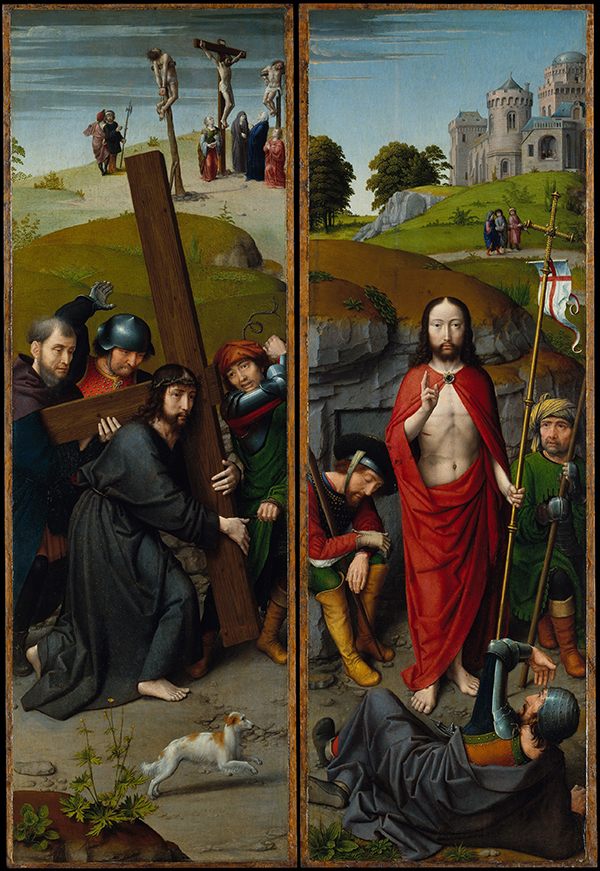
The problem here is that Kereszty approaches the evidence with a fairly narrow, a priori set of boundaries concerning what people could or could not have experienced with their five senses — and this blinds him to some of the empirical evidence actually presented in the Gospels. For one thing, it is abundantly clear that a subjective state of faith was not necessary to enable someone to see the risen Jesus: As previously discussed, neither James, the brother of the Lord, nor Saul of Tarsus were believers at all until after they had seen Christ risen from the dead; the same goes for most of the apostles after the Crucifixion, and especially “doubting Thomas” (Jn 20:24-29).
In fact, the Gospels drive the point home that the faith of the disciples was grounded in their sensory experiences of the risen Lord (e.g., Lk 24: 36-43), and certainly not that their experiences of Him were grounded in faith. Their spiritual and psychological state before they saw Him actually was one of profound sorrow and dejection (Lk 24:13-24; Jn 20:19), changing to fear, wonder and amazement when He first appeared to them (Lk 24: 37, 41). A theologian may conjecture that the fullness of Christ’s heavenly glory was veiled from them, so as not to overwhelm them (Lk 24:16), but what filled them with joy and empowered them for mission was the unshakeable conviction that they had seen, touched, and even shared meals with the risen and glorified Lord (Lk 24: 28-35; Jn 21: 9-15; Acts 10:41).
Moreover, the fact that they were chosen witnesses, specially selected by God (Acts 10:41), does not mean that they were chosen for their faith; rather, they were chosen because God knew in advance those whom He had providentially prepared to bear the burden of the early mission of the Church once He had brought them to Easter faith, by means of the empty tomb and the empirically verifiable appearances of His risen Son (Jn 20:20; I Cor 15: 3-8).
Can we prove it?
So, in the end, can the historian prove that Jesus rose from the dead?
Of course, as we discussed earlier in this web series, the word “prove” is a slippery one. The strength of historical evidence on hand is directly related to the philosophical presuppositions of the person considering that evidence. A hardened atheist is not likely to be convinced by any preponderance of historical evidence that Jesus rose from the dead, as he or she is already convinced on other grounds that there is no God in the universe that could perform such a miracle. Someone agnostic about the existence of God, however, may be willing to admit at least that the Christian interpretation of the evidence fits all the data on hand better than the alternative theories available.
As we have seen, no one has yet pieced together a convincing explanation for the empty tomb, the appearances of the risen Jesus, and the sudden explosion of courageous faith and witness by his disciples just a few weeks after he was crucified — other than the explanation given in the New Testament. The historical evidence for Easter, therefore, can serve as a challenge both to atheists and agnostics alike to rethink their presuppositions and broaden their worldview, in order to make room for realities that they have hitherto dismissed or ignored.
Beyond a reasonable doubt
If one approaches the historical evidence from the standpoint of belief in an all-good, all-powerful and all-knowing Creator God, however, the evidence shows that it is “true beyond a reasonable doubt” that Jesus rose from the dead.
The preponderance of the historical evidence; the lack of any convincing alternative explanations; the fact that there is a God who could perform such a miracle; the suspicion that, surely, if there was ever any historical figure among the friends of God whom he might vindicate by raising that person from the dead, Jesus would be the one — and, as we shall see, the otherwise inexplicable explosion of preaching by the earliest Christians, risking persecution and death to proclaim everywhere that “Jesus is risen,” and Jesus is Lord” — all of these considerations converge to provide a solid, rational foundation for the Easter faith of the Church.
Next: Part 36: The Gospel Message of the Resurrection.
Previous article.
Note
[1] Roch Kereszty, O.Cist., Fundamentals of Christology (New York: St. Paul’s Books and Media, 2002 edition), p. 55, and 65-66.
{shopmercy-ad}
