














The diarist resembles water moving onto a porous surface, relentlessly finding every fissure and dip, every pocket and gap. Her penetration seeps through to the most profound aspects of Divine Mercy, and by the osmosis of her spiritual testimony, we are left the better for it.
Buyer's Remorse - God's call led St. Faustina on, but at first she doubted the way. A largely unnoticed aspect of her early life in the convent shows us her discontent. This is six years before the onset of her mystical experiences, well before she begins The Diary. In fact, after being accepted by the Congregation of the Sisters of Our Lady of Mercy on Aug. 1, 1925, she gets a bad case of buyer's remorse. Three weeks later, she wants out of the Congregation altogether, so she might enter a stricter order.
As we journey back to 1925 Poland, we see a nun who thinks she knows what she wants. God has other plans. Saint Faustina's main objection to the Sisters of Our Lady of Mercy is that the life affords too little time for prayer. She has a contemplative's need for luscious solitude, but instead receives a laborer's fill of menial tasks. The nun's sharp-eyed observance has sized up her fate with accuracy. During the next several years, she will work long hours at menial tasks in the kitchen, the bakery, and the bakery store, washing pots and pans, scrubbing floors, making bread, peeling vegetables, stocking shelves, cleaning bathrooms. Little can she imagine what Providence has in store for her.
In response to Faustina's initial urge to flee to a more contemplative order, her superior wisely sends her to Skolimow, a vacation house near Warsaw owned by the Congregation. There, she is told to rest, relax, recover - and reflect.
The Big Picture - As the Danish philosopher/theologian Soren Kiergegaard cannily observed, though life is lived going forward, we understand it by looking backward. History affords 20/20 hindsight plus a lingering look at the Big Picture. From that lofty vantage point, we can see that this sense of being in the wrong place was instead a confirmation that St. Faustina not only was in the right place, but at the right time. Space and time intersected in the person of this young nun, whom God destined for something as removed from grunt labor as an ant is to a zebra, both anatomically and alphabetically.
As we take a mental snapshot of Sr. Maria Faustina as she gets back from her reflections at Skolimow, what do we see? We see a nun in formation, not so much as a Sister of Our Lady of Mercy but as one of Catholicism's most important figures of the 20th century, a fate she wouldn't have guessed in 28 lifetimes of trying. Fortunately, God's ways are not our ways.
I Think She Knows - We turn now to an actual photo, this one taken in Plock, Poland, in 1929, still a couple years before The Divine Mercy appears in her room. Faustina stands warily before the camera, arms tucked into her sleeves, looking slightly askance, more of the right side of her face toward the lens.
A black and white veil frames her features. It's the eyes that attract. The gaze is clear and direct, looking through the lens and into the eyes of the viewer of the picture. The look is an incense-oil mix of serenity, vulnerability, and resolution, with a hint of sadness. Maybe this is hindsight speaking, but the young woman in this photo looks as if she stands on the verge of something - one foot on an oil slick, the other dangling into the abyss of eternity.
I think she knows what's coming.
The first reported hint that Sr. Faustina is in for more important things than peeling potatoes comes on April 3, 1927. The rest of the world, particularly the United States, is caught up in the decadent height of the Roaring 20s, Babe Ruth is about to set the record for home runs, and prosperity seems like it will never end. In Europe, though, more than beer is brewing. So is trouble. The nascent Nazi machine is falling in rapture with a charismatic super-orator with a demagogue's genius for pushing people's emotional buttons, which turn on a real-looking counterfeit love that soon spills over into obsession. A holocaust slouches around the corner, getting ready to spring.
April 3, 1927. As the civilized world is losing its mind doing the Charleston ... as Adolph Hitler, rising, thrusts into the vortex ... as God, in His heaven, takes note ... a lowly nun experiences the dreaded spiritual "dark night of the soul."
The 'Dark Night' - That "dark night" remained almost to the end of Faustina's Novitiate. What is the "dark night of the soul?" The phrase, today almost a spiritual cliche, was coined in the 16th century by Spanish poet and Catholic mystic, St. John of the Cross. The phrase is both a title to a poem he wrote and a book that contains his commentary on the poem. The Carmelite priest's work examines the stages of development he underwent on his journey to holiness.
Most of us have heard the term "dark night" in reference to spirituality. We associate it with spiritual progress and may idly (and always when we are not in one) wish for our own "dark night" experience. If, however, one truly knew what the dark night is like, he or she wouldn't wish for it. To sum up in a few words what properly takes a book: the dark night of the soul is the feeling of utter abandonment, an interior suffering that seems as if it will never end.
One writer described it as a "lengthy and profound absence of light and hope." When you're in this interminable state, there's nothing you can do with the mind or body - no thought or action, no idea or motion - that can "get you out of it." You feel trapped and can't find the exit. No one can help you. You want nothing more than to escape and get out of the "night." You'd even give your own soul, and so you do.
You're stuck.
No One, No Where, with No Thing - It comes as no slice of relief to realize that this "dark night" is actually a literal form of contact with a field of higher consciousness. It is matter meeting antimatter, the relative making contact with the Absolute, the tenuous brushing up against Omniscience and Omnipresence.
The seeker in the midst of the dark night is not in a relationship with God any longer but experiencing an immersion in Him. One's ego begins to dissolve, willingly or not. All previous ways of defining the self vanish, leaving you feeling like no one, nowhere, with nothing. The phenomenon then takes on urgency. You are No One, No Where, with No Thing. You question your sanity and may think you are losing your mind.
The loving and merciful God has you just where He wants you.
Traditional prayer is useless. Ritualistic worship becomes agony. All the "safe" ways you knew of praying disappear, giving way to a transitional phase of contemplation before morphing into an utter inability to pray. Spiritually, God is making room for Himself in you, but "knowing" this provides no comfort. You believe the opposite is true. You believe God has abandoned you. All you can do is wait, feeling alone. That is one frightening space to be in.
For all you know, your prayer life has collapsed and God has left you. You are, in poet Andre Gide's striking image, like a moth inside a cocoon trying to know itself. The moth that tries this will never become a butterfly. All it can do is let the transformational process happen. So is the soul caught in the midst of the dark night, in the Experience of No Self. God begins to take over. You begin to change and the old "you" is no more. You dread every minute of it.
'Paint an Image' - That's where St. Faustina finds herself on April 3, 1927. She remains in that deserted wilderness for more than a year. Finally, on Good Friday, April 16, 1928, the suffering novice experiences the mystical flame of God's love. Two weeks later, on April 30, she makes her first vows. Through an arduous preparation, God has prepared her for the arduous task ahead, to be the secretary and messenger of Jesus as The Divine Mercy. That won't come until Feb. 22, 1931.
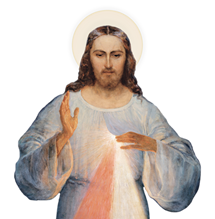
That's the day St. Faustina sees a vision of Jesus. He tells her He is The Divine Mercy and instructs her to "paint an image" of Him according to what she sees standing before her (Diary, 47). His left foot approaches in motion. The left hand pulls away His robe allowing radiant rays of red and pale to stream out from the Heart area. The right hand is raised in blessing. The face is ethereally strong, the eyes penetrating and loving.
The aura of the image is one of comfort and approachability. No dark night now, but a heart lit up with the photonic rays of luminous red and pale. These "holy lasers," the young nun soon understands, are meant not just for her but - through her - for the whole world.
From that point forward, under direction and obeying orders, Faustina begins keeping a journal of her mystical experiences. The world now knows this as the message of and devotion to The Divine Mercy.
A Wistful End - More than 1,800 entries follow in six notebooks over the next seven years, from 1931 to 1938. As she approaches the end, weakened by suffering and illness, the entries get shorter, the observations briefer. She wraps up, poignantly and wistfully, by giving thanks:
O Jesus, eternal God, thank you for Your countless graces and blessings. Let every beat of my heart be a new hymn of thanksgiving to You, O God. Let every drop of my blood circulate for You, Lord. My soul is one hymn in adoration of Your mercy. I love you, God, for Yourself alone (Diary, 1794).
She has only nine entries left in her sixth and final notebook.
One Final Journal - Saint Faustina goes on to write one more journal, "My Preparation for Holy Communion," dated Jan. 10, 1938. She will die that year on Oct. 5. At 4 p.m. on her final day on earth, she makes her confession for the last time. Oh, to have been a fly on that wall. At 9, a chaplain and her assembled sisters recite the prayers for the dying at Faustina's bedside. Saint Faustina, conscious to the end, joins those praying. Saying goodbye is joyous, but humanly hard. A great earthly light is extinguished to human perception.
At 10:45 p.m., Faustina dies. It is finished.
The very last entry in her Diary provides a fitting summation:
Today, the Majesty of God is surrounding me. There is no way that I can help myself to prepare better. I am thoroughly enwrapped in God. My soul is being inflamed by His love. I only know that I love and am loved. That is enough for me. I am trying my best to be faithful throughout the day to the Holy Spirit and to fulfill His demands. I am trying my best for interior silence to be able to hear His voice ... (1828)
.
That final entry ends with the three ellipses marks, a device used in writing to indicate the omission of words. It is the perfect way to end the Diary, because by that time, St. Faustina doesn't need words. For one, she has said it all. For two, she now has moved beyond human language.
She is speaking God's vernacular, the pure, loving language of the wordless exchange, the merciful Absolute communing happily with His grateful and humble servant, who finds herself unmitigated and unalloyed, delightfully unrecognizable. She's fit for heaven.
What do you know? She has become one with the Absolute.
All of us, we thank St. Faustina for undergoing the journey. She did it selflessly, for our sake.
