










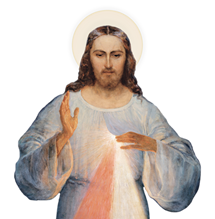


This year, 2020, marks the 85th anniversary of the Chaplet of Divine Mercy. To be precise, from Sept. 13-14, 1935, the words of the Chaplet were revealed to St. Maria Faustina Kowalska and recorded in her Diary (entries 745 and 746).
Why did our Lord give her this prayer? And what promises did He extend to those who pray it?
Father Seraphim Michalenko, MIC, who served as vice-postulator of the cause for the canonization of Sr. Faustina, has a surprising answer for you.
An unnamed place
In her Diary, 474, St. Faustina records seeing an angel sent to exact God’s wrath. She wrote:
When I saw this sign of divine wrath which was about to strike the earth, and in particular a certain place, which for good reasons I cannot name …
Why couldn’t St. Faustina use the name of the place? According to Fr. Seraphim Michalenko, MIC, “When she wrote her first notebook, which she later burned, she had been putting places and names in. When she had to rewrite it, her confessor and spiritual director Fr. Michael Sopocko told her to leave those names out.”
The Diary quotation continues:
I began to implore the Angel to hold off for a few moments, and the world would do penance. But my plea was a mere nothing in the face of the divine anger.
“Now,” says Fr. Seraphim, “people wonder what just stirred up this wrath of God. And we have to understand ‘wrath’ correctly, as His total opposition to evil of every kind.”
At this point, St. Faustina says, she felt in her soul the power of Jesus’ grace:
I found myself pleading with God for the world with words heard interiorly.
As I was praying in this manner, I saw the Angel’s helplessness: He could not carry out the just punishment which was rightly due for sins. Never before had I prayed with such inner power as I did then.
What was the punishment supposed to be for? Father Seraphim says that Divine Mercy evangelizers Joan and David Maroney (see sidebar) discovered that in the early 1930s, Warsaw was a center for abortions. “So, we believe it to be the reason there was supposed to be chastisement on the city.”
Father Seraphim has other support for this deduction.
“Saint Faustina writes in other places that she had experiences three times and she would get terrible pains within her. They were so severe that she lost consciousness at times,” he said.
Her doctors could not figure out what could be bothering her, and no medication eased her suffering (see Diary, 1276).
“The Lord then helped her to understand [the purpose of] her sufferings: to make reparation to the Heavenly Father for sins of abortion,” Fr. Seraphim said. “When Fr. Sopocko went through her Diary, he asked her the reason for the chastisement, and she said, ‘For the massacre of infants not yet born — the most grievous crime of all.’”
In subsequent revelations, the Lord made it clear that the Chaplet was not meant just for St. Faustina’s use, but for the whole world. The Diary records promises attached to its recitation, most notably for the dying:
At the hour of their death, I defend as My own glory every soul that will say this chaplet; or when others say it for a dying person, the pardon is the same.
When this chaplet is said by the bedside of a dying person, God’s anger is placated, unfathomable mercy envelops the soul. (811)
When they say this Chaplet in the presence of the dying, I will stand between My Father and the dying person, not as the just Judge but as the Merciful Savior. (1541)
For her part, St. Faustina continued to pray the Chaplet almost constantly, offering it especially for the dying.
The Power of the Chaplet
“I can share a funny story,” said Robert Stackpole, STD, director of the John Paul II Institute of Divine Mercy, an apostolate of the Marian Fathers. “In my first few years of work with the Marians back in 1997-2000, I started praying the Chaplet for people I knew who were seriously ill — and most of them died!
“My wife started calling me ‘the Grim Reaper of the Chaplet’ and pleaded with me never to say the Chaplet for her. But afterwards I reflected: ‘Was this a failure for the Chaplet? Or was this my own failure of faith as a prayer-intercessor?’
“No, I think our Lord just knew that He wanted several people to come home to Him, and He used me as the prayerful instrument to make it happen. I had asked Him sincerely in prayer to use me for the sake of His merciful love. I just never figured, to begin with at least, that is how He would do it!”
‘God’s presence right there’
Since 2001, Joan and Dave Maroney, the husband-and-wife team known as Mother of Mercy Messengers (MOMM), an apostolate of the Marian Fathers, have been traveling to give Divine Mercy presentations at parishes and schools.
Within the first couple years of their ministry, Dave noticed something about all the people who shared their Chaplet stories with them.
“I said, ‘I bet we’ve heard a thousand miraculous stories about the Chaplet and praying for those who are in their last moments. And everybody said their sister or their mother or whoever it was, was just put at ease, and they knew that God was with them. The Chaplet takes those moments that can oftentimes be filled with doubt, fear, and anxiety, and it puts God’s presence right there in their midst and takes away all their anxiety. They know that their loved one is being enfolded in the arms of Jesus at their passing from this life.”
Joan agrees. “It’s not only about their experience years ago when someone was dying. It’s that experience right there when they tell the story. We always will get chills, goosebumps. You can see the peace and the joy in their faces. And the confidence in their face that they truly did experience
something marvelous and godly. That’s what moves me.”
What surprises those who attend MOMM presentations?
Joan answers, “People tell us they’ve been involved with Divine Mercy for a gazillion years and never knew the connection to when St. Faustina received the Chaplet and how it withholds punishment for all our sins but in particular for the sin of abortion. It continues to be the greatest plague that the world is
facing right now. That’s a very important thing for people to know: the power of the Chaplet to fight against the most grievous sin of all.”
The Chaplet during a pandemic
Stirred by the Sept. 11 terrorist attacks, Marie Romagnano, a trauma and catastrophic injury nurse, founded what is now Healthcare Professionals for Divine Mercy, an apostolate of the Marian Fathers.
“Our entire ministry is centered around the Divine Mercy message and devotion and in particular the Divine Mercy Chaplet,” says Marie. “We can pray for the dying, whether we pray before we go to work, when we know that our patients are critically ill, or after. But it is a powerful, practical application. I think it’s especially important that people are very aware that when there is a disaster — like 9/11 — we actually could save souls by praying the Divine Mercy Chaplet.”
Marie says the Chaplet is a great encouragement to the nurses, the doctors, and all members of a healthcare team, especially now during the pandemic. “They see literally hundreds of people dying every month. If you have five to 10 people in one day die, that’s just a horrific distress.”
Marie continues, “I want to say to all those who have lost a loved one during these many tragedies that there’s no time limit with God. We can keep praying the Chaplet, and it’s a constant source of hope and consolation.”
These prayers are more urgently needed during the days of coronavirus. Marie explains, “Normally we would be calling the priest to administer the Sacraments. But, because of the pandemic, a priest or pastoral care worker is not allowed to go into the unit.
“If the healthcare professional is losing a patient — or many patients, like in the pandemic — at least they know that they’ve done all they can do physically for them and then again all they can do spiritually by praying the Chaplet.”
Promoting the Chaplet among the laity
Eucharistic Apostles of The Divine Mercy (EADM), also an apostolate of the Marian Fathers, was formed
to support spiritual formation for the laity and encourage works of mercy.
“Promoting the Chaplet — praying it especially for the sick and the dying and pro-life causes — has been a big part of our work,” says EADM founder Bryan Thatcher, MD. The apostolate has received a papal blessing for each of these ministries.
EADM follows in St. Faustina’s love for the dying. “We send the blessing out to churches and chapels that will pray for the sick and the dying. We have well over 1,000 churches and chapels all over, praying during Adoration.”
Praying for the sick and for pro-life causes ties in together, Dr. Thatcher says. “Being a physician, I think of all the dying patients I used to take care of. People dying in my arms sometimes.
“People say to me, ‘Our loved ones in nursing homes are at a very high risk, and their friends or family members cannot even enter the facilities to be at their bedside as they die. What can we do? It is heartbreaking that I cannot be with my loved one!’ I tell them to pray! Pray the Holy Rosary and the Chaplet, and realize that you are doing a powerful act of mercy. Find comfort that Jesus, Our Lady, and a host of angels will be there at the bedside of your loved one.”
— Terry Peloquin
