












A bombed-out vehicle on a street in Kharkiv, Ukraine.
By Chris Sparks
My daughter, tell the whole world about My inconceivable mercy (Diary of Saint Maria Faustina Kowalska, 699).
War in Ukraine.
Soaring inflation around the world, beyond the capacity of any one government to tame, and consequent famine.
The pestilence of COVID, and all the attendant maladies — mental health issues, missed medical care, and the consequences.
The 2020s have arrived with a bang. We seem to be going deeper into the darkness, year by year.
What do you do in the face of overwhelming evil and suffering? What do you do when the world’s seemingly gone mad?
What do you do when suffering and evil seem to have the upper hand, especially in the lives of friends or family, and you don’t have any earthly remedy?
Answers in the Word
The Book of Job tells us that there aren’t answers in written or spoken words, but rather in the Word, in God Himself appearing.
God curses the friends of Job, the suffering righteous man, even though these supposed friends had been attempting to excuse or defend the evils Job endured. After all, Job must have deserved them, right? God is just; God is all-knowing; and so Job must be guilty of something.
But Job was not guilty of anything. Job spoke rightly of God when he complained about his sufferings and the terrible evils that had befallen him — loss of family, of fortune, of home, of health.
Job’s friends, with all their words, are cursed by God at the end of the book (see Job 42:7-8). Job, on the other hand, is blessed. He was right—his sufferings were unmerited. He was a good man to whom bad things had happened.
And the only answer to that impossible contradiction was God, present, visible:
By hearsay I had heard of you,
but now my eye has seen you.
Therefore I disown what I have said,
and repent in dust and ashes (Job 42:5-6).
Here in the Old Testament is one of the great hints of the Gospel, of the impossible answer God would give to evil and suffering: the Word made flesh; the Incarnation of God the Son. God didn’t just send prophets to warn against coming suffering, to exhort us to do things to avoid it. God didn’t just send judges to condemn us for our sins and to apportion suffering.
No. God came Himself and endured the worst sort of suffering at the hands of evil, incompetence, malice, and ignorance. God’s answer to evil and suffering is Himself, dwelling among us.
Divine Mercy Incarnate
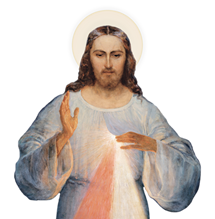
God’s answer to evil is Divine Mercy Incarnate.
"[T]he limit imposed upon evil, of which man is both perpetrator and victim, is ultimately the Divine Mercy" — St. John Paul II, Memory and Identity.
The limit imposed on evil is the limit on darkness set by the light that streams from the pierced side of Divine Mercy Incarnate, the light eternal, divine light, shining into time through the bleeding Sacred Heart. Victory over our enemies is promised us when we venerate that Divine Mercy Image (see Diary, 47, 48). Saint John Paul II, who outlasted the Nazis and the Soviet Communists to become one of the greatest popes and saints the Church has ever seen, knew the truth of God’s promises to us through St. Faustina. He placed Divine Mercy at the center of his pontificate, which then became a light to a world badly in need of it.
Saint Faustina, also, living in Poland between two world wars, knew that the answer to evil wasn’t more intelligent, more powerful, more skillful evil deployed in the name of some earthly good. No — the answer to evil and suffering comes from the One who took on Himself all sin, and so all death and all suffering. The answer to the darkness is Christ, the Light of the World.
Christendom has had a series of revolutions and in each one of them Christianity has died. Christianity has died many times and risen again; for it had a god who knew the way out of the grave — G.K. Chesterton.
Christ is the answer
The Son of God, the Son of St. Joseph the Worker, the Son of Mary — Jesus Christ is the answer to the problems of today as He has been the answer to the problems of every age, and as He will be the answer at the end of the world. Jesus Christ, and all those whom He loves, and all that He loves, if only we return that love — Jesus Christ and the whole Communion of Saints, which on some level extends beyond individual persons to the communion of sanctity, of holiness, of grace. There is a communion of consecrated creation, a communion of all things made new by the light from beyond time, by Jesus, which we get a glimpse of in the person of Our Lady, and in sacred places, in sacramentals and sacramentality, in shrines and tabernacles, in relics and the difference in the world made by the presence of a saint.
Put not your trust in princes, or in money, or in worldly wisdom. Put not your trust in violence, or political revolution, or force of arms to bring an ultimate resolution to evil. Put instead your trust in Jesus, the Divine Mercy. Put your trust in the One who greets you, not with worldly wealth or weapons, but with pierced hands and side, from whom light radiates, from whom life comes in this and in every age.
“Master, to whom shall we go? You have the words of eternal life” (Jn 6:68).
Jesus, I trust in You!
Pray for me, that I may practice what I preach. I’ll pray for you.
Chris Sparks serves as senior book editor for the Marian Fathers. He is the author of the Marian Press book How Can You Still Be Catholic? 50 Answers to a Good Question.
{shopmercy-ad}
