












By Chris Sparks
Be adored, O Most Holy Trinity, now and for all time. Be adored in all Your works and all Your creatures. May the greatness of Your mercy be admired and glorified, O God (Diary of Saint Maria Faustina Kowalska, 5).
The news has been unspeakable for so long, and never more so than in the wake of the recent mass shootings, whose numbers tragically seem to grow every day: first Buffalo, and just 10 days later, Uvalde. God only knows how many more will be added to their number by the time you’re reading this column (please God, none).
Further, the illegal, unjustified Russian invasion of Ukraine continues (but no longer tops the news headlines), constituting its own sort of mass shooting, undertaken by a man ranting angry nonsense about “deNazifying” Ukraine (and Poland, and God only knows how many more former Soviet nations).
The difference between the president of Russia and the mass shooters terrifying the USA these days is simply that one is the head of state of a country with a massive military, and the mass shooters have more limited access to methods of death and destruction.
We could do with some light in this darkness. And the exceptional month of June is upon us.
The Answer is a Mystery
The answer to the sins of the world is always right in front of our eyes: the Savior of the World, and His Mystical Body, the Church. The answer to the mystery of evil and suffering is the even greater mystery of the Trinity, of God almighty, a mystery into which we are invited through the Sacraments (especially Baptism, Confirmation, and the Eucharist), and through the Incarnation of Christ.
On one occasion I was reflecting on the Holy Trinity, on the essence of God. I absolutely wanted to know and fathom who God is. ... In an instant my spirit was caught up into what seemed to be the next world. I saw an inaccessible light, and in this light what appeared like three sources of light which I could not understand. And out of that light came words in the form of lightning which encircled heaven and earth. Not understanding anything, I was very sad. Suddenly, from this sea of inaccessible light came our dearly beloved Savior, unutterably beautiful with His shining Wounds. And from this light came a voice which said, Who God is in His Essence, no one will fathom, neither the mind of Angels nor of man. Jesus said to me, Get to know God by contemplating His attributes. A moment later, He traced the sign of the cross with His hand and vanished (Diary, 30).
Thank God for light in the darkness, for the gift of Himself, His life and His love. As we see in the Book of Job, the only answer to the senseless evil, suffering, and tragedy we face in the world all too often is to come face-to-face with God.
June Feasts
The feasts coming up in June center on the greatest Light of all, on God who is Love, on the Spirit of Love, Truth, Life. We’re heading into a month of exceptional Sundays, a run of extraordinary devotions and feasts.
- June 3 and 4 are First Friday and First Saturday, respectively, devotions that promise peace in our world — if we are faithful.
- June 5 will be Pentecost Sunday, commemorating the descent of the Holy Spirit on the Apostles gathered in the Upper Room.
- June 12 is Trinity Sunday.
- June 19 is Corpus Christi, the day the Church dedicates to celebrating the Most Holy Body and Blood of Christ.
- June 24 is the Solemnity of the Sacred Heart, and June 25 is the Feast of the Immaculate Heart of the Blessed Virgin Mary — the Two Hearts whose alliance, according to the promises made to St. Margaret Mary Alacoque (1647-1690) and the visionaries at Fatima, seems to be the great gifts of grace and devotion from Heaven in answer to the darkness and evils of the present age.
Thank God.
the light shines in the darkness,
and the darkness has not overcome it (Jn 1:5).
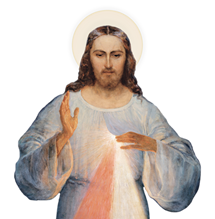
We see Jesus Christ, the face of the Father’s mercy and the Light of the World, in a special way in the Eucharist, in the Divine Mercy Image, and every time we look at another human being, for we are all made in the image and likeness of God. From that glimpse of the face of God in our neighbor, we are summoned to pursue justice and mercy in this world, flowing out of our love of God.
If anyone says, “I love God,” but hates his brother, he is a liar; for whoever does not love a brother whom he has seen cannot love God whom he has not seen (1 Jn 4:20).
Our agenda as Catholics
In the face of the evils stalking our world today, what does love of God and neighbor demand? Our bishops lead us in an annual Fortnight for Freedom starting June 21, a special time to pray and study the Church’s social teaching and serve the cause of human rights, especially religious liberty. What is our agenda as practicing Catholics?
First, of course, is living our faith. You can’t give what you haven’t got; you can’t be salt and light in the world if you’ve lost your savor, or if your light has gone out. Receive the Sacraments frequently; have a regular habit of prayer; do spiritual reading, especially of the Bible; and practice one or more of the works of mercy on a regular basis.
Secondly, listen to Christ and His Church. We’ve been in this struggle with the culture of death for some time. The successors to St. Peter have laid out their agenda: the New Evangelization, forming the Culture of Life, leading to a Civilization of Love. We must pursue both personal holiness (see Catechism, 2013) and social justice (see Catechism, 1928-1929), as the Church has long commanded. We can learn more about what all that entails by studying the Catechism, the social encyclicals of the Holy Fathers (summarized in the Compendium of Catholic Social Teaching), and the teaching of the US bishops applying Church teaching to our nation’s needs (summarized in our series available here).
Papal wisdom
Now I know it can seem like a lot to wade through. Permit me to close with some magisterial documents laying out some of the crucial issues, the unavoidable issues of our time.
First, St. John Paul II, writing in Evangelium Vitae (The Gospel of Life), explains the urgency of the Church’s proclamation of the Gospel of Life and targets the greatest evils our world confronts. Note — the list does not fit neatly along American party lines:
Every individual, precisely by reason of the mystery of the Word of God who was made flesh (cf. Jn 1:14), is entrusted to the maternal care of the Church. Therefore every threat to human dignity and life must necessarily be felt in the Church's very heart; it cannot but affect her at the core of her faith in the Redemptive Incarnation of the Son of God, and engage her in her mission of proclaiming the Gospel of life in all the world and to every creature (cf. Mk 16:15).
Today this proclamation is especially pressing because of the extraordinary increase and gravity of threats to the life of individuals and peoples, especially where life is weak and defenceless. In addition to the ancient scourges of poverty, hunger, endemic diseases, violence and war, new threats are emerging on an alarmingly vast scale.
The Second Vatican Council, in a passage which retains all its relevance today, forcefully condemned a number of crimes and attacks against human life. Thirty years later, taking up the words of the Council and with the same forcefulness I repeat that condemnation in the name of the whole Church, certain that I am interpreting the genuine sentiment of every upright conscience:
"Whatever is opposed to life itself, such as any type of murder, genocide, abortion, euthanasia, or wilful self-destruction, whatever violates the integrity of the human person, such as mutilation, torments inflicted on body or mind, attempts to coerce the will itself; whatever insults human dignity, such as subhuman living conditions, arbitrary imprisonment, deportation, slavery, prostitution, the selling of women and children; as well as disgraceful working conditions, where people are treated as mere instruments of gain rather than as free and responsible persons; all these things and others like them are infamies indeed. They poison human society, and they do more harm to those who practise them than to those who suffer from the injury. Moreover, they are a supreme dishonour to the Creator".
And secondly, in 2002, then-Cardinal Ratzinger released an official doctrinal note on Catholics and politics, in which he laid out what you might call a set of non-negotiable issues for Catholics in public life (para. 4). I highly encourage you to take the whole document to prayer. Fair warning: Once again, it doesn’t fit neatly into American political categories.
Rededicate ourselves
As we mourn recent tragedies and celebrate the great feasts of God in June, let us rededicate ourselves to loving and serving Christ and His Church. Let us worship our God who is Merciful Love, who is Three and One, who is with us in the Eucharist, in our neighbor, in the Scriptures, and in our hearts. Let us abide in faith, hope, and love, practicing prudence, justice, temperance, and fortitude, even as we accompany and serve our neighbors who are suffering such tremendous evils.
Pray for me, that I may practice what I preach. I’ll pray for you.
Chris Sparks serves as senior book editor for the Marian Fathers. He is the author of the Marian Press book How Can You Still Be Catholic? 50 Answers to a Good Question.
Photo by Julien DI MAJO on Unsplash
{shopmercy-ad}
