














By Chris Sparks
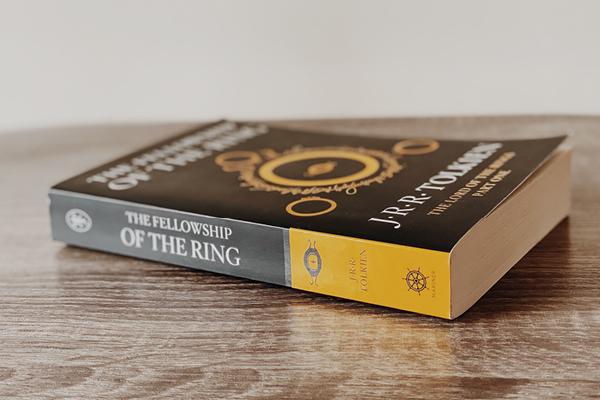
J.R.R. Tolkien’s master work, The Lord of the Rings, is back in the news, with the premiere of a blockbuster prequel series on Amazon Prime, "The Rings of Power." Tolkien fans like myself are intrigued and excited (and, at times, I admit, mildly obsessed).
But I acknowledge that many of you may wonder: why all the fuss? What’s it all about?
I first encountered Lord of the Rings on my grandmother’s bookshelves, when I was still in elementary school. I knew they were considered some of the great works of fantasy; I also knew, looking them over, that they were very big and had very small font. So it took me a while to really get into them. Eventually, I had fallen in love with the books, with Tolkien’s writing, with the whole world of Middle Earth. Over time, I read the books straight through.
They are some of the great, foundational works of fantasy, and will be forever. You can see their influence in tabletop games, novels, video games, movies — anything that owes a debt to the fantasy genre owes something to Tolkien. I love the novels because I love fantasy … and yet there’s more. They transcend simple fantasy storytelling. Why?
Haunted by the Holy Spirit
Simply put, the books are Catholic. The whole series is haunted by the Holy Spirit, saturated by Tolkien’s Catholicism and the history of the Church.
It’s a funny thing to talk about, because on the one hand, Tolkien was very careful to avoid explicit religion — churches, a hierarchy, etc. On the other hand — as Tolkien himself explained, “The Lord of the Rings is of course a fundamentally religious and Catholic work; unconsciously so at first, but consciously in the revision. That is why I have not put in, or have cut out practically all references to anything like ‘religion,’ to cults or practices, in the imaginary world. For the religious element is absorbed into the story and symbolism.”
The whole of Lord of the Rings is a Catholic Pilgrim’s Progress, a 20th century Divine Comedy, a great meditation on the spiritual life, on the spiritual combat, on the pilgrimage that is living on earth while hoping for Heaven. That’s why so many Catholics love it so much. We recognize our own lives, our own faith, our own worldview in it, for all that it is a fantasy. Written during World War II, it’s also one of the greatest diagnoses of the errors of Russia spoken of by Our Lady at Fatima that I’ve ever seen.
The One Ring
The perennial temptation throughout Lord of the Rings is to seize the One Ring, the Master Ring created by the Dark Lord Sauron to allow him to control all of Middle Earth, and use that One Ring to defeat Sauron. In other words, the peoples of Middle Earth again and again confront the temptation to use evil means to defeat evil.
But, as Tolkien makes plain throughout the story, the ends do not justify the means. The Church has always forbidden doing evil in order to obtain good (see Rom 3:8; see also Catechism, 1755, 1759, 1761). If we become evil in order to defeat evil, we have lost, not won. Some victories are not worth winning; some prices are too high to pay. The true remedy for evil, as St. John Paul II and St. Faustina have taught us so powerfully, is Divine Mercy.
Appreciation of beauty
Tolkien depicts goodness throughout Lord of the Rings as few other authors have ever been capable of showing it. The reasons may lie in the source of his appreciation of beauty: the Blessed Mother, she who was both most beautiful and most holy. In a letter to Fr. Robert Murray, SJ, Tolkien wrote, “I think I know exactly what you mean by the order of Grace; and of course by your references to Our Lady, upon which all my own small perception of beauty both in majesty and simplicity is founded.”
And Tolkien had a tremendous love of the Eucharist. He said:
Out of the darkness of my life, so much frustrated, I put before you the one great thing to love on earth: the Blessed Sacrament. . . . There you will find romance, glory, honour, fidelity, and the true way of all your loves on earth, and more than that: Death.
By the divine paradox, that which ends life, and demands the surrender of all, and yet by the taste—or foretaste—of which alone can what you seek in your earthly relationships (love, faithfulness, joy) be maintained, or take on that complexion of reality, of eternal endurance, which every man’s heart desires.
The only cure for sagging or fainting faith is Communion. Though always itself, perfect and complete and inviolate, the Blessed Sacrament does not operate completely and once for all in any of us. Like the act of Faith it must be continuous and grow by exercise.
Frequency is of the highest effect.
Seven times a week is more nourishing than seven times at intervals. Also I can recommend this as an exercise (alas! only too easy to find opportunity for): make your Communion in circumstances that affront your taste. Choose a snuffling or gabbling priest or a proud and vulgar friar; and a church full of the usual bourgeois crowd, ill-behaved children—from those who yell to those products of Catholic schools who the moment the tabernacle is opened sit back and yawn—open-necked and dirty youths, women in trousers and often with hair both unkempt and uncovered. Go to Communion with them (and pray for them).
It will be just the same (or better than that) as a mass said beautifully by a visibly holy man, and shared by a few devout and decorous people.
It could not be worse than the mess of the feeding of the Five Thousand—after which our Lord propounded the feeding that was to come.
All that is present in Lord of the Rings, baked in, you might say. Just as the individual ingredients in a well-mixed loaf of bread can’t be distinguished anymore one from another, so too is Tolkien’s Catholicism thoroughly incorporated into his work without necessarily being obvious, without being blatant. And yet the final product is unimaginable without Catholicism, without the saints and angels, the Eucharist and Our Lady, the whole moral order and underlying goodness of the cosmos that is all part of the Catholic faith.
Grace and faith
There are different ways of communicating grace and faith. Sometimes, the Sacraments; sometimes, a fairy tale; sometimes, the Scriptures; sometimes, a work of mercy. Tolkien’s done it through novels about as well as it’s ever been done, and more. He created a deathless epic, one of the greatest novels ever written. His faith informed his writing without dominating it. He truly did the work of writing well and storytelling well in the genre he was writing, and didn’t sacrifice the quality of his story on the altar of preaching to his audience.
Rather, his faith spoke through his life and work; he lived the faith. Word and work must go together, for words alone quickly lose all power or credibility, and works alone require some explanation.
When any work is animated by the Holy Spirit, it gains the power to change the world. The Lord of the Rings has done just that. As Amazon Prime releases its new “Rings of Power” series, Tolkien’s enduring ability to inspire, to transmit a light from beyond the stars through story, will hopefully be demonstrated once again.
I’ll be watching. And I might just crack open The Lord of the Rings again — and recommend that you do so, too.
Chris Sparks is the author of the Marian Press book How Can You Still Be Catholic? 50 Answers to a Good Question.
Photo by Madalyn Cox on Unsplash
{shopmercy-ad}
