














Brothers and sisters, do not be afraid to welcome Christ and accept his power. Help the Pope and all those who wish to serve Christ and with Christ's power to serve the human person and the whole of mankind. Do not be afraid. Open wide the doors for Christ. To his saving power open the boundaries of States, economic and political systems, the vast fields of culture, civilization and development. Do not be afraid. Christ knows “what is in man.” He alone knows it
— St. John Paul II, homily, inaugural Mass of his pontificate, Oct. 22, 1978.
By Chris Sparks
I’ve just spent a year writing reflections on 365 Scripture passages that either tell us to not be afraid or reflect the spirituality that allows us to be not afraid.
In that time, a few things have become abundantly clear to me. Among them: For some reason, our forefathers in the faith perceived that fear is inextricably bound together with recognizing something or someone as divine. When you fear a creature, somehow, there’s a loss of faith in God; when you fear God, on the other hand, you are wise. You see clearly.
So Scripture tells us, “Be not afraid.”
Living without fear … in this world?
It’s counterintuitive and seems incredibly dodgy. After all, so many things and so much of life is acutely dangerous. We live in an age of extraordinary technological power. Russia or the United States could render much of the world uninhabited and uninhabitable with our nuclear arsenals. The dangers of the industries that we take for granted are demonstrated in tragedies like the train derailment in East Palestine, Ohio. And of course, there are the perennial dangers we’ve always faced in this world — nature red in tooth and claw.
And yet the whole of Scripture can be read as one, long ringing summons to move by faith beyond fear. Or rather, to have right and proper fear, the only fear that Scripture presents as just: fear of the Lord, which is the beginning of wisdom.
Fear of the Lord
When we first meet God, encountering an intelligent power at the back of all things, a certain fear is the right and proper response. Further, that fear of the Lord reduces all other fear to irrelevance by comparison. Fear of the Lord is the beginning of wisdom, recommended by Scripture, because it’s the antidote to idolatry. Yes, there are dangers in this world. There are natural forces. Our ancestors tended to worship these as gods, trying to propitiate them, to make the world a little easier by honoring what they feared.
And yet there is only one true God.
There is only one being worthy of worship — the Creator, not the creatures. When we internalize that truth, it changes everything. God is God, and we are not. God is greater than the world, the flesh, and the devil, which means that evil will never get the upper hand or the last word. Suddenly, we need not be afraid.
Reacting to evil
Now, does this mean we’re supposed to feel nothing about suffering, death, sickness, or the evils of the world? If we aren’t to fear them, can we feel anything negative about them?
Jesus gives us the answer in the Beatitudes and in His own life.
Blessed are they who mourn,
for they will be comforted. …
Blessed are they who hunger and thirst for righteousness,
for they will be satisfied (Mt 5:4, 6).
Jesus doesn’t say, “Blessed are the rich, the comfortable in this world.” He blesses those who weep. Blessed are those who know something is wrong and feel some way about it.
Mourn the ways of the world, yes, and the sufferings people face. Mourn over injustice; do not become comfortable with the brokenness of the world, with the many ways so many people are hurt. Mourn, and be angry at evil deeds, though remain loving of evil people, for no one alive is beyond redemption, if they’ll repent.
But don’t be afraid.
Jesus shows what this looks like when He weeps over Jerusalem (see Lk 19:41-44), and over the death of Lazarus and the sorrow of Martha and Mary (see Jn 11:35). Jesus cries out to God the Father in the Garden of Gethsemane before He endures His Passion, begging for the cup to pass from His lips. What was about to happen was awful, even as it would save the world. It was only natural, only right, for He who is Goodness Itself to cry out against the evil that was to be done to Him, even as He accepted it for the sake of love.
Rebel, not fear
So we’re supposed to rebel against the evils of the world, but we’re not supposed to fear them.
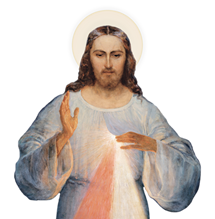
Jesus said, Yes, I will be with you always, if you always remain a little child and fear nothing. As I was your beginning here, so I will also be your end (Diary of Saint Maria Faustina Kowalska, 295).
To reach the place beyond fear, we must love God and neighbor. We must open ourselves up to the divine life and love through the Sacraments, prayer, and reading Scripture. We must make a habit of the works of mercy, and of virtue.
In short, practice your faith, and eventually, Christian courage will be yours.
Chris Sparks is the author of the Marian Press book How Can You Still Be Catholic? 50 Answers to a Good Question.
Image: Adobe Stock.
{shopmercy-ad}
