











 Register NOW for in-person and remote attendance (via livestream).
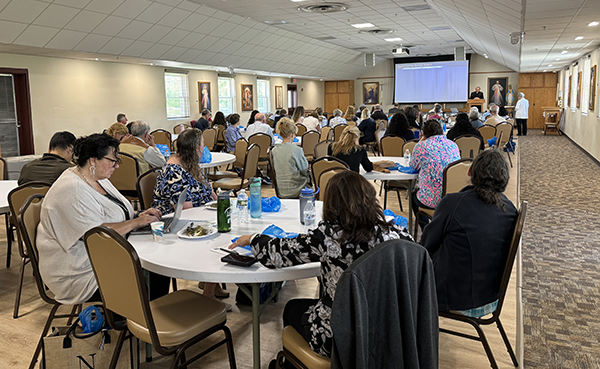
The 19th annual Divine Mercy Medicine, Bioethics, and Spirituality Conference is happening now on the grounds of the National Shrine of The Divine Mercy in Stockbridge, Massachusetts. Organized by the Marian Fathers’ apostolate Healthcare Professionals for Divine Mercy, the conference is a place where faith and reason meet and mutually enrich each other.
Noted healthcare professionals, clergy, consecrated religious, and academics will be addressing the topic “Exploring Compassion and Mercy in Healthcare.”
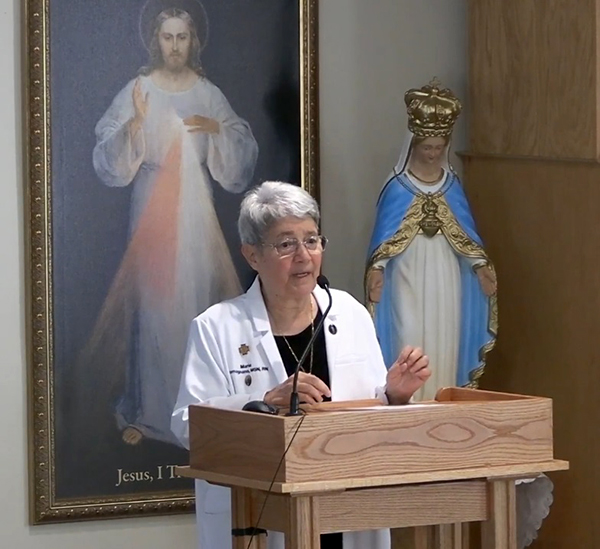
“I would welcome everyone to our 19th year of the annual Medicine, Bioethics, and Spirituality conference, which to my knowledge is the longest running bioethics conference in the United States,” says organizer Marie Romagnano, MSN, RN, CCM-R, founder of Healthcare Professionals for Divine Mercy. “We are especially excited because this is our second year at the National Shrine of The Divine Mercy.
“Many of our participants have told us over the years that this is an academic program, yet it’s a retreat. We’ve combined two days of academic study with daily Mass, Confession, and a half day retreat on day three, so this is such a comprehensive program."
Continuing Education Credits are available to conference participants.
Day 1: June 5, 2024
The conference opened with Holy Mass at the National Shrine of The Divine Mercy, celebrated by Fr. Kazimierz Chwalek, MIC.

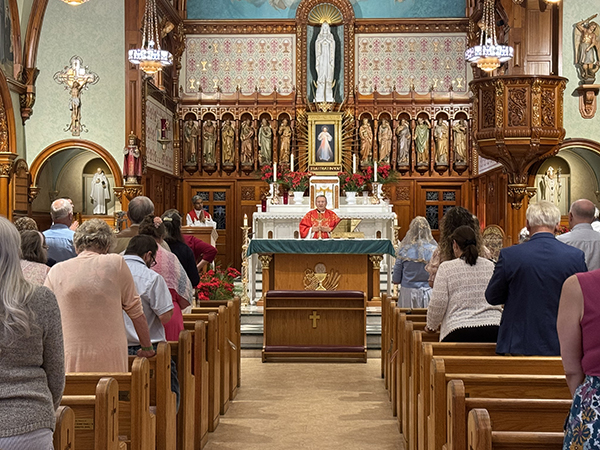
“Jesus, meek and humble of heart. Make our hearts like unto thine,” Fr. Kaz prayed during his homily on today's feast of St. Boniface, apostle to the Germans and martyr. June is the month dedicated to honoring the Sacred Heart of Jesus, and living the vocation of a healthcare professional as sons and daughters of God means, he stressed, that we need to have hearts as merciful, as compassionate, as the Sacred Heart of Jesus. But that mercy, that compassion, needs to operate in accordance with biomedical ethics, Fr. Kaz concluded.
The Mass concluded with the novenas to the Two Hearts, Sacred and Immaculate, as well as to the Marian Martyrs of Rosica, who died alongside their parishioners during World War II.
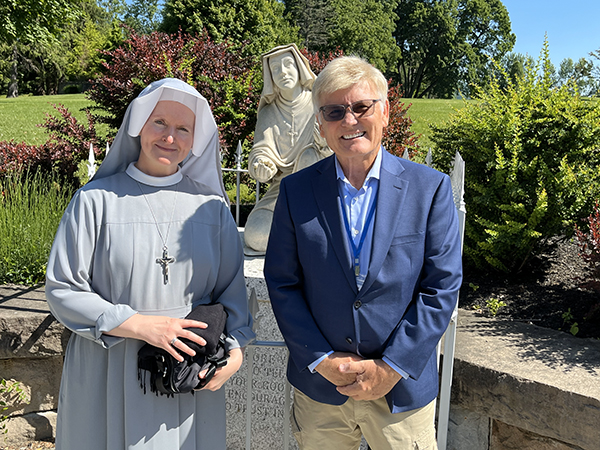
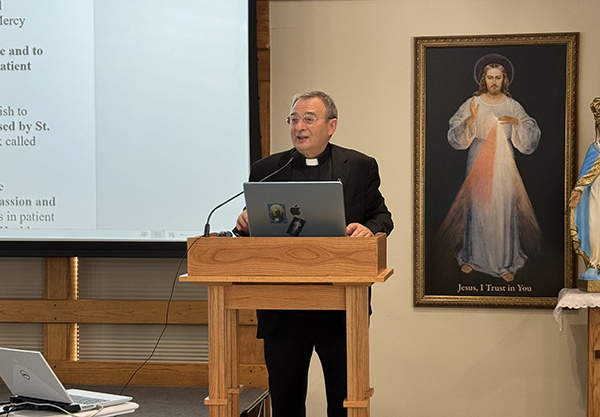
Fr. Kaz, director of the John Paul II Institute of Divine Mercy and Religious Director of Healthcare Professionals for Divine Mercy, gave the first talk of the day, on "Understanding Compassion and Mercy in Healthcare: Benefits to Patient Care."
Father Kaz laid out the crucial insight that a hospital or professional healthcare facility could have all the most highly trained staff, the very best equipment, and every resource needed to offer the very highest standard of patient care. But if the facility does not have staff motivated by the zeal that is fueled by compassion and mercy, all those resources may well be useless. Patients and families will suffer in the context of merciless healthcare.
“Mercy and compassion is extremely important because it could be life or death,” Fr. Kaz noted.
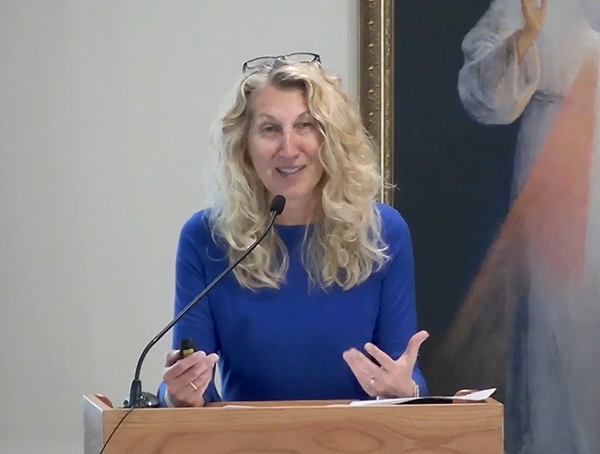
Our next speaker is Robin Goldsmith, MD, president and Chief Medical Officer of the St. Gianna Clinic in De Pere, Wisconsin, on "The Need for Courage and Compassion in Catholic Primary Care." Dr. Goldsmith co-founded the St. Gianna Clinic in 2014.
She spoke of the challenges, threats, blessings, and possibilities that face primary care in this country, proposing “an entirely new healthcare system where Catholic healthcare serves as an agent of change.”
“This talk could just as easily have been titled, ‘Jesus, I trust in You,’” she noted wryly, explaining that she’d first been asked to give this talk on the eve of St. Faustina’s feast day. “There’s no greater time than now to rejuvenate and return medicine to its roots to the vocation it once was, where God is recognized as the Divine Healer and each person is viewed as a gift from God, deserving dignity and respect."
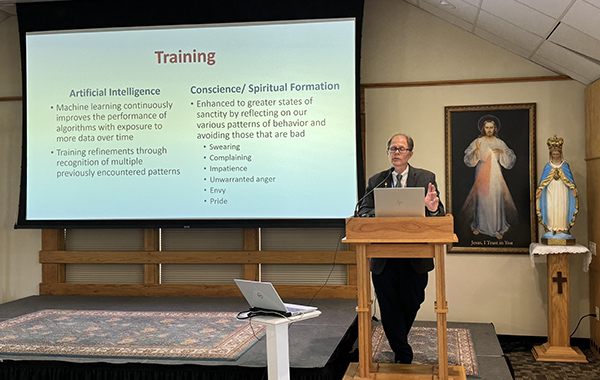
Our next speaker is Ronald Sobecks, MD, professor in the Department of Hematology and Medical Oncology at Taussig Cancer Institute of the Cleveland Clinic. The title of his talk is, "Approaches to Merciful Healthcare: Enhancing the Patient Experience."
Illustrating his talk with lively PowerPoint slides, Dr. Sobecks mentioned the growth of AI (Artificial Intelligence) applications in healthcare, urging caution and a healthy skepticism. A computer cannot show and express mercy. But he did allow that technological advances can enhance workflow, giving more time to be with patients and show mercy.
He also stressed the importance of listening. "We need to be assertive with patients, to speak clearly and directly," he said. "But active listening is very important. Don't interrupt when the patient is speaking. Restate their message, making sure they feel heard and understood. This will increase rapport and foster relationships."
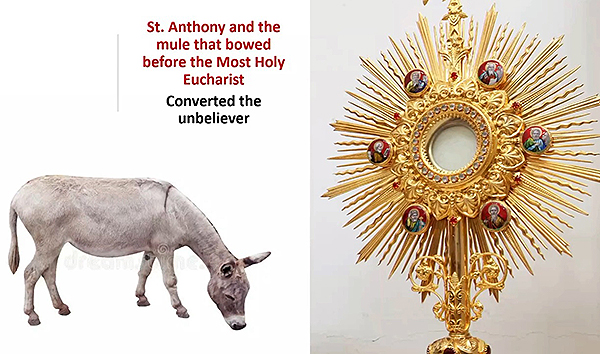
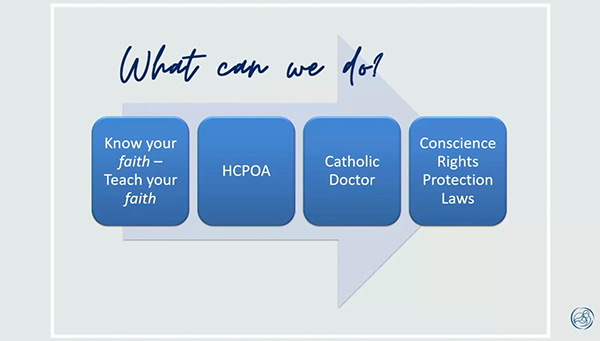
Dr. Robin Goldsmith delivered her second talk of the conference, entitled "Life at the End of Life." She presented four points of action (above), with HCPOA standing for "Healthcare Power of Attorney."
"Life is sacred and precious and a gift from God," she said. "We must remind others of that." The words of St. Padre Pio sustain her: "Pray, hope, and don't worry."
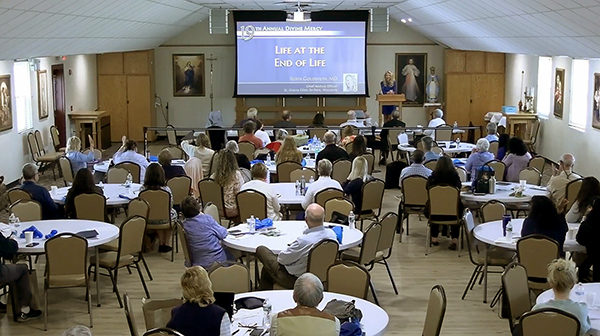
"We must fight the rising trend that the 'compassionate' thing to do is to end a patient's life. That is not 'compassionate care.'" Instead, we will always walk with them until the natural end and witness the power of redemptive suffering.
A great resource when struggling to know the ethical thing to do is the National Catholic Bioethics Center.
"Our Founding Fathers thought the most important right was the right of conscience," Dr. Goldsmith concluded. "If a physician's and the patient's conscience rights are not protected, then no one's conscience rights are protected, and our society is ultimately doomed to failure." Be vigilant, she said, and support laws that uphold conscience rights and religious freedom. "It is so important that we, inside and outside of medicine, fight for these laws. We need to let people know why it is so important to live according to our conscience."
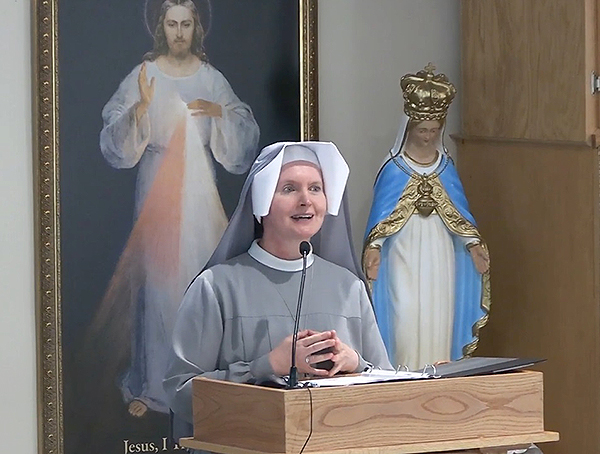
Our next speaker is Sister M. Salvatrice Musial, OLM, of the Sisters of Our Lady of Mercy, St. Faustina's order. She holds an MA from the Pontifical Academy of Theology and has studied at the School of Religious Formators. Her talk is on the "Spirituality of Mercy: Transforming painful experiences into a gift to heal others."
"I am convinced that you are chosen by God in a very unique way to carry His love and mercy to others," she said. "It is a gift. We have someone who is in need, and someone who can help. Two people that meet together. In God's eyes, they are a gift to each other. I call it a merciful interchange."
"It's not only that we encounter God in serving the patient," she continued. "It is much deeper. Everyone who takes care of someone in need of mercy, Jesus makes Himself present in them. He is blessing the person you are helping, and He is also blessing you. The Merciful God has chosen to be with you, due to the charism of your mission. Not every profession can claim that. And you have God's special promise that He will always be with you. You always have hope, no matter how challenging the circumstances. This helps us to be stronger, to understand."
Saint Faustina calls Jesus the "best physician" in the Diary, Sister reminded the gathering. At the end of a long day of healing the sick, what did Jesus do? "He went to rest and pray," she said.
"We are broken and fragile, without exception," Sister concluded. "But we can be strong in the Lord. Suffering can be a great teacher." Look to St. Faustina, she said. "Saint Faustina united her suffering to Jesus' suffering and learned from Him how to offer her suffering for the benefit of others."
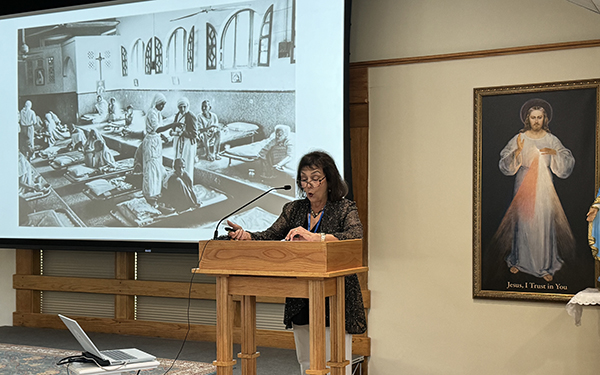
After a period of prayer and the Divine Mercy Chaplet, the conference resumes with a talk by Kathleen Brooks Scoble, EdD, MEd, MA, RN, dean emeritus, College of Our Lady of the Elms School of Nursing, and professor of nursing. She addressed the topic “Life of Compassion and Mercy: Rendering Medical Care to the ‘Poorest of the Poor’ Found on the Streets of Calcutta.”
Professor Scoble discussed the life and ministry of the great Saint of Calcutta, Mother Teresa. She surveyed Mother Teresa’s life and work, examining the works of the Missionaries of Charity, its growth across the world, and the incredible witness borne by Mother Teresa and her collaborators to the dignity of every human being. The Missionaries of Charity are in countries of very different levels of development, including the United States, first in the south Bronx and rural Kentucky.
Examining her life and work both as a Catholic woman religious and a trained nurse, Scoble explored how Mother Teresa exemplified the compassion and mercy that’s the theme of the conference.
"My presentation is a mere glimpse into her astounding life,” said Professor Scoble.
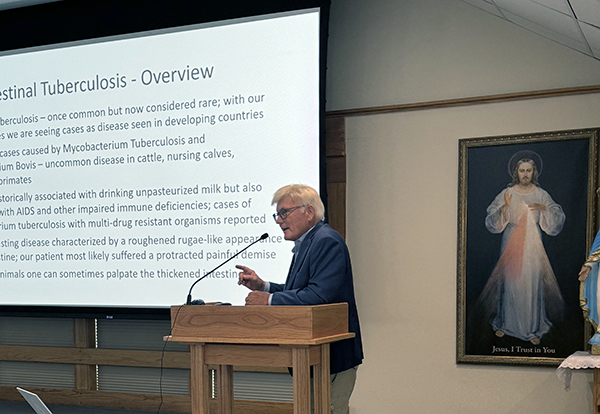
The penultimate speaker today is Bryan Thatcher, MD, the international director of Doctors for Divine Mercy and founder of the Eucharistic Apostles of The Divine Mercy (EADM), an apostolate of the Marian Fathers. He spoke on "Reflections on Mercy and Compassion – A Case Study of a Patient with Terminal Tuberculosis."
Dr. Thatcher treated as a medical case study the disease that took the life of the great Secretary and Apostle of the Divine Mercy, St. Maria Faustina of the Most Blessed Sacrament (1905-1938).
Going through her symptoms and the suffering she must have experienced as a result of her fatal disease, Dr. Thatcher put the illness in the context of the medical equipment, treatments, and diagnostic methods available while St. Faustina was alive. He delved into passages in her Diary where she shared some of the symptoms of her illness, and put on the screen photos of similarly diseased organs to give his listeners a realistic sense of her experiences.
Dr. Thatcher noted that her fellow religious thought “she was a hysteric and a fake, so that was another form of suffering. She used her suffering for spiritual advancement."
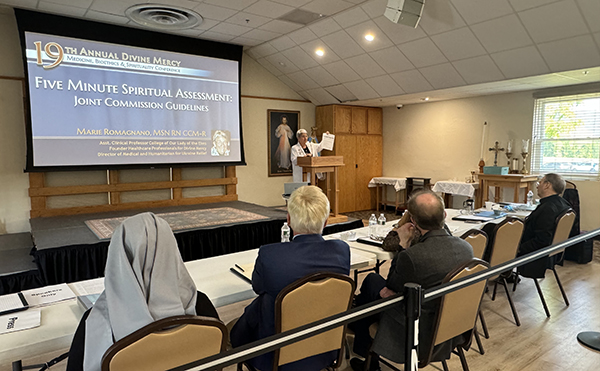
Our final speaker today is Nurse Marie Romagnano, founder of the Healthcare Professionals for Divine Mercy; assistant clinical professor at the College of Our Lady of the Elms, School of Nursing; and director, Medical and Humanitarian Case Management Operations for Ukraine Relief. She offered "The Five-Minute Spiritual Assessment for Any Healthcare Professional and Joint Commission Guidelines."
"The Joint Commission requires that a spiritual assessment be made of every patient," Nurse Marie said. "Physical illness provokes spiritual questions like, 'What will happen to my family if I die?' If a nurse or doctor is properly trained on how to perform a spiritual assessment, it will be more effective and widespread. If a patient's spiritual needs are not met, the physical healing will be prolonged."
Nurse Marie reminded the gathering to always call the Catholic priest to administer the Sacraments. "The ray of hope is sticking to your faith. If a priest is not available, pray with the patient. Talk to them about the mercy of God. If there's no crucifix in the room, draw a cross on a piece of paper."
The Conference resumes tomorrow, Thursday, June 6 at 9 a.m.
Register NOW for in-person and remote attendance (via livestream).
{shopmercy-ad}
