











Highlights from Day 1: June 5, 2024
The 19th annual Divine Mercy Medicine, Bioethics, and Spirituality Conference is happening now on the grounds of the National Shrine of The Divine Mercy in Stockbridge, Massachusetts. Organized by the Marian Fathers’ apostolate Healthcare Professionals for Divine Mercy, the conference is a place where faith and reason meet and mutually enrich each other.
Noted healthcare professionals, clergy, consecrated religious, and academics will be addressing the topic “Exploring Compassion and Mercy in Healthcare.”
“I would welcome everyone to our 19th year of the annual Medicine, Bioethics, and Spirituality conference, which to my knowledge is the longest running bioethics conference in the United States,” says organizer Marie Romagnano, MSN, RN, CCM-R, founder of Healthcare Professionals for Divine Mercy. “We are especially excited because this is our second year at the National Shrine of The Divine Mercy.
“Many of our participants have told us over the years that this is an academic program, yet it’s a retreat. We’ve combined two days of academic study with daily Mass, Confession, and a half day retreat on day three, so this is such a comprehensive program."
Continuing Education Credits are available to conference participants.
Day 2: June 6, 2024
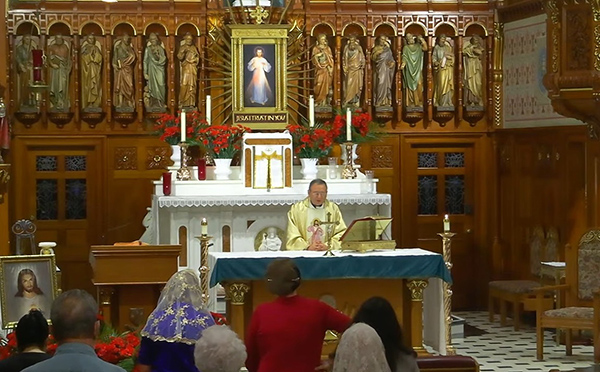
The second day of the conference begins with the celebration of Holy Mass at the National Shrine of The Divine Mercy, celebrated by Fr. Kazimierz Chwalek, MIC. It is a votive Mass of the Divine Mercy.
Father Kaz noted how appropriate today's Gospel reading (Mk 12:28-34) is:
One of the scribes came to Jesus and asked him,
"Which is the first of all the commandments?"
Jesus replied, "The first is this:
Hear, O Israel!
The Lord our God is Lord alone!
You shall love the Lord your God with all your heart,
with all your soul, with all your mind,
and with all your strength.
The second is this:
You shall love your neighbor as yourself.
There is no other commandment greater than these."
"All people have to fulfill this Great Commandment: love the Lord and love your neighbor," Fr. Kaz said. "But healthcare professionals are a special type of people. You encounter people who are worried and fearful and not always conducive to love. But this is the commandment that we receive today. This is an invitation is to take a closer look at our heart and ask how we are fulfiling this Great Commandment."
Look to Divine Mercy for strength in difficult circumstances, Fr. Kaz added. "When we welcome Jesus into our hearts, we can do extraordinary things. To believe in Him, to trust in Him, is to welcome something so extraordinary we cannot even understand. He has chosen us, and He will fill us with His Presence until the day He calls us home to share in His glory."
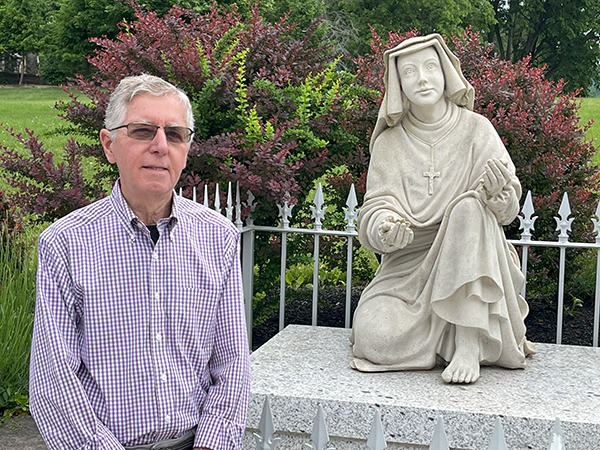
Here for the conference is Paul Budzik, RN of Epping, New Hampshire. He’s been attending the conference for the past seven years. "It’s definitely worth the trip," he says. "The conference material that’s presented is very faithful. It’s just a very humbling experience.:
Paul's work centers on the homeless. “We have a primary care practice where we take care of all the homeless populations in the city,” he said. “Compassion and mercy are just so valuable to our work. You can’t do anything with a person who’s distraught until you have a relationship with them, and that comes with caring and compassion and mercy."
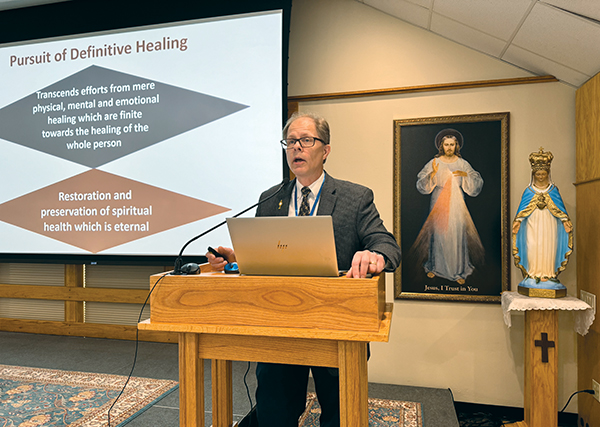
The first speaker of the day was Ronald Sobecks, MD. He’s a professor in the Department of Hematology and Medical Oncology at Taussig Cancer Institute of the Cleveland Clinic. Dr. Sobecks addressed the topic “Conforming to the Divine Will in Healthcare: Benefits to Patient Care.”
He talked about how some form of healing has been part of human society from the beginning, essentially defined as alleviating suffering, either physical, mental, or spiritual.
“Most people’s goal is to be cured of the disease,” he acknowledged, but much of medical care is palliative care — treating and alleviating an illness, rather than offering a cure.
Dr. Sobecks put the profession in the context of the whole of human history, looking back to the Fall of humanity as the source of modern suffering. He recommended to his listeners St. John Paul II’s Apostolic Letter Salvifici Doloris, calling it "a masterpiece."
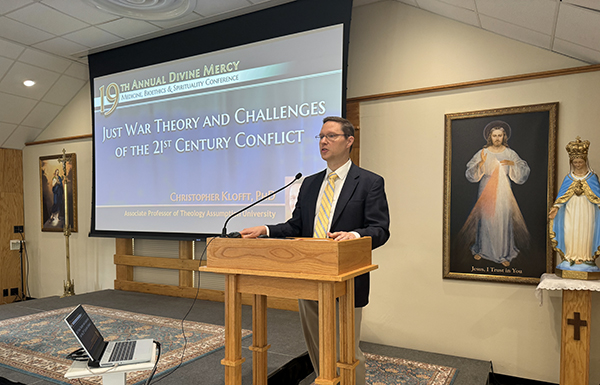
Next was Christopher Klofft, PhD, an associate professor of theology at Assumption University. Dr. Klofft addressed the topic, “Just War Theory and the Challenges of 21st Century Conflict.”
He acknowledged that the topic seemed like an odd one for a medical ethics conference (and on the 80th anniversary of D-Day), but he explained that current realities around the world make it urgent for healthcare professionals to familiarize themselves with the issues and the Catholic moral framework. After all, healthcare professionals are called upon to heal in the wake of war.
He surveyed the history of war in salvation history, examining Scripture first, then turning to how the Church has traditionally understood our obligations when it comes to war.
“Moral theology involves humans in a way systematic theology does not,” Dr. Klofft said. “In moral theology, we start down here, in the mud; the mud from which we came, no less, but the mud that is now infected with our sinfulness. The moral theologian has to deal with us at our worst in a way.”
"We are in the business of life," Dr. Klofft concluded, and only by sharing and living the life of Christ can we bring an end to all war.
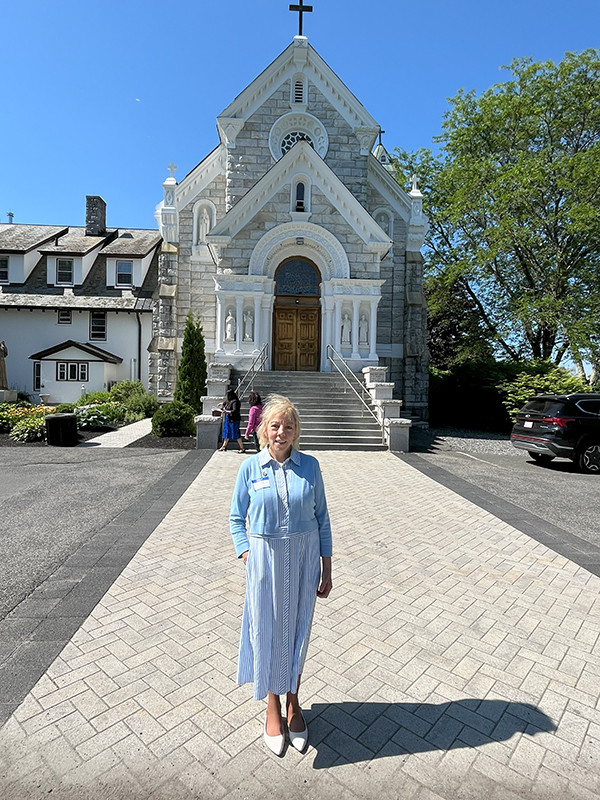
Tanya Cheney of Newport News, Virginia, is attending her second conference. “I’m a nurse, and I wanted to get my CEUs to renew my nursing license,” she says. “I also wanted to meet other nurses and healthcare professionals that are fond of Divine Mercy.”
She encourages everyone to make a pilgrimage to the National Shrine of The Divine Mercy. “This is the epicenter of Divine Mercy of the entire world. If not for the conference, come for yourself, come for your faith, come for the mercy, come for Confession. You will not find a better place on earth for Confession than right here.”
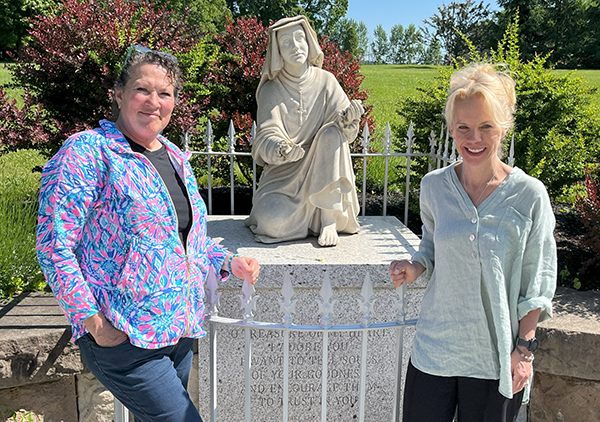
Theresa Redmond (left) of Scituate, Massachusetts, is attending her fourth conference, and Linda Worcester of Millis, Massachusetts, is a first-time attendee.
“I just need to be ‘filled,’” Theresa says. “I’m a nurse practitioner. It helps me in my vocation as a nurse Practitioner, but also mother, wife, sister, aunt — it just fills me up.”
“I’m an ER physician,” Linda adds. “And as Theresa said, I, too, just need to be filled up with the peace of Jesus and Divine Mercy because I work in a tough environment. We try to being compassion to situations that often very much wants the opposite.”
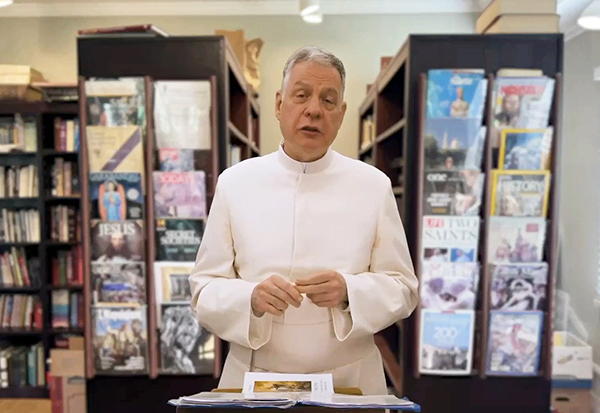
After lunch, the first presentation was a video talk from the Most Rev. Joseph Roesch, MIC, MA, STL, Superior General of the worldwide Congregation of Marian Fathers of the Immaculate Conception of the Most Blessed Virgin Mary. Father Joe addressed the topic “Practicing Faith-Based Virtues as the Key to Compassionate and Merciful Care in the Medical Settings.”
He took as a model for healthcare professionals and all Catholics St. Francis de Sales (1567-1622), the holy Catholic bishop of Geneva. Father Joe explained that St. Francis struggled with inordinate pride and a bad temper from a very young age, but so faithful and dedicated was he to virtuous living that those who knew him had no clue of his weaknesses.
“With grace and persistence, we can overcome our vices,” said Fr. Joe, just like St. Francis de Sales. Practicing virtue makes it a habit, after all, and makes us holy.
The Marian Fathers have from their founding been promoting the traditional devotion to the 10 Evangelical Virtues of Our Lady, as Fr. Joe has previously explored in his popular podcast “Venerable Casimir and Our Lady.” Father Joe went through the 10 evangelical virtues and applied them to the vocation of healthcare, referencing saints and blesseds who had lived the virtues well in the service of Christ and their patients.
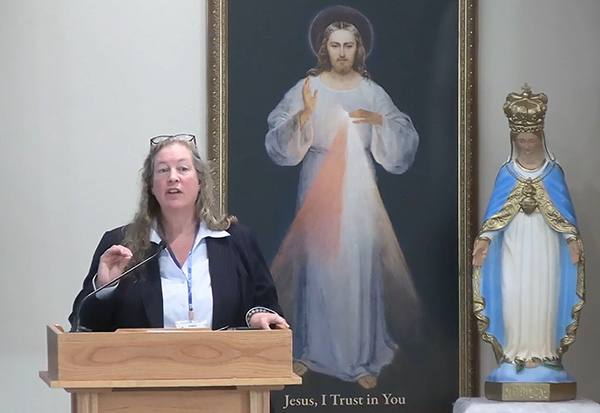
Following Fr. Joe was Professor Andrea Bertheaud, MSN, RN-BC, a clinical assistant professor at the College of Our Lady of the Elms, School of Nursing. She’s also the coordinator for mental health and population health nursing courses. She addressed the topic “Compassion and Mercy: Medical Profession Students Caring for Populations at Home and Abroad.”
She started her presentation with a challenge: “All healthcare professionals: Please fall in love with your job again. The job is an honor, and I think it’s God’s work.” She shared her experiences of teaching nurses, talking about helping her students to grow by exposing them to many different forms of care — senior citizen centers, homeless shelters, the whole range of healthcare.
“Nursing students don’t always consider mental health or population health real nursing,” she said, and yet those fields demand compassion and mercy, as do all other forms of nursing. Professor Bertheaud mentioned working with nursing sisters, including the Sisters of St. Joseph, and spoke highly of their work, their professionalism, and their care for their patients.
Professor Bertheaud spotlighted Mary Seacole, Florence Nightingale, Harriet Tubman, and Lillian Wald as models for her students and for the conference participants.

Next up: Fr. Mark Baron, MIC, director of the Association of Marian Helpers (“Fr. Joseph, MIC”). He addressed the topic “Our Lady and the Eucharist: Importance for Patient Care.”
Father Mark brought a priestly, pastoral perspective to end-of-life care, drawing on his past experience as a parish pastor, conducting around 100 funerals a year. “That’s a lot of anointings,” Fr. Mark said, referring to the Sacrament of the Anointing of the Sick, colloquially called Last Rites.
He shared the powerful experience of flying home to pray the Divine Mercy Chaplet at the bedside of his grandmother as she lay dying, speaking with reverence of the deeply sacred nature of a person’s final moments on earth. “A person is going to stand before the Lord,” said Fr. Mark, “and in those moments prior, they’re making their final decision.”
“I have to say it was my faith that gave me a vision,” explained Fr. Mark, “not just for my grandmother at that time, but how I dealt with dying patients and their families.”
The Divine Mercy Image shows us that the Lord is always reaching out to us, even in those final moments, said Fr. Mark, and talked about how he would share the Divine Mercy message and devotion with families at the bedside of their dying loved ones.
He encouraged spending time in Eucharistic Adoration. "Make that appointment with God," he said.
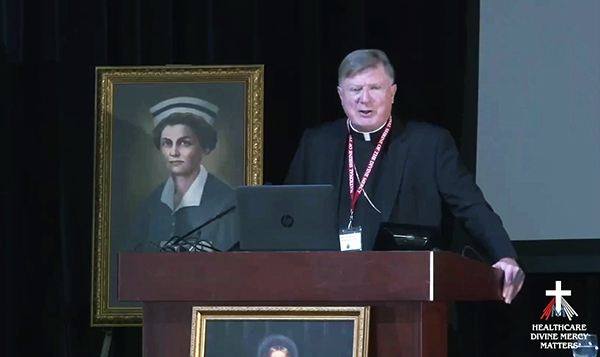
Following the 3 p.m. Hour of Great Mercy devotions, an encore presentation was shown of a video by the Most Rev. Robert J McManus, DD, STD, Bishop of Worcester, Massachusetts, and past chairperson of the Committee on Education for the United States Conference of Catholic Bishops (USCCB). Bishop McManus spoke in 2018 on “How The Ethical and Religious Directives for Catholic Healthcare Services Helps Physicians, Nurses, and Others Provide Better Healthcare.”
A supporter of the Healthcare Professionals for Divine Mercy’s annual Medicine, Bioethics, and Spirituality Conference from the beginning, Bishop McManus spoke of Jesus, the Divine Physician, and how healing was integral to His ministry.
“As Catholics, we believe the salvific ministry of Christ has been confided to the church,” Bishop McManus explained. “And an integral part of the Church’s ministry for centuries has been the healing ministry.” That means the bishops have a role in both supporting and overseeing hospitals and other facilities for healing within their dioceses, assuring that Catholic healthcare remains truly Catholic.
Bishop McManus gave an overview of how exactly that oversight is exercised, and why, drawing from the Ethical and Religious Directives for Catholic Health Care Services. Produced by the USCCB, these directives cover healthcare at all phases of life, including end of life issues and pastoral care for the dying.
Catholic healthcare is offered in light of the dignity of every human person, explained the Bishop, a dignity that comes from our being made in the image and likeness of God, and from the Incarnation of Jesus.
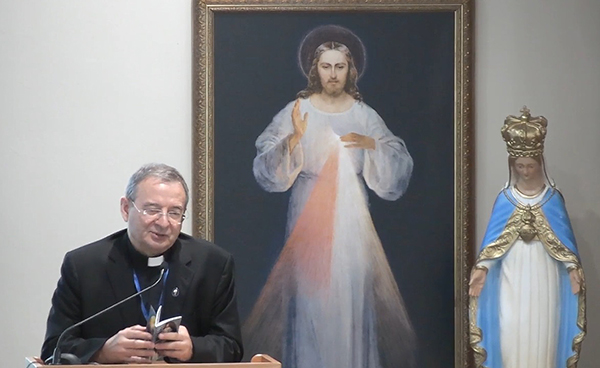
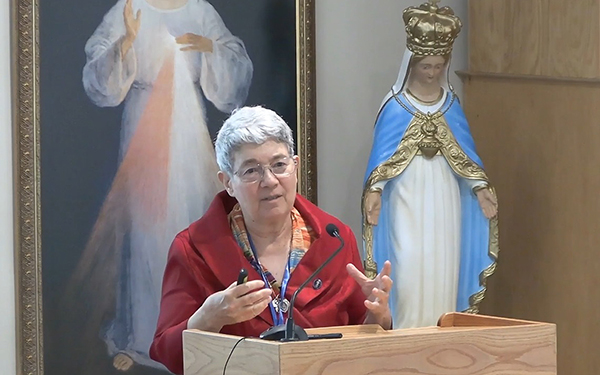
Next, Nurse Marie Romagnano, MSN, RN, CCM-R and Fr. Kazimierz Chwalek, MIC, BA, STB, STL (Cand.), jointly presented “A Case Study of a Dying Patient: Clinical, Family, and Pastoral Considerations for the Medical and Pastoral Team.”
Nurse Marie led off with a presentation of the case of her brother-in-law, who had recently died but had suffered from many failures of communication from his healthcare providers about the severity of his symptoms, his prognosis, and what the options were for him.
“Let’s face it. None of us have really been taught how to tell a patient they are dying," said Nurse Marie. “Nurses usually defer to doctors, but sometimes nurses are placed in positions where we need to say it.”
Nurse Marie emphasized the importance of having the full medical team — palliative and pastoral care, social work, everything — ready to help the patient and their family confront the necessary decisions that arise at the end of a patient’s life. Nurses need to know who to call and be willing to reach out to ensure patients receive the full spectrum of care needed.
Father Kaz then addressed the challenge of defending life when someone’s seriously ill, discussing the many challenges that can emerge from family members unwilling to authorize the care the patient needs to recover. We have to defend life, he explained, sharing the teaching of our faith. It’s hard to judge the decisions of any given medical team, he emphasized.
Father Kaz discussed the preparation for the end of life that Nurse Marie provided to her sister and brother-in-law, talking through the steps Nurse Marie has taken.
Never fail to call the priest, Fr. Kaz insisted. He recalled meeting an elderly, non-responsive patient in the hospital. He whispered to her, "Do you want to be anointed?" and she said, "Yes!" "This absolutely shocked her son and daughter," he recalled. "She asked for Holy Communion as well. And she joined me in prayer, praying the Our Father in German."
Six months later, on the death of her mother, her daughter called Fr. Kaz. Since his visit, her mother was more responsive. "She said that the past months were the best time for us," Fr. Kaz recalled. "God works. The Lord wanted me to be there."
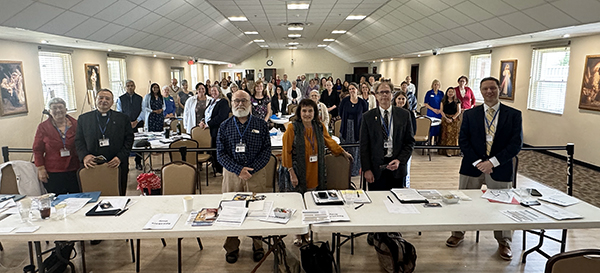
Thank you for joining us for the 19th annual Divine Mercy Medicine, Bioethics, and Spirituality Conference! See you next year!
{shopmercy-ad}
