














We have a canvas image of Fr. Seraphim up in the editorial offices, a way to remind us of his legacy, to say a prayer for him, and to ask for his prayers in our work. August 30 is his birthday, and so it seemed a good time to remind you all that, without Fr. Seraphim, there may well be no St. Faustina.
WATCH videos by and featuring Fr. Seraphim on DivineMercyPlus.org.
By Chris Sparks
This is a special week for the Marian Fathers of the Immaculate Conception: Friday, Aug. 30 is the birthday of the late, great Fr. Seraphim Michalenko, MIC (1930-2021). He would have been 94 years old.
I don’t remember when I first met Fr. Seraphim in person, nor when I first became aware of him and his work. My grandmother had been devoted to the Divine Mercy message long before I became aware of it, and so I grew up seeing her with her plastic bag of devotionals, Rosaries, medals, and saint cards by her chair. The Divine Mercy Image on that white cover was a regular presence in that bag.
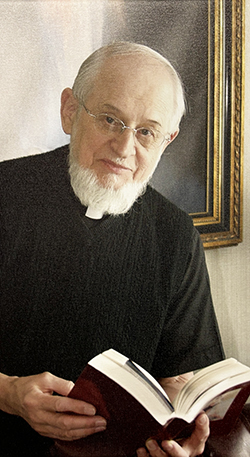
We have a canvas image of Fr. Seraphim (right) up in the editorial offices, a way to remind us of his legacy, to say a prayer for him, and to ask for his prayers in our work. August 30 is his birthday, and so it seemed a good time to remind you all that, without Fr. Seraphim, there may well be no St. Faustina.
Vice postulator
It’s true that Fr. Seraphim was the vice postulator for the cause, not the postulator. That makes it sound like the cause for sainthood would have proceeded without him. It’s possible that Divine Providence would have found another way, but the way that Divine Providence chose in reality is that Fr. Seraphim brought a microfiche copy of the Diary of St. Faustina out of Communist Poland against Soviet law in his luggage. Father Seraphim always insisted he hadn’t smuggled anything. The authorities simply hadn’t bothered to search his luggage.
One of my earliest memories of working here on Eden Hill for the Association of Marian Helpers was spotting Fr. Seraphim in the parking lot, on his way from the Marian Helpers Center to God only knows what other part of his life and work, stopped by pilgrims who were very excited to see him. As soon as they asked him about smuggling the Diary out of Poland, though, he started to move away, insisting he’d done no such thing.
He remained uncomfortable with the attention on him to the end of his life, always ready to correct mistaken information, but unwilling to speak about his own role in the spread of the Divine Mercy message and devotion.
And yet it was such an important role!
Miracles and prophecy
Father Seraphim was present for and documented the beatification miracle for St. Faustina’s cause. Several years after she was beatified, Fr. Seraphim documented the miracle for St. Faustina’s canonization, at which Fr. Seraphim’s longtime collaborator on the translation of St. Faustina’s Diary, Fr. Kazimierz Chwalek, MIC, was present.
Yes, God could have established Divine Mercy without Fr. Seraphim but He didn’t. Instead, I believe, Divine Providence selected Fr. Seraphim for the task.
After all, it looks awfully like Fr. Seraphim is prophesied in the Diary:
May 8, [1938]. Today, I saw two enormous pillars implanted in the ground; I had implanted one of them, and a certain person, S.M., the other. We had done so with unheard-of effort, much fatigue and difficulty. And when I had implanted the pillar, I myself wondered where such extraordinary strength had come from, And I recognized that I had not done this by my own strength, but with the power which came from above. These two pillars were close to each other, in the area of the image. And I saw the image, raised up very high and hanging from these two pillars. In an instant, there stood a large temple, supported both from within and from without, upon these two pillars. I saw a hand finishing the temple, but I did not see the person. There was a great multitude of people, inside and outside the temple, and the torrents issuing from the Compassionate Heart of Jesus were flowing down upon everyone (Diary, 1689).
Now, I have to acknowledge that Fr. Seraphim always insisted “S.M.” meant Fr. Sopocko, and Fr. Kaz supports that, pointing out the order of the initials doesn’t matter in Polish.
A trio
I subscribe to a former colleague’s interpretation — initials are given in the Diary because three people are meant, not just one: Blessed Fr. Michael Sopocko, confessor to St. Faustina and priest of the Diocese of Vilnius; Stanislaus/Fr. Seraphim Michalenko (Stanislaus was his birth name; Seraphim was his name in religion); and Fr. Seraphim’s sister, the late Sr. Sophia Michalenko, CMGT.
Ewa Czaczkowska’s Faustina: The Mystic and Her Message (Marian Press, 2014) interprets the hand from above as the work of St. John Paul II to start the cause for canonization, beatify and canonize St. Faustina, and establish Divine Mercy Sunday as a feast on the Church’s universal liturgical calendar.
In any event, let’s pray for Fr. Seraphim on his birthday. Let us rededicate ourselves to practicing and promoting the Divine Mercy message and devotion, and so ensure that Fr. Seraphim’s legacy continues to change lives and save souls.

{shopmercy-ad}
