















"Every minute we can find a Lazarus if we seek him, and every day, even without seeking, we find one at our door," writes Pope Leo XIV. "Now beggars besiege us, imploring alms; later they will be our advocates ... Therefore do not waste the opportunity of doing works of mercy; do not store unused the good things you possess."
By Chris Sparks
Recently, I took a long-planned pilgrimage to Italy — Rome, Assisi, and San Giovanni Rotondo — with my former pastor and a group of pilgrims largely from the Diocese of Springfield, wherein the National Shrine of The Divine Mercy is situated.
We had an amazing time, a deeply blessed trip, passing through the four Holy Doors in Rome to receive the Jubilee graces; visiting the relics of many of the greatest saints in our Church’s history, including the tombs of Sts. Francis and Clare in Assisi (and Br. Leo, one of Francis’ early, beloved companions — a historical fact that renders Pope Leo’s choice of name and his collaboration with Pope Francis interesting); and generally being wide open to God’s graces throughout.
The law of God
Assisi is an amazing place. Somehow, it really does feel as though St. Francis’ spiritual triumph there was so great, so complete, that it has left an abiding luminosity to Assisi, an abiding clarity and cleanness to the air, an abiding touch of Eden, or of the New Jerusalem, to the hills and streets of the city. Think of Tolkien’s description of Lothlorien, or of Rivendell, and you have some sense of Assisi. The little poor man, bearing in his own flesh the wounds of Jesus, embracing the whole world with wounded hands, walking to wherever the need of the Church was greatest on wounded feet — he so thoroughly became the light of the world that everything he loved still shines.
And St. Francis loved no one and nothing more than God and the poor. Those two loves guided this whole life, after his deeper commitment to the faith. Those loves are the source and content of his victory over the world, the flesh, and the devil. Those loves, interconnected, inseparable, are at the heart of the law of God, are at the source of Divine Mercy.
Two Popes
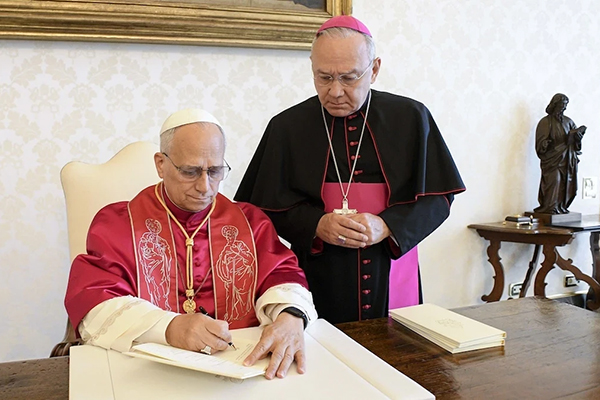
Those loves of God and the poor recently inspired the late Pope Francis’ last encyclical letter Dilexit nos (He Has Loved Us) as well as Pope Leo XIV’s first major teaching document of his pontificate, the apostolic exhortation Dilexit te (I HaveLoved You). Fittingly, he signed the document on Oct. 4, the feast of St. Francis.
Take a moment to appreciate the historic nature of the document. It was begun by the first pope from the New World, the first Jesuit and Argentinian pope (Pope Francis), and completed by the second pope from the New World, the first Augustinian pope, the first pope from the United States of America, and the first citizen of Peru to be made pope. And yet these two men, so unique and first of their kind in the Petrine office, are restating one of the most solid, most ancient planks of our Catholic faith.
The Magnificat
God’s love for the poor can be found across the whole of Scripture, summed up in a spectacular way in Our Lady’s Magnificat, as Leo spotlights in the very first paragraph:
“I have loved you” (Rev 3:9). The Lord speaks these words to a Christian community that, unlike some others, had no influence or resources, and was treated instead with violence and contempt: “You have but little power… I will make them come and bow down before your feet” (Rev 3:8-9). This text reminds us of the words of the canticle of Mary: “He has cast down the mighty from their thrones, and lifted up the lowly; he has filled the hungry with good things, and sent the rich away empty” (Lk 1:52-53).
Everything in Pope Leo’s first apostolic exhortation can also be found in the life of St. Francis of Assisi. Look to the great deacon, stigmatist, and father of the Franciscan orders across the world to understand what Pope Leo is saying to us today. Saint Francis is the embodiment and summary of the exhortation — probably why Pope Leo made a point to sign the document on Oct. 4, the feast of St. Francis.
But of course the Holy Father casts his net more broadly than just the Little Poor Man of Assisi. He surveys Scripture, Tradition, and Magisterium, drawing on saints, popes, and a variety of ecclesiastical gatherings and councils to exhort the faithful to return to our former love, to be true to love of God, and therefore, to love of the poor, whom God loves with a special love: “[A]ll of us must ‘let ourselves be evangelized’ by the poor and acknowledge ‘the mysterious wisdom which God wishes to share with us through them.’” (102)
This is neither a liberal nor a conservative document; it is Catholic, as Pope St. John Paul II made plain when he returned again and again to the phrase “preferential option for the poor” throughout his pontificate. To attempt to read Dilexit Te through a political lens will only allow you to see it through a glass darkly, and not as it is. The Scriptures, as well as much of the Tradition and Magisterial teaching that Pope Leo re-presents in this exhortation, is much older than liberalism or conservatism, left or right, terms that stem from the modern world and the French Revolution’s parliamentary divisions, and not from some deeper truth about human nature or society.
Holy love for the poor
Our first Augustinian pope draws deeply on the wisdom and witness of the great St. Augustine of Hippo:
Augustine’s spiritual guide was Saint Ambrose, who insisted on the ethical requirement to share material goods: “What you give to the poor is not your property, but theirs. Why have you appropriated what was given for common use?” For the Bishop of Milan, almsgiving is justice restored … (43).
Indeed, everything in Dilexit Te is in the lives of all the saints; in the life of Christ our Lord, and Our Lady, and St. Joseph, for they brought the sacrifices of the poor, and lived in a stable in Bethlehem while Our Lady bore her Son, and were refugees, forced emigrants, to Egypt (see Pope Ven. Pius XII, Exsul Familia Nazarethena).
Faustina makes plain
Perhaps you can see this more clearly through the lens of the life of St. Faustina, and how Our Lord responded to her care for the poor — with a personal visit, under the appearance of a poor beggar at her convent gate (Diary of Saint Maria Faustina Kowalska, 1312).
That story from the life of St. Faustina shows us in the 20th century the truth of this insight from the early saint and Doctor of the Church Pope Gregory the Great, cited by Pope Leo at #108:
Every minute we can find a Lazarus if we seek him, and every day, even without seeking, we find one at our door. Now beggars besiege us, imploring alms; later they will be our advocates ... Therefore do not waste the opportunity of doing works of mercy; do not store unused the good things you possess.
Let us love God and the poor like the saints have done, as Pope Leo is teaching us.
Photo by Bill Wegener on Unsplash.
{shopmercy-ad}
