














The altar rail facilitates not only a more reverent distribution of Holy Communion, but also a more efficient way. Whether the communicant is standing or kneeling, it is quicker for the priest to keep moving to distribute to the next person who is prayerfully waiting to receive their heavenly food from their spiritual father, representing Christ.
By Fr. Matthew Tomeny, MIC
Rector of the National Shrine of The Divine Mercy
Thanks to the generosity of many Marian Helpers, the National Shrine of The Divine Mercy has a new altar rail. Carved in Italy of white Carrara marble and brown Onice Ambra marble, and installed by King Richard’s Liturgical Design & Contracting, the new altar rail matches the altars and remnants of the previous altar rail in the Shrine.
I blessed the new altar rail during Mass on Feb. 15, the feast of Bl. Michael Sopocko:
By popular demand
During the current National Eucharistic Revival (which began in 2022), a growing number of Marians, Marian Helpers, and pilgrims requested the restoration of the altar rail in the Shrine. [1]
The previous rector, Fr. Anthony Gramlich, MIC, had put a two-person kneeler in 2020 in front of the center aisle to accommodate the increasing number of pilgrims wishing to kneel while receiving Holy Communion. Based on how well that was received, he told me when I became rector in October 2022 that he hoped the next rector would help facilitate the building of an altar rail.
In September 2023, our Marian Provincial Council unanimously approved moving forward with such a project. Along with other necessary improvements and repairs, including the renovation of the Pilgrim Information Center and Memorial Hall, the altar rail arrives during the Jubilee Year of Hope, and in time to honor the 65th Anniversary of the Dedication of the Shrine, which occurred on May 30, 1960.
While the old altar rail was on the edge of the original sanctuary step, it was decided to design the new altar rail partly on the lower step, not only to extend the sanctuary (accommodating more space for the new wood altar which was not in the original plans for the Shrine during its building in the 1950’s), but also to make it easier for people to kneel without having to climb any steps. While partly on the edge of the lowest step, the rail still allows pilgrims to access the side chapels of the Shrine and venerate the images and relics there.

Altar rail history
Why was the old altar rail removed in the first place?
In the 1970’s the Marians needed to make more room in the sanctuary for the new altar used for Mass facing the people and a more substantial wooden ambo. Many other churches removed their altar rails at that time because bishops and pastors during the 1970’s and 80’s argued that altar rails should be removed based on their interpretation of the liturgical reforms of Vatican II to mean “active participation” (actuosa participatio) of the laity would be better facilitated without a perceived separation of the clergy and the laity. Subsequently, sanctuaries were redesigned to feel more open and communal rather than hierarchical. [2]
Moreover, the indult (special permission) which allowed bishops to request the reception of Holy Communion while standing led to standing becoming the norm in the United States by the late 1970’s, made altar rails seemingly obsolete. [3]
However, no Church document ever called for the removal of the altar rail!
Altar rails have a longstanding history of use in the Church, even before being used for the distribution of Holy Communion. Once churches began to be built in early Christian history, much thought was put into the symbolism of its architectural elements to express and encapsulate Catholic theology. The sanctuary, where the priest and assistant clergy offered the Holy Sacrifice of the Mass, was distinguished from the nave, where the laity gathered to assist, with a barrier. [4] The word “Sanctuary” derives from the Latin “Sanctus” which means “Holy,” which the Israelites of the Old Testament believed meant “set apart for God.”
Regardless of the cultural style, certain architectural elements developed to express particular Christian teachings. The sanctuary, like the Holy of Holies of the Temple of the Old Testament, symbolized Heaven, where God dwells, and the nave symbolized earth, the domain of humans. The sanctuary barrier, which eventually developed into the altar rail in the Western tradition and the iconostasis in the Eastern tradition, is not merely a barrier but actually a veil-like connection between them. [5] It marks the threshold where the heavenly and earthly realms meet in worship.
Eastern and Western tradition
As a seminarian, I remember asking Fr. Seraphim Michalenko, MIC, who was bi-ritual in Byzantine rite, why the Byzantine Rite had an iconostasis when it blocked the view of the Divine Liturgy for the laity. “It’s the union of heaven and earth!” he exclaimed. The iconostasis reveals the mystery of heavenly worship and is a sacred threshold inviting the laity to encounter God, with the Communion of Saints through its icons and Royal Doors by which the Word of God (Gospel) and the Word Made Flesh (Bread from Heaven) are brought.
Similarly, the altar rail in the Roman Rite reveals for the laity journeying on earth (nave) the worship of God who dwells among us in the sanctuary (Heaven). It is the sacred threshold where the laity are invited to encounter God with the Communion of Saints at the distribution of Holy Communion, kneeling in humble adoration to receive the true Bread of Heaven, just as the saints and angels worship the Lamb of God (Rev 4:10) at the marriage banquet of Heaven. At this meeting point of Heaven (sanctuary) and earth (nave), the priest, acting in persona Christi with his consecrated hand, reaches from Heaven to earth to give the Eucharist as a gift of divine life.
Thus, the altar rail is not a separation but a connection, a sacred threshold where Heaven and earth meet in the Eucharist.
Extension of the Altar
The altar rail evolved in the Roman Rite to be low enough for the faithful to line up and receive Holy Communion, and therefore also became known as the communion rail. When the faithful gather at the communion rail, they symbolically gather at the altar. [6]
Scripture scholar Dr. John Bergsma, one of my professors at Franciscan University of Steubenville, put it in class once like this: The disciples of Christ recline at the communion rail like the Apostles who reclined at the sacrificial meal of the Last Supper.
The altar rail is an extension of the altar and sometimes called “The People’s Altar.” This is why some altar rails are made of the same material and design as the altar. This connection is also seen with the linen communion cloth on top of the altar rail which was required to be used until 1962. [7] The linen communion cloth is still used in some churches today to emphasize partaking at the Sacred Banquet of Heaven, including the Shrine of the Blessed Sacrament founded by Mother Angelica, the founder of EWTN.
The communion rail facilitates not only a more reverent distribution of Holy Communion, but also a more efficient way. Whether the communicant is standing or kneeling, it is quicker for the priest to keep moving to distribute to the next person who is prayerfully waiting to receive their heavenly food from their spiritual father, representing Christ. [8] While the local norm now in the United State is to receive standing, kneeling is still officially the universal norm for the Roman Rite and cannot be denied to those who continue to wish do so. [9] The communion rail makes it easier for those who desire to kneel in adoration without being rushed while still respecting the desire of those who wish to stand or cannot kneel.

Reverence
Outside of Mass, the altar rail serves other practical purposes. It encourages reverence of the altar and the Blessed Sacrament reserved in the sanctuary. This is especially pertinent to the National Shrine of The Divine Mercy where pilgrims and visitors are invited to come up some steps to venerate saints in their images and relics in the side chapels but do not always realize they should not step up further into the sanctuary.
This issue can be seen in other highly-visited churches without altar rails where many visitors are unfamiliar with the sanctity of the sanctuary. Where an altar rail is missing, red velvet ropes are often used around the sanctuary.
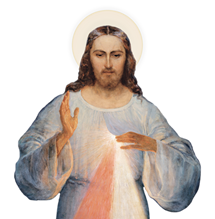
Furthermore, the altar rail invites people to come closer to our sanctuary and kneel and pray before the Blessed Sacrament, the Image of the Divine Mercy, the statue of the Immaculate Conception, the image of the Trinity, and the statues of the 12 Apostles. While the images in the side chapels each have a kneeler, the two most important images in our Shrine, the Divine Mercy and the Immaculate Conception, can now more comfortably accommodate those wishing to venerate them up close.
On behalf of the Marian Fathers of the Immaculate Conception in the USA, thank you very much to all the benefactors who made this beautiful altar rail possible during this Jubilee Year of Hope. May the Lord bless this altar rail to help foster a greater sense of the sacred and deeper appreciation of the Eucharist to all those who come here to receive His Divine Mercy, Who is so good to us, that He continues to pour out on us and the whole world His Blood and Water almost 2,000 years later through the Eucharist.

Notes
[1] Some speculate Pope Benedict XVI’s example gave spark to this increasing desire to kneel. Beginning in 2008, the Pope required all communicants at His Masses to receive on the tongue while kneeling, reinforcing the traditional practice.
[2] This was also a time in which there was a social loss of the sense of transcendence whereby the distinction was blurred between Heaven, our final home, and earth, our temporary journey along the way. There was an intense focus on social justice, influenced by Liberation Theology, in building a utopia, where the “Kingdom of Heaven” would be realized on earth.
[3] Memoriale Domini (1969) reaffirmed that the traditional practice of receiving Communion on the tongue, while kneeling should be retained but allowed bishops to petition Rome for an indult for Communion in the hand and standing if a contrary practice had already developed. The instruction Inaestimabile Donum (1980), issued by the Congregation for Divine Worship (CDW), reaffirmed that “the faithful should receive kneeling or standing, as determined by the episcopal conference,” but stated that no one may be forced to stand or be refused Communion for kneeling. A 1994 Clarification by the CDW confirmed that kneeling remains the universal norm, but standing may be allowed by indult in specific countries.
[4] Originally called a “chancel barrier” in the West and a “templon” in the East, the sanctuary barrier also practically helped to protect the altar and the Eucharist and promote reverence.
[5] By the 4th century, the templon or chancel barrier were screens or colonnade which sometimes had curtains between spaces. In the East, the screen overtime became covered in icons and the iconostasis became a defining feature of Byzantine churches by the 10th century. In the West, the chancel screen took on different forms, such as the ornate rood screen common in Gothic churches, often with a with crucifix and saints. During the Counter-Reformation (16th-17th centuries) after the Council of Trent, there was a vast movement to lower the screens to become the low altar rail in order to increase visibility of the altar for the laity so they would be encouraged to engage the Mass more closely. While the Byzantine Rite had a visual veil of the sacred mysteries taking place in the sanctuary with the iconostasis, their Divine Liturgy was chanted in the vernacular language, allowing the faithful to still follow along. The Roman Rite still had a sonic veil of the sacred mysteries taking place in the sanctuary through the use of Latin and the silent Roman Canon, but then with the low altar rail could allow the faithful to follow along more easily with greater visibility.
[6] How touching it is to see people of all backgrounds line up side by side as equal but different members of the Mystical Body of Christ, e.g. a professor next to his student, a judge next to an ex-criminal, a senator next to a poor person. I especially appreciated this when I once distributed Holy Communion at a Navy base chapel that still had a communion rail and noticed I gave Holy Communion to an Admiral and a lowly enlisted man side by side.
[7] The communion cloth was also known as the “houseling cloth” and was used in chapels or side altars without an altar rail by two ministers or servers, or even the communicants themselves, holding the cloth underneath communicant’s chin. It also served to catch a host of the Blessed Sacrament in case it was dropped while being distributed, but this has been supplanted by communion patens, which were popularized in the United States in the 1880’s, officially tolerated in 1917, and officially prescribed for use in 1929. Cf. https://blog.adw.org/2017/02/chin-paten-thought-impious/. The communion paten for the Communion of the faithful is prescribed by General Instruction of the Roman Missal (GIRM) 118. The CDW’s 2004 instruction Redemptionis Sacramentum (RS) §93 reminded: “The Communion-plate for the Communion of the faithful should be retained, so as to avoid the danger of the sacred host or some fragment of it falling."
[8] Those standing should make an act of reverence before receiving by bowing or genuflecting while those kneeling do not since their act of reverence is kneeling itself.
[9] GIRM 160 (U.S. Adaptation): “The norm established for the Dioceses of the United States of America is that Holy Communion is to be received standing, unless an individual member of the faithful wishes to receive Communion while kneeling.” RS 91: “It is not licit to deny Holy Communion to any of Christ’s faithful solely on the grounds, for example, that the person wishes to receive the Eucharist kneeling or standing.”
{shopmercy-ad}
