














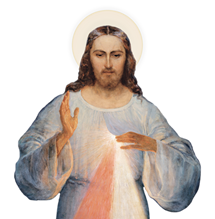


Jesus Himself broke through the strongest social barriers of his day by freely offering His friendship to women, children, Samaritans, Gentiles, Romans, tax collectors, prostitutes, lepers — all whom society considered second-class citizens or social and religious outcasts were to be included and treated as one’s true “neighbors.”
Part 11: The Dawning of the Kingdom of God
By Robert Stackpole, STD
In this weekly web series, Dr. Robert Stackpole, emeritus director of the John Paul II Institute of Divine Mercy, leads us step-by-step through the life of the Founder of Christianity, from Bethlehem to Galilee to Jerusalem. Along the way, we pause to consider in-depth the historical debate over the gospel stories of the virginal conception and nativity of Jesus, his message of the Kingdom, his embrace of persecution and death on the Cross, and his glorious bodily resurrection from the dead. Finally, we plunge into the great mystery of the Incarnation, and show how it actually shines through the whole gospel story from beginning to end.
Read the series from the beginning.
Near the start of His public ministry, Jesus went to the synagogue in His hometown and read this passage from Holy Scripture:
The spirit of the Lord is upon me, because he has anointed me to preach good news to the poor. He has sent me to proclaim release to the captives, and recovering of sight to the blind, to set at liberty those who are oppressed, to proclaim the acceptable year of the Lord. (Lk 4:18-19)
Then He closed the book and said, “Today this scripture has been fulfilled in your hearing” (Lk 4:21). It was a bold move; Jesus was clearly announcing the arrival of the Kingdom of God, that day “acceptable to the Lord” when justice and mercy would be established on the earth (Is 58:5-14). In fact, He was publicly claiming that his own ministry marked the dawning of that Kingdom in our midst.
God's global shalom
“The Kingdom of God” meant God’s global shalom, in other words, the state of affairs in which He reigns over every aspect of human life: over human minds with faith and truth, over human hearts with hope, over human wills with love, over human bodies with health and wholeness, and over human communities with justice and peace.
In one sense, Jesus said, that Kingdom is already here, beginning with His own mission: “The time is fulfilled and the kingdom of God is at hand” (Mk 1:15); “[B]ehold, the kingdom of God is in your midst” (Lk 17:21). His ministry of healing and exorcism was a sure sign that God’s love is breaking into the world in a new way to set His people free from all that oppresses them: “[I]f it is by the finger of God that I cast out demons, then the kingdom of God has come upon you” (Lk 11:20). [1]
Yet the Kingdom of God has not yet come in its fullness, Jesus said, for it will grow gradually like a mustard seed into a great tree of life (Mt 13:31-32), and leaven the world just as yeast leavens a new loaf of bread (Mt 13:33). So Jesus taught His disciples to pray with hope: “Father, may your kingdom come … on earth as it is in heaven” (Lk 11:1; Mt 6:10).
Moreover, Jesus knew it would take more than just gradual growth and leavening for the Kingdom to spread and become established on the earth. He predicted there also would be cataclysmic events along the way: earthquakes, plagues, wars, famines, the fall of the great Temple in Jerusalem, and the worldwide persecution of his followers. God’s ultimate triumph, however, was assured, and Jesus promised that one day He Himself would return to this world with all the angels of Heaven to bring God’s Kingdom to its consummation (Mk 13:24-27).
All must make way
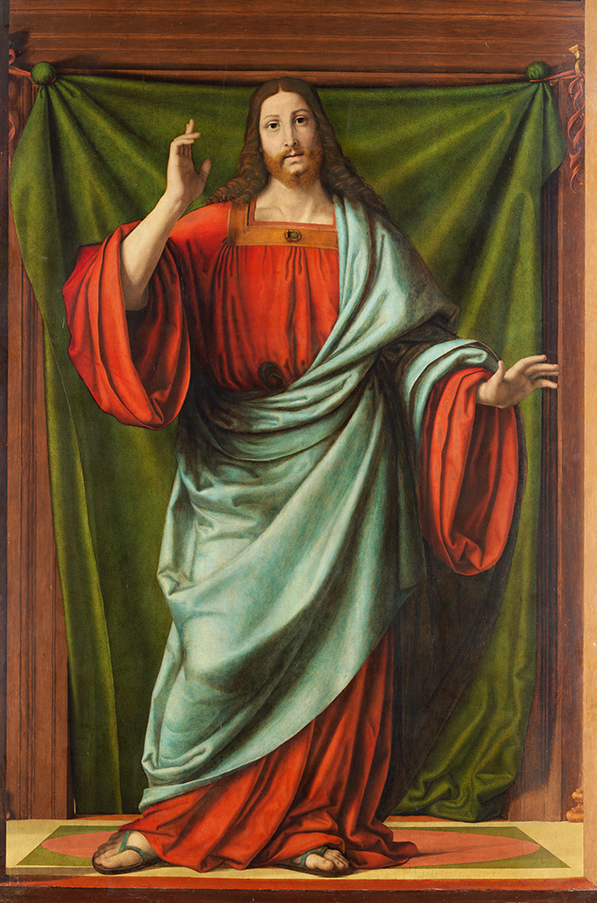
Christ’s proclamation of the Kingdom of God clearly challenged all of the lesser kingdoms of his day — and our own time as well. Families, economic and religious institutions, social systems, nations, empires: all must make way for the dawning of the Kingdom that God freely offers. Thus, Jesus taught what we may call a new “Kingdom ethic” for social and institutional life.
To begin with, He commanded His disciples to serve one another, not to dominate and oppress one another, saying: “Whoever would be great among you must be your servant, for the Son of Man also came not to be served but to serve …” (Mk 10:44-45). This ideal of service was to be based on His own example as one who devoted His life to caring for the spiritual and bodily needs of His neighbors: “A new commandment I give to you, that you love one another; even as I have loved you …” (Jn 13:34).
No boundaries
Furthermore, Jesus put no boundaries of gender, ethnicity, race, class, nationality, or religious adherence on His concept of one’s “neighbor.” The neighbor whom we are commanded to love is anyone in need we meet along life’s way (see Lk 10:29-37, the Parable of the Good Samaritan). Jesus Himself broke through the strongest social barriers of his day by freely offering His friendship to women, children, Samaritans, Gentiles, Romans, tax collectors, prostitutes, lepers — all whom society considered second-class citizens or social and religious outcasts were to be included and treated as one’s true “neighbors.”
Christ summed up His Kingdom ethic in two commandments, which he said were the greatest of all (both taken from the Hebrew Scriptures): “The first is, ‘Hear O Israel: the Lord our God, the Lord is one; and you shall love the Lord your God with all your heart, and with all your soul, and with all your mind, and with all your strength.’ The second is this, ‘You shall love your neighbor as yourself.’ There is no other commandment greater than these” (Mk 12:29-31).
Next Monday, Feb. 17: Part 12: Misunderstandings about Christ’s Kingdom Message.
Previous article.
Note
[1] New Testament historian E.P. Sanders is convinced that Jesus was known to be an exorcist during his lifetime:
"Exorcism was well known in the first century. Is it the case, then, that any first-century religious leader would be credited with exorcisms? Apparently not. John the Baptist seems not to have been an exorcist. After Jesus’ day, Theudas and the Egyptian promised miracles, but [the ancient Jewish historian] Josephus does not say that they exorcized. [The charismatic rabbis] Honi and Hanina were not famed as exorcists. Exorcism, then, was a specialization: some religious leaders were exorcists, but not all. I think it strongly probable that Jesus was regarded as an exorcist" (The Historical Figure of Jesus. London: Penguin Books, 1993, p. 152-153).
{shopmercy-ad}
