
















Multiple individuals do not experience the same visions at once, any more than numerous individuals can dream the same dream at once. When they do have the same vision, we call them objective “apparitions,” not purely internal visions, and are usually signified by external signs (for example, by the uncovering of the spring of water at Lourdes, or the miracle of the sun at Fatima).
Part 26: The Appearances of the Risen Jesus
By Robert Stackpole, STD
In this weekly web series, Dr. Robert Stackpole, emeritus director of the John Paul II Institute of Divine Mercy, leads us step-by-step through the life of the Founder of Christianity, from Bethlehem to Galilee to Jerusalem. Along the way, we pause to consider in-depth the historical debate over the gospel stories of the virginal conception and nativity of Jesus, his message of the Kingdom, his embrace of persecution and death on the Cross, and his glorious bodily resurrection from the dead. Finally, we plunge into the great mystery of the Incarnation, and show how it actually shines through the whole gospel story from beginning to end. Read the series from the beginning.
So what happened on the first Easter that so completely transformed the lives of Jesus' disciples?
The New Testament answer to that question is crystal clear: Jesus rose from the dead, in a new and glorified body that was nevertheless recognizably Him. It was beyond anything that the disciples expected, or could have imagined. It also vindicated His implicit claims to be the Messiah, Savior and Lord, and the message of the Kingdom that He both lived and preached.
Indeed, it was an experience so astounding that, in just a few encounters, spread out over a period of 40 days, it set a nucleus of His disciples on fire with love and zeal, so that they became willing to sacrifice their lives to spread the good news about Jesus Christ to the ends of the earth. …
Alternative explanations?
… And it also has been called into question by many historians for the past 400 years. In that time, a number of alternative explanations for what happened on that first Easter have been proposed. Here are the most significant ones.
1) It was a purely “spiritual” event in the hearts and minds of Christ’s disciples.
This theory asserts that the disciples experienced merely the ongoing influence of the divine Spirit of Love that had filled the heart and the life of Jesus when He was with them, and after His death they discovered that this same Spirit lived on in their hearts, and was not conquered by His crucifixion.
The main problem with this theory is that it expressly contradicts all of the historical sources we have concerning the Easter events. Both the Gospels and the book of Acts, for example, make it crystal clear that the risen Jesus was tangibly present to His disciples, in a flesh-and-bones, corporeal way:
And behold, Jesus met them and said “Hail!” and they came up and took hold of his feet and worshipped him. (Mt 28:9)
And as they were saying this Jesus himself stood among them, and said to them, “Peace be to you.” But they were startled and frightened, and supposed that they saw a spirit. And he said to them, “why are you troubled, and why do questionings rise in your hearts? See my hands and feet, that it is I myself; handle me and see; for a spirit does not have flesh and bones as you see that I have.” And when he had said this he showed them his hands and his feet. And while they still disbelieved for joy, and wondered, he said to them, “Have you anything here to eat?” They gave him a piece of broiled fish, and he took it and ate it before them. (Lk 24:36-43)
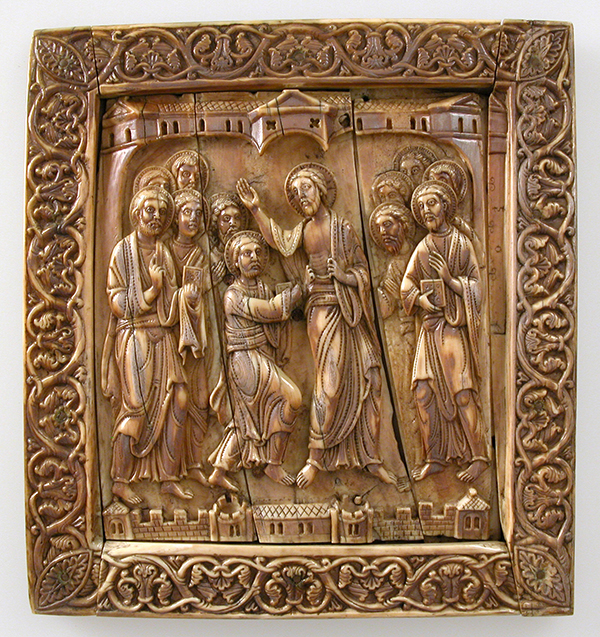
Eight days later, his disciples were again in the house, and Thomas was with them. The doors were shut, but Jesus came and stood among them, and said, “Peace be with you.” Then he said to Thomas, “Put your finger here, and see my hands; and put out your hand, and place it in my side; do not be faithless, but believing.” (Jn 20:26-27)
[Peter said] “And we are witnesses to all that he did both in the country of the Jews and in Jerusalem. They put him to death by hanging him on a tree, but God raised him on the third day and made him manifest; not to all people, but to us who were chosen by God as witnesses, who ate and drank with him after he rose from the dead.” (Acts 10:39-41)
Visions?
One historian who tried to keep this “spiritual experience only” theory alive was the Anglican New Testament scholar Marcus Borg. In his book Jesus: The Life, Teachings and Relevance of a Religious Revolutionary, he wrote: “[V]isions can involve not only seeing and hearing, but even a tactile dimension, as dreams sometimes do. Thus, a story in which Jesus invites his followers to touch him or is seen to eat does not intrinsically point away from a vision.” [1]
By “vision” here Borg evidently means not a purely subjective, fictitious, imaginary experience, but a true inner, spiritual, supernatural encounter that occurs solely in the mind and heart of the religious devotee, and does not involve any objectively verifiable, tangible presence.
The trouble is that such “visions” are experienced solely by individuals — multiple individuals do not experience the same visions at once, any more than numerous individuals can dream the same dream at once. When they do have the same vision, we call them objective “apparitions,” not purely internal visions, and are usually signified by external signs (for example, by the uncovering of the spring of water at Lourdes, or the miracle of the sun at Fatima).
Moreover, characters in dreams and visions can indeed eat things — but what if the food in the sensory, material world actually disappears as they do so? Are we to suppose that the disciples were so stupid and gullible that they did not notice that the fish that the risen Jesus ate before them was still on the plate, untouched after He left them? And are we to suppose that in a purely spiritual vision, Jesus asked His disciples to touch Him to verify that He was not a ghost — when in fact, He was not in any way tangibly present and could not be physically touched?
Borg continues:
Even if one takes seriously that one could touch him, as suggested in some of the Easter stories, it would be ridiculous to imagine that the risen Jesus has a flesh-and-blood body. How much would he weigh? How tall would he be? Does he still have to eat? These are ridiculous questions — which is exactly my point. According to the Easter stories themselves, the risen Jesus is not confined by time and space, but enters locked rooms, journeys with his followers without being recognized, appears in both Galilee and Jerusalem, vanishes in the moment of recognition, and abides with his followers always, ‘to the end of the age.’…
If the risen Jesus exists as a body, it is a body so radically different from any meaning we give to the word “body” that it seems misleading to use the term. … It seems idle to me to try to assign meaning to the notion by speaking of a ‘glorified body’ or ‘transformed physicality,’ as if these phrases make the matter more intelligible. We should leave it in the language of paradox, as Paul does—a ‘spiritual body’—and simply admit that the risen Jesus transcends our categories of body, flesh and blood. Epistemological humility and ontological modesty are called for. [2]
Intellectual humility, however, means being open to all of the evidence before us in order to comprehend a mystery as best we can, not “cherry-picking” from it in order to fit with our own, pre-conceived notions that what is supernatural cannot also in some way be physical as well.
Heaven and Earth
Saint Paul does not tell us in his epistles that the reality of the risen body totally “transcends” our concepts of flesh and blood. His paradoxical language is his way of communicating that there is analogy between an earthly human body and a heavenly celestial body (see I Corinthians 15: 35-41). In other words, in some ways they are similar, and in other ways they are not.
And this is exactly what the Gospels show us as well. The two kinds of bodies are similar in that the risen Jesus was recognizably Himself; He could be touched, and He could even eat physical food (not, evidently, because He needed to, but to show His apostles that He was not a ghost). And yet unlike someone in an earthly body, He could appear and disappear, and pass through the locked doors of the cenacle.
What was His height and weight? We do not know, although when He appeared to His disciples He seemed to be the same physical size as He was on earth. He can be “with us always, to the close of the age” as He promised (Mt 28:20) because His risen body and soul occupies another dimension of existence, a heavenly dimension, from which He can see us always, and which can intersect with our space-time-matter-energy dimension at any point, as He wills.
Flesh and Bones
As for all this being “ridiculous”: well, unlike Borg’s theory it fits with all of the evidence, not just some of it, and it was the risen Jesus Himself who said He still had “flesh and bones” (Lk 24:39). So, was Jesus being ridiculous because he unveiled a mystery that does not fit with Borg’s personal philosophy that what is “spiritual” or religiously significant must also be completely immaterial, or completely incomprehensible?
Besides, it stands to reason that the fullness of human life, healed and brought to fruition in heaven, is a body-and-soul reality, since human beings in this life are body-soul creatures. Thus, the risen Jesus was no more likely to be a pure spirit than we ourselves will be, when we ourselves are raised to new life with Him.
After all, the gospels take pains to show us, again and again, that although the Holy Spirit worked through Him to cast out demons and perform miracles at His command, Jesus was nonetheless fully human: He was born and grew up; He needed to eat and sleep; He could suffer weariness and pain; He experienced joys and sorrows, and even spiritual desolation and bodily death. A purely “spiritual” resurrection would not be the rising to life of the fullness of “Jesus” — it would be the survival of a mere remnant of his fully human existence.
Next time we will begin to look at some other theories about what happened at the first Easter that do indeed merit the description “ridiculous.”
Next: Part 27: More Implausible Theories about the Appearances of the Risen Lord.
Previous article.
Notes
[1] Marcus Borg, Jesus: The Life, Teachings and Relevance of a Religious Revolutionary (2006), p. 278.
[2] Ibid., p. 288-289.
{shopmercy-ad}
