












By Chris Sparks
Long before I came to work on Eden Hill for the Marian Fathers of the Immaculate Conception, I had known that Fr. Seraphim Michalenko had had an important place in spreading the Divine Mercy message and devotion. After all, his name was prominently on "The Divine Mercy Message And Devotion," the little booklet given to me by my mom’s friend when I was in middle school. He was one of the folks involved in the translation and editing of the Diary of St. Faustina, listed as such in the copy that my grandmother owned. And then when I first came to work for the Marian Fathers, his was the last word on all things related to St. Faustina, her writings, and the message and devotion.
In the weeks before I started work, though, I read St. Faustina’s Diary from cover to cover, and I learned how important Fr. Seraphim really was.
You see, he and his work on Divine Mercy are present in St. Faustina’s prophecies.
May 8, [1938]. Today, I saw two enormous pillars implanted in the ground; I had implanted one of them, and a certain person, S.M., the other. We had done so with unheard-of effort, much fatigue and difficulty. And when I had implanted the pillar, I myself wondered where such extraordinary strength had come from, And I recognized that I had not done this by my own strength, but with the power which came from above. These two pillars were close to each other, in the area of the image. And I saw the image, raised up very high and hanging from these two pillars. In an instant, there stood a large temple, supported both from within and from without, upon these two pillars. I saw a hand finishing the temple, but I did not see the person. There was a great multitude of people, inside and outside the temple, and the torrents issuing from the Compassionate Heart of Jesus were flowing down upon everyone (Diary of Saint Maria Faustina Kowalska, 1689).
The author and journalist Ewa Czaczkowska interpreted the hand from above as representing St. John Paul II, the Great Mercy Pope, who’d launched St. Faustina’s cause for canonization as cardinal archbishop of Krakow, beatified and canonized her as pope, and established the universal Feast of Divine Mercy Sunday. But S.M. — who was this? Father Seraphim himself insisted it referred to Bl. Michael Sopocko. Not an unreasonable assertion. After all, the Marian Fathers received Divine Mercy from Fr. Sopocko during World War II. Without that, Fr. Seraphim himself might never have been involved.
But I wasn’t convinced. The initials are S.M., after all, not M.S. Another colleague of mine, Mary Flournoy, proposed an answer. She said that given the work of both Fr. Michael Sopocko and Fr. Seraphim Michalenko, as well as Sr. Sophia Michalenko, a biographer of St. Faustina and biological sister to Fr. Seraphim, Mary presumed that the initials S.M. were meant to indicate all three of them.
Whatever the case, I’m convinced Fr. Seraphim was prophesied by St. Faustina in the very Diary he would bring out of Poland to the rest of the world. He was foretold by the prophet whose beatification and canonization miracles he would document. His long labors to firmly establish Divine Mercy as a new splendor for the Church in spite of every obstacle, persisting in trust in Jesus and in His Secretary and Apostle of Divine Mercy, have born about as much fruit as any other work of any person in the Church, and continue to do so.
In the Year of St. Joseph, Patron of a Happy Death, and February, the month dedicated to the Holy Family, Fr Seraphim went to his eternal reward on the Feast of Our Lady of Lourdes. Once again, the Church and the world has lost one of the great Catholic lights on a feast day with extraordinary, direct personal significance. About a decade ago, Fr. Seraphim had been suffering from cancer. He went on a pilgrimage to Lourdes, bathed in the waters, and was given another long stretch to live.
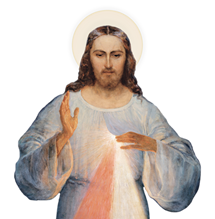
But the Feast of Our Lady of Lourdes also has special significance to the Marian Fathers more broadly, as well. When she appeared to St. Bernadette Soubirous on March 25, 1858, Our Lady said, “I am the Immaculate Conception.” How fitting that one of the greatest sons of the Congregation of Marian Fathers of the Immaculate Conception of the Blessed Virgin Mary should have passed away on her feast! And Our Lady of Lourdes had given France and the world the give of a seemingly inexhaustible miraculous spring, visited by millions of pilgrims since the time of the apparitions. Those waters resemble the living waters promised by Jesus to those who came to Him and drank (see Jn 4:14; 7:37-39), the water that poured from Christ’s side on the Cross (see Jn 19:34; 1 Jn 5:6), the water represented by the pale ray on the Divine Mercy Image. “O Blood and Water, which gushed forth from the Heart of Jesus as a fount of mercy for us, I trust in You.”
Finally, it’s worth mentioning that St. Faustina died of tuberculosis. Father Seraphim died of COVID-related pneumonia. Both spent time in the hospital toward the end of their lives, enduring diseases with respiratory symptoms that would ultimately take their lives.
Let us pray for him, asking the Divine Mercy whom he’d served so long and so well to welcome him home.
