











By Chris Sparks
These are dark and dangerous times — and so we must abide with Jesus, the Divine Mercy Incarnate.
The Church and the world seem caught in an immense storm. Crosswinds of partisanship; the ravages of the culture of death; the destructiveness of the dictatorship of relativism; the indifferent brutality of a throwaway culture — all of it rages. All of it does what damage it can.
And so we must continue in faith, hope, and love, founded on prudence, temperance, justice, and fortitude.
We seem addicted to the notion of a secret solution, of some simple one-step answer to all the problems in the world. For all that I love Tolkien’s “Lord of the Rings,” sometimes I think he helped open the door to a whole slew of stories about immense, world ending problems that can be resolved by a very simple solution — throw the Ring in the fire, for instance, or throw the water on the witch. Once you can do the one simple action, everything will be made right.
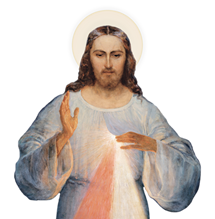
There’s something to that. After all, God has sent us angels and saints promising us powerful graces and spectacular wonders if only we do simple little things. There are extraordinary promises attached to the Divine Mercy message and devotion, especially to the Feast, the Image, the Novena, the Chaplet, and the Hour. God has promised powerful graces through the Rosary, the Sacred Heart devotion, and the Immaculate Heart devotion.
It’s so important to take these prophetic promises seriously. After all, in Scripture, we have the example of Naaman the Leper.
Naaman was a Syrian, a man of great wealth and power, who suffered from leprosy. He came to Israel to seek healing and was told by the prophet Elisha, "Go, wash in the Jordan seven times, and your flesh shall be restored and you shall be clean." The Scriptures tell us:
But Naaman became angry and went away, saying, "I thought that for me he would surely come out, and stand and call on the name of the Lord his God, and would wave his hand over the spot, and cure the leprosy! Are not Abana and Pharpar, the rivers of Damascus, better than all the waters of Israel? Could I not wash in them, and be clean?"
He turned and went away in a rage.
It was only after his servants reasoned with him, pointing out that if the prophet had told Naaman to do something difficult, he would have done it willingly, that Naaman consented to go and do the simple, seemingly meaningless task set him by the prophet. And guess what? His leprosy was healed. He was made clean (2 Kgs 5:8-14).
So we need to not discount or ignore the simple acts that God gives us to resolve seemingly impossible problems. But we also need to be ready for the long haul.
We won’t pray the Rosary once and see the whole world restored to perfect faith. We won’t have a single Mass said for every need and see every need met. We generally won’t pray a single Divine Mercy Chaplet, attend Divine Mercy Sunday once, or go to Confession once for all time and be forever done.
No — our Sacraments and devotions aren’t merely medicine for a particular disease. Rather, they’re all part of Catholic life.
In order to live (and to live well), we don’t just eat once and expect to never eat again, or sleep once and never again, or exercise once and never again. No — life is liturgical. Life is full of ritual, of routine, of habits, of simple things done again and again across a whole lifetime. Food really nourishes; sleep really heals and restores; exercise is powerful to build good health. The mere fact that we must repeat our eating, our sleeping, and our exercise doesn’t mean these things are ineffective, but rather that we are creatures, not the Creator. We need other created realities from moment to moment in order to survive.
We need to apply this same wisdom to our spiritual lives. We need to be going to Mass regularly, going to Confession regularly, praying regularly, studying Scripture regularly. We need to be Catholic every day of the week, not just on Sundays, persevering in the practice and the disciplines of our faith if we are to have any hope of changing, not just ourselves, but our whole world.
The Rosary, the Chaplet, the Sacraments — the promises attached to these things are true. But we must persevere in using them. We must do more than just pray the Rosary once; we need to pray the Rosary daily for peace in the world. The same with our sacramental lives or any and all other devotions to which we are called. We are called to sanctify space and time throughout our lives, making our homes into holy places, bearing God with us in our hearts when we are in the state of grace to work, to school, or wherever we go. We are meant to be on fire with the love of God, with the Holy Spirit, and bringing that divine fire to set the whole world aflame (see Lk 12:49).
And so our persistence is vital, not just for our own salvation, but for the conversion, salvation, and sanctification of the entire world.
So let us renew our commitment to being practicing Catholics, knowing that we need practice to become perfect, that God’s grace is always available to us, waiting on our yes to the divine will. Let us set out again today on the road home to Heaven, trusting in the Divine Mercy to strengthen us each day and see us through to the end. Let us ask Mary, Mother of the Church, for her special help and protection today and always so that we may persevere in love and service of her Son.
Pray for me, that I may practice what I preach. I’ll pray for you.
Chris Sparks serves as senior book editor for the Marian Fathers. He is the author of the Marian Press book How Can You Still Be Catholic? 50 Answers to a Good Question.
{shopmercy-ad}
Photo by Rosie Kerr on Unsplash
