














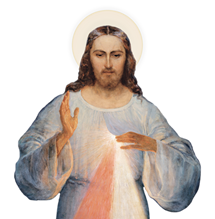


A special feature of the miracles of Jesus (and one that certainly sets them apart from attempts to heal by the use of magic and the occult) is the importance Jesus attached to people’s “faith” in Him if they were to be able to receive the inflow of His healing power. This act of faith acted like the opening of a door or channel, removing obstacles to the flow of Christ’s healing love.
Part 16: Finishing the Case for the Gospel Miracle accounts: reasons 7-10
By Robert Stackpole, STD
In this weekly web series, Dr. Robert Stackpole, emeritus director of the John Paul II Institute of Divine Mercy, leads us step-by-step through the life of the Founder of Christianity, from Bethlehem to Galilee to Jerusalem. Along the way, we pause to consider in-depth the historical debate over the gospel stories of the virginal conception and nativity of Jesus, his message of the Kingdom, his embrace of persecution and death on the Cross, and his glorious bodily resurrection from the dead. Finally, we plunge into the great mystery of the Incarnation, and show how it actually shines through the whole gospel story from beginning to end. Read the series from the beginning.
We need to look more closely at the comparison we made last time between stories of miracles and wonders in pagan antiquity, and the miracles of Jesus recorded in the New Testament.
Claims of magic
In his book Zealot: The Life and Times of Jesus of Nazareth, Reza Aslan reports the claim of one of the early church Fathers, St. Irenaeus of Lyons, regarding the special nature of the miraculous deeds of Christ:
It was precisely the lack of such magical devices that distinguished Jesus’ miraculous actions from those of the common magician. Jesus, in the words of Irenaeus, performed his deeds “without any power of incantations, without the use of the juice of herbs and grasses, without any anxious watching of sacrifices, of libations, or of seasons.” [1]
Aslan then goes on to claim that according to St. Mark’s gospel Jesus did in fact use “magician’s techniques” for some of his miracles — including the use of “chanting” and “ritual formula”— and since Aslan believes Mark was the earliest and therefore most historically reliable account of the life of Jesus, it is not unreasonable to label Jesus a “magician.”
But Aslan can only point to two healing stories in Mark that allegedly back up his claim (in Mark 7:31-35 and 8:22-26), and in neither case does Jesus use chants or ritual formula (as a mere reading of the text in any English translation will show). What He does use in both cases is spittle — which was commonly believed in the ancient world to have healing properties.
What this shows is not that Jesus was relying on magic, or even any alleged curative powers of spittle (in Mk 7:34, for example, it was not the spittle but Jesus’ word of command, Ephphatha, “Be opened,” that directly effected the cure). Most likely, in these two cases Jesus was reassuring His patients, and eliciting deeper trust from them, by using a sign of healing that the sick person understood; in other words, it was an act of accommodation on the part of Jesus to the need for external signs or symbols to help awaken the faith of His patients.
Importance of Faith
This brings us to another special feature of the miracles of Jesus (and one that certainly sets them apart from attempts to heal by the use of magic and the occult): namely, the importance Jesus attached to people’s “faith” in Him if they were to be able to receive the inflow of His healing power. This act of faith acted like the opening of a door or channel, removing obstacles to the flow of Christ’s healing love.
The great mid-20th century New Testament scholar Gunther Bornkamm explained the matter this way:
All those who turn to him in faith count on the power of Jesus which knows no bounds, and on the miracle which he can work, where human help fails. Thus, the bearers who came bringing one sick of palsy (Mk 2:1), the lepers (Mk 1:40 ff., etc.), the blind by the wayside (Mt 9:27 ff.; 20:29 ff.), the woman who was a sinner (Lk 7:36 ff.). The miracle stories in all the Gospels are meant to show that Jesus does not disappoint these expectations, and that he has been given this power. It would be difficult to doubt the physical healing powers which emanated from Jesus, just as he himself interpreted his casting out of demons as a sign of the dawning of the kingdom of God (Lk 9:20; Mt 12:28). …
And the father of the child cried out “I believe; help my unbelief!” (Mk 9:24). I believe! — here the petitioner has indeed exceeded his own ability, and confesses a faith greater than he really has. Help my unbelief! — here he who falls short of faith throws himself on the power and help of Jesus. In this paradox of faith and unbelief, as the story points out [Mk 9:20-27], faith becomes true and capable of receiving the miracle of God. Where Jesus does not find this faith, he cannot work a miracle (Mk 6:1-6). This certainly does not mean that faith itself is the power which works the miracle, although in the Christian view faith may be enabled to work miracles (Acts 2:43; 5:12; Mk 6:7; I Cor 13:2; II Cor 12:12). What matters here, however, is the readiness to receive the miracle. It is so indispensable for Jesus’ work that he can say repeatedly to the cured and the saved — for both terms are implied by the word “salvation” — “Your faith has made you whole” (Mt 9:22; Mk 10:52; Lk 17:19). [2]
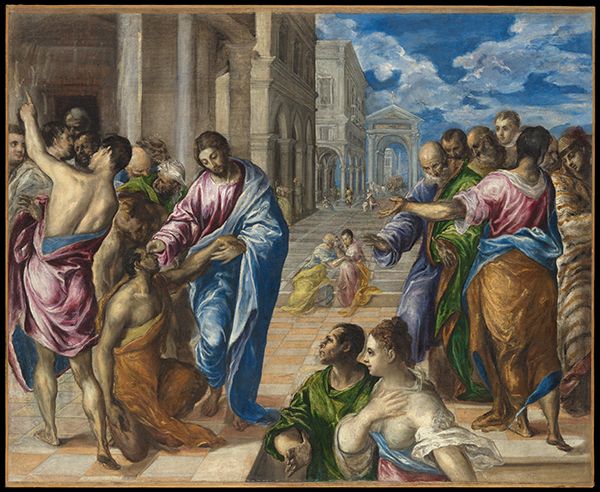
So, to finish our list of 10 reasons why we can trust the historical evidence in the Gospels that Jesus performed miracles:
Reason 7
Many scholars believe (for various reasons) that St. Mark’s gospel was the first gospel to be written, but Mark is full of stories of the miraculous works of Jesus Christ, including his nature miracles. Even earlier, the Pauline epistles leave no doubt as to early Christian belief in the miracle of the Resurrection. Moreover, the first records we have of early Christian preaching also mention the miracles of Jesus (see Acts 2:22-24, and 10:34-41).
Thus, it is not likely that the miraculous elements in the gospel in general can be dismissed as later accretions and legendary embellishments of an earlier, non-miraculous, “simple gospel;” there was just not enough of a time lapse between the earthly ministry of Jesus (ca. 30-33 AD) and the writing of the synoptic gospels (ca. 60-80 AD) for such legends to arise and gain widespread acceptance (especially since there were many eyewitnesses of the life of Jesus, and close friends of eyewitnesses, still living right to the end of the first century, e.g. St. Clement of Rome, St. Polycarp, and St. John the Apostle himself).
Reason 8
Even the earliest Jewish opponents of Jesus admitted the brute fact that Jesus performed miracles, although they generally believed he performed them by the power of “Beelzebub,” the Devil (Mt 9:34; Mk 3:22). We know this not only from the gospel accounts, but also from early rabbinic sources such as Sanhedrin 43a, a copy of the records of the Jewish Temple Court discovered in Persia, which tell us that Jesus was executed because He practiced “sorcery,” and “led the people astray.”
Reason 9
Recent attempts to explain away the accounts of the miracles of Jesus on the grounds that these accounts are similar to stories about the marvelous deeds performed by charismatic Jewish rabbis of first century Palestine (such as Honi the Rainmaker and Hanina ben Dosa), also have fallen short of the mark. First of all, these devout Jewish rabbis generally did not do the same kinds of miracles reported of Jesus, for example, Jesus was not a rain-maker, and the rabbis did not cure people of lameness or paralysis, or raise the dead.
Most importantly, the form of their miraculous deeds was entirely different: much like Moses and the prophets, they healed or performed wonders by means of devout prayer to God, whereas Jesus healed not by prayer, but by touch and/or by simple command; in other words, on His own personal authority as God’s only Son and Messiah, specially anointed with the Holy Spirit: “Little girl, I say to you, arise” (Mk 5:41). It was precisely this extraordinary, divine authority evident in His miraculous deeds that led His first followers to ask: “Who is this, that even the wind and the sea obey him?” (Mk 4:41)
Reason 10
Historian Humphrey Carpenter added one final argument:
If we label the miraculous element as fiction and discuss Jesus purely in terms of his teachings, we may be satisfying the demands of modern minds which do not accept the supernatural, but we are doing violence to the historical record. We are also leaving ourselves with a “non-miraculous Jesus” whose extraordinary impact on his contemporaries becomes inexplicable. His teachings, on their own, are not enough to explain the impression he caused. [3]
Thus, contra Bultmann, and Co. (see article 13 in this series), there is no significant rational obstacle for “anyone with a good education” to believe in the strength of the historical evidence for the miraculous deeds of Jesus Christ. Indeed, the evidence in their favor is simply overwhelming.
(This article was based in part on an article by Dr. Stackpole that appeared on the Mere Christian Fellowship website in 2017; extended portions quoted with permission.)
Next: Part 17: On the Nature Miracles of Jesus.
Previous article.
Notes
[1] Reza Aslan, Zealot (New York: Random House, 2014), p. 108.
[2] Gunther Bornkamm, Jesus of Nazareth (London: Hodder and Stoughton, 1973), pp. 130-132.
[3] Humphrey Carpenter, Jesus (Oxford: Oxford University Press, 1980), p. 73)
{shopmercy-ad}
