

















The historical evidence strongly suggests that belief in Jesus as the divine Lord goes back to the earliest days of the Christian community, and the evidence that Jesus witnessed to His own identity as the divine Son in word and deed is unmistakable.
Part 42: Jesus Shows His Disciples the Truth about His Divine Sonship.
By Robert Stackpole, STD
In this weekly web series, Dr. Robert Stackpole, emeritus director of the John Paul II Institute of Divine Mercy, leads us step-by-step through the life of the Founder of Christianity, from Bethlehem to Galilee to Jerusalem. Along the way, we pause to consider in-depth the historical debate over the gospel stories of the virginal conception and Nativity of Jesus, His message of the Kingdom, His embrace of persecution and death on the Cross, and His glorious bodily Resurrection from the dead. Finally, we plunge into the great mystery of the Incarnation, and show how it actually shines through the whole gospel story from beginning to end. Read the series from the beginning.
Like any good teacher, Jesus often showed the truth about Himself to His disciples, rather than simply speaking about it. He did this especially in two of His most amazing nature miracles: the calming of the storm at sea, and walking on the water.
Brant Pitre comments on the gospel story of Jesus stilling the waves of the sea (Mk 4:35-41):
Over and over again, the Old Testament emphasizes how the God of the universe displays his power by controlling two of the most powerful forces in creation: the wind and the sea. For example, in the book of Job, God shows his might when at his “rebuke” and “by his power” he “stilled the sea” (Job 26:11-12). Likewise, the book of Psalms shows how “great” the Lord is by declaring that he has power over the “winds” and that he “rebuked” the “waters” of the sea when he made the world (Psalm 104:1- 7). Finally, and most striking of all, Psalm 107 describes the Lord as having the power to save His people by stilling a storm and calming the waves of the sea ....
[By stilling the wind and the waves on the Sea of Galilee] Jesus has not merely performed a remarkable miracle. Even more, he has displayed a power that the Old Testament repeatedly attributes to God alone. ...
The divine implications of Jesus’s actions become even clearer when we realize that he does not pray to God to make the wind and the sea stop. He gives no impression that he depends on any outside force to supply this divine power. Instead, he simply commands the wind and sea himself, and they obey him. [1]
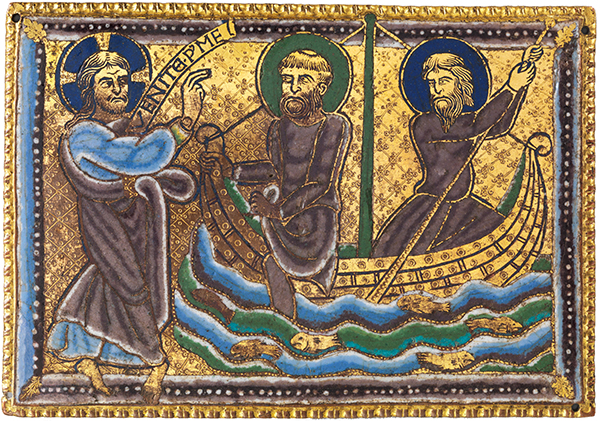
What only God can do
Much the same holds true for the story of Jesus walking on the water of the Sea of Galilee (Mk 6:45-51). Jesus does what only God can do, according to the Hebrew Scriptures: namely tread safely upon the sea (Job 9:8). This gospel actually includes an implicit verbal statement of His divine identity as well, for when His disciples catch sight of Jesus walking toward them on the waters, and He says to them (according to the RSVCE translation), “Take heart, it is I; have no fear” (Mk 6:50), the actual phrase He uses is not “it is I” but “I am” (Greek ego eimi), the same phrase in Greek used to translate God’s self-chosen name in Exodus 3:14.
So, Jesus really did witness, both in words (as we saw in the previous article of this series), and in deeds to the mystery and miracle of His own divine identity. All of this, therefore, brings us to the classic “trilemma,” made famous especially by C.S. Lewis in Mere Christianity:
I am trying to prevent anyone saying the really foolish thing that people often say about Him: ‘I’m ready to accept Jesus as a great moral teacher, but I don’t accept his claim to be God.’ That is the one thing we must not say. A man who was merely a man and said the sort of things Jesus said would not be a great moral teacher. He would either be a lunatic — on a level with a man who says he is a poached egg — or else he would be the Devil of Hell. You must make your choice. Either this man was, and is, the Son of God: or else a madman or something worse. You can shut him up for a fool, you can spit at Him and kill Him as a demon; or you can fall at His feet and call Him Lord and God. But let us not come with any patronizing nonsense about His being a great human teacher. He has not left that open to us. He did not intend to. [2]
It seems we are left, therefore, with this stark trilemma: either Jesus was and is who he claimed to be, the divine Son of God, or He was a megalomaniac, or an immoral charlatan. Lord, Liar or Lunatic: take your pick.
A mere legend?
Not so fast, some commentators say; those are not the only three options available. After all, it could be a mere legend that the true, historical Jesus claimed, implicitly or explicitly, to be the divine Son. Perhaps He was deified in the religious imagination of His followers some decades after He died, and this legend crept into the gospel records. Trouble is: we met this claim before and discussed it in-depth in the previous installment of this web series, and earlier in this present one.
The historical evidence strongly suggests that belief in Jesus as the divine Lord goes back to the earliest days of the Christian community, and the evidence that Jesus witnessed to His own identity as the divine Son in word and deed is unmistakable.
Still, some unbelievers may not be fully convinced by the trilemma alone. They might rightly say: “To justify such an extraordinary claim as the divine identity of a human being who lived over 2,000 years ago, we surely need extraordinary corroborating evidence!” The gospels, however, are ready to provide that too. For Jesus alone, among all who have ever lived, rose from the dead. As we have seen in this series, the historical evidence for the astonishing miracle of His resurrection is exceptionally strong.
Then ask yourself: why would God raise from the dead a Jewish rabbi who falsely claimed to be the divine Son of God, dwelling among us in a fully human form? The miracle corroborates the mystery.
Next: The Finale: Epilogue: The Mystery of the Incarnation.
Previous article.
Notes
[1] Brant Pitre, The Case for Jesus (2016), p. 123 and 125.
[2} C.S. Lewis, Mere Christianity (1952), Book 2, Chapter 3.
{shopmercy-ad}
