
















It seems more likely that it was God Himself who illustrated the truth that Jesus was a new and better Moses by means of the Transfiguration; it’s not likely that Matthew did so by concocting a literary fiction which the other synoptic gospel writers, and indeed the entire early Christian community, all mistook for historical fact.
Part 18: On the Transfiguration of Jesus
By Robert Stackpole, STD
In this weekly web series, Dr. Robert Stackpole, emeritus director of the John Paul II Institute of Divine Mercy, leads us step-by-step through the life of the Founder of Christianity, from Bethlehem to Galilee to Jerusalem. Along the way, we pause to consider in-depth the historical debate over the gospel stories of the virginal conception and nativity of Jesus, his message of the Kingdom, his embrace of persecution and death on the Cross, and his glorious bodily resurrection from the dead. Finally, we plunge into the great mystery of the Incarnation, and show how it actually shines through the whole gospel story from beginning to end. Read the series from the beginning.
In his book The Historical Christ and the Theological Jesus, Dale Allison writes:
Consider the transfiguration. How can we receive it as sober history? Jewish legend bestowed radiance upon Adam, Enoch, Noah, and Abraham and a host of others. Christian imagination similarly moved the artistic nimbi decorating the icons of the saints into sacred biographies. [1]
Allison himself is not entirely convinced by this skeptical line of reasoning: “For the inference implicitly assumes that people are never transfigured into light, or at least that there are no credible accounts of such, whereas, if one patiently investigates without prejudice, one discovers a surprisingly large body of first-hand testimony reporting just this.” [2]
Tepid defence
While Allison’s open-mindedness here is commendable, such a tepid defence of the Transfiguration narrative (a defence haunted by the ghost of “historicism” again: see article #13 in this series) is hardly fair or adequate.
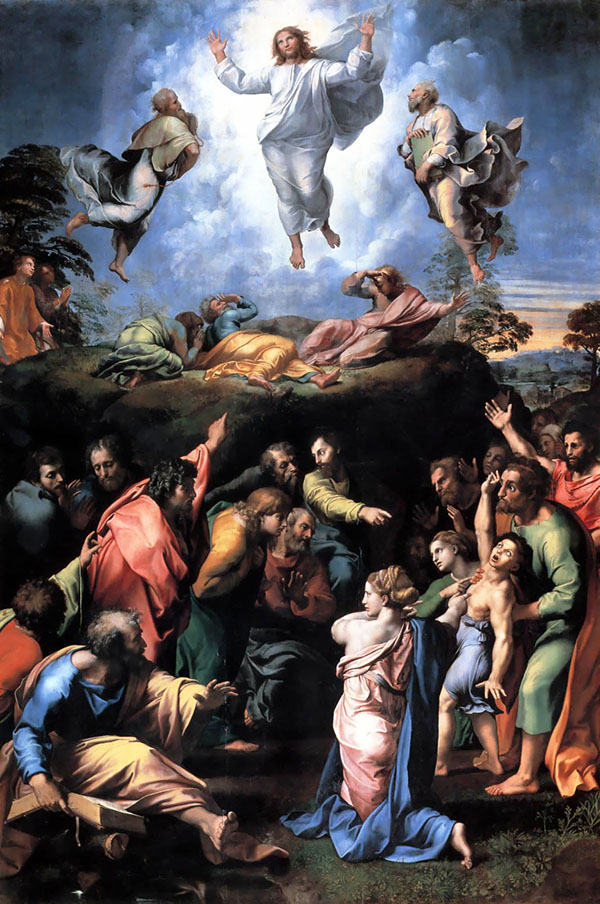
First, Allison misses what makes the Transfiguration story in the gospels unlike most, if not all of the accounts of Jewish holy men and others who have appeared to the faithful shining with divine light. The evangelists tell us not just that Jesus was immersed and surrounded by the light of God as in a nimbus, but that the light emanated from him, shining through his garments; in other words, he was the very source of that light (Mt 17:2; Mk 9:2-3; Lk 9:29).
This is especially emphasized in St. Luke’s account, where he says that Jesus shone with “his glory” (9:26, 32). The divine status of Jesus as “the Lord of Glory” (I Cor 2:8; Js 2:1), and “the light of the world” (Jn 8:12) is thereby implicit in these Transfiguration accounts, and this is how they were understood by a number of the early Church Fathers. In fact, as Catholic scholar Brant Pitre has pointed out,
If you go back to the Jewish Scriptures, you will discover that both Moses and Elijah experience theophanies — that is, appearances of God — in which God comes to them on a mountain and reveals his glory. Yet neither Moses nor Elijah is able to see God’s face. … On the mountain of Transfiguration, Moses and Elijah are finally allowed to see what they could not see during their earthly lives: the unveiled face of God. How is this possible? Because the God who appeared to them on Mt. Sinai has now become man. In Jesus of Nazareth the one God now has a human face. [3]
Corroboration
Second, we not only have multiple attestation for the Transfiguration stories in the New Testament (namely, all three synoptic gospels), but we also have a late first century corroboration of these accounts in 2 Peter 1:16-18, which appears to be a direct response to the charge that the Transfiguration narrative was really just a product of what some would call the “mythomania” of the ancient world:
For we did not follow cleverly devised myths when we made known to you the power and coming of our Lord Jesus Christ, but we were eyewitnesses of his majesty. For when he received honor and glory from God the Father and the voice was borne to him by the Majestic Glory, “This is my beloved Son, with whom I am well pleased,” we heard his voice borne from heaven, for we were with him on the holy mountain.
Third, one further sign that we are dealing with historical reportage here rather than with pious fiction is that the Transfiguration event is one of the few in the synoptic gospels with a definite chronological marker: it occurred “about eight days after” Peter’s confession of faith at Caesarea Philippi, according to St. Luke (9:28), or “six days later” according to St. Matthew (17:1) and St. Mark (9:2) — essentially the same marker, depending on whether you include the day of the confession and the day of the Transfiguration in the count, or merely the days in-between.
Pious embellishment?
Fourth, we might be tempted to think that the Transfiguration story was the result of some early attempt at creating Hebrew-style “haggadic fiction” (a pious embellishment of a religious story), if the account was found only in the Gospel According to St. Matthew. After all, Matthew takes great pains in his gospel to arrange the biographical material about Jesus in such a way as to show that Jesus was the New Moses, the giver of the New Law in His Sermon on the Mount. In fact, historian Dale Allison points to seven parallels between the story of the Transfiguration and the story of Moses on Mt. Sinai in Exodus 24 and 34. [4]
But again, Matthew was not the only evangelist to recount the Transfiguration story for us; Mark and Luke did as well, and they were generally far less interested in scoring Mosaic points for Jesus than Matthew was. Thus, it seems more likely that it was God Himself who illustrated the truth that Jesus was a new and better Moses by means of the Transfiguration; it’s not likely that Matthew did so by concocting a literary fiction which the other synoptic gospel writers, and indeed the entire early Christian community (e.g. II Pet 1:16-18) all mistook for historical fact.
Multiple witnesses
On the whole there seems to be no strong evidence against the general historical authenticity of the Transfiguration narratives in the gospels. Given the presumed innocence of multiple witnesses, and also how unlikely it is, a priori, that the early Christian communities, or the evangelists themselves, could concoct out of thin air a legend of this magnitude about the life of Jesus while so many first-hand and second-hand witnesses to his life were still alive — and then have the whole thing mistaken for historical reportage by the very same generation of Christians onward, as well as the author of St. Peter’s second epistle! — then the balance of historical evidence seems to favor the gospel accounts once again.
Clearly, the nature miracles, and the Transfiguration of Christ, are not just remarkable feats of supernatural power: they are enacted parables, designed to reveal to the disciples of Jesus the deepest mysteries of His Messiahship, and His divine identity. As such, they were meant not only to convey profound and astounding truths, but to give the disciples reason to believe in those truths. Above all, they mark the beginning of the transfiguration of the whole creation, the dawning of the Kingdom that Jesus was sent to bring to this poor earth.
New Testament scholar N.T. Wright said it best in his book Simply Jesus:
These “miracles” make little or no sense within the present world of creation, where matter is finite, humans do not walk on water, and storms do what storms will do, no matter who … tries to tell them not to.
But suppose, just suppose, that … there were a god like Israel’s God. Suppose this God did after all make the world. And suppose he were to claim, at long last, his sovereign rights over the world, not to destroy it … or merely to “intervene” in it from time to time … but to fill it with his glory, to allow it to enter into a new mode in which it would reflect his love, his generosity, his desire to make it over anew. Perhaps these stories are not, after all, the sort of bizarre things that people invent in retrospect to boost the image of a dead hero. … Perhaps they are, instead, the sort of things that might just be characteristic of the new creation, of the fulfilled time, of what happens when heaven and earth come together. [5]
Next: Part 19: Jesus Christ and Social Justice.
Previous article.
Notes
[1] Dale Allison, The Historical Christ and the Theological Jesus (Grand Rapids: Eerdmans, 2009), p. 69.
[2] Ibid., p. 62.
[3] Brant Pitre, The Case for Jesus (2016), p. 132-133.
[4] Allison, p. 69.
[5] N.T. Wright, Simply Jesus (New York, HarperOne, 2011), p. 141.
{shopmercy-ad}
