
















The disciples themselves might have given up on Jesus if they had not seen these miraculous signs of the dawning of God’s Kingdom themselves. Moreover, they noticed that when Jesus preached, He did not speak a message from God, but, as the accounts say, He spoke “with authority.”
Part 21: Jesus was the Kind of Messiah that No One Expected
By Robert Stackpole, STD
In this weekly web series, Dr. Robert Stackpole, emeritus director of the John Paul II Institute of Divine Mercy, leads us step-by-step through the life of the Founder of Christianity, from Bethlehem to Galilee to Jerusalem. Along the way, we pause to consider in-depth the historical debate over the gospel stories of the virginal conception and nativity of Jesus, his message of the Kingdom, his embrace of persecution and death on the Cross, and his glorious bodily resurrection from the dead. Finally, we plunge into the great mystery of the Incarnation, and show how it actually shines through the whole gospel story from beginning to end. Read the series from the beginning.
The people of Israel had long awaited the Messiah (meaning “anointed one”): the man anointed by God’s Spirit to be the Savior of God’s Chosen People, and one day to bring all the nations of the world to worship the true God on Mt. Zion. Jewish super-patriots (later to be called “Zealots”) believed that the Messiah would come first as a rebel-military leader to expel the Roman occupying army by force of arms, and rule with justice from his throne in Jerusalem like King David of old.
The Pharisees, devout adherents of the Law of Moses (and of the extension of those laws to every aspect of daily life) also eagerly awaited the Messiah. They generally believed that God’s Chosen People, by strictly observing the Divine Law, would merit favor with God. Then God’s Messiah would unleash His supernatural power and work the great redemption of Israel as their reward.
Fled acclaim
At least once in Jesus’ ministry, the people tried to seize Him and proclaim Him king (Jn 6:15). But Jesus fled their acclaim. His kingdom would not come to the world by an armed uprising, nor (at first, at least) by the unleashing of God’s almighty power.
When Jesus retired for a time to the mountain regions of the north, His apostles accompanied Him, and His disciple Peter told Him plainly what was on all their hearts: they believed Him to be the Christ, the Messiah (Mt 16:16). And immediately, “he began to teach them that the Son of Man must suffer many things and be rejected by the elders, and the chief priests and the scribes, and be killed, and after three days rise again” (Mk 8:31).
This was a kind of “Messiah” almost no one expected at the time — least of all His disciples! Where is the glory of national liberation, a new Israelite kingdom, and the universal worship of the true God in such a prophecy of doom? Peter spoke for them all: “Surely, this will never happen to you!”
Even John the Baptist, trapped in Herod’s prison, began to have doubts. He sent a messenger to Jesus, asking, “Are you the one who is to come, or shall we look for another?” All Jesus could do was to point to the works He was doing (alluding to the words of the Messianic prophesy of Isaiah 35:5-6): "Go and tell John what you see and hear: the blind receive their sight, and the lame walk, lepers are cleansed and the deaf hear, and the dead are raised up, and the poor have the good news preached to them”—surely these are the signs that God’s Kingdom is breaking into this world!—and yet, because He knew that even all this would not be enough for many to enable them to believe, Jesus added: “and blessed is he who takes no offence at me” (Mt 11:2-6).
Miraculous signs
The disciples themselves might have given up on Jesus if they had not seen these miraculous signs of the dawning of God’s Kingdom themselves. Moreover, they noticed that when Jesus preached, He did not speak a message from God, but, as the accounts say, He spoke “with authority.” In other words, He did not say, like the prophets of old, “Thus says the Lord,” as if He was merely passing on a message from God, but “Truly, I say to you,” and “You have heard that it was said … but I say to you.”
Was this not God’s Messiah, speaking with the direct, personal authority of God himself? Furthermore, the disciples must have wondered why Jesus kept calling Himself “the Son of Man,” if He did not intend to restore the kingdom of Israel and rule over all the world in God’s name. For in the book of Daniel it was written, “Behold, with the clouds of heaven came one like a son of man … and to him was given dominion and glory, and kingdom, that all peoples, nations, and languages should serve him” (Dan 7:13-14).
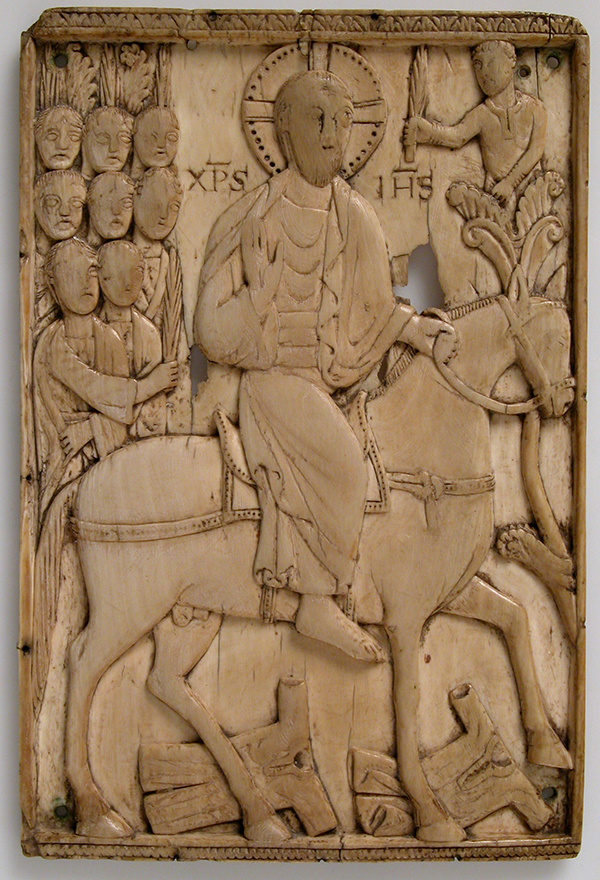
Despite His predictions of rejection and death, therefore (and the cryptic things he said about “rising on the third day”), the disciples clung fast to their hope that Jesus was the long-awaited, triumphant Messiah, the true Liberator of Israel (Lk 24:21). When Jesus journeyed to Jerusalem, the capital city of the Jews, for the Feast of the Passover the people ran to meet Him and laid palm branches before Him, crying out “Hosanna [save now], Son of David!”
Jesus then rode into the city on a donkey, in fulfillment of a Messianic prophecy familiar to many (Zech 9:9). That prophecy specifically stated that the one who would ride on a donkey into Jerusalem would do so as Israel’s rightful “king,” just as Solomon, the Son of David, had ridden on a donkey to his anointing as king in Jerusalem long ago (I Kings 33, 38, 44). Indeed, Zechariah prophesied that the Lord Himself will become King over His people at the coming of his Messiah (14:9), and drive the money traders from the House of the Lord (14:21) — which, of course, is precisely what Jesus did.
Next Monday, April 28: Part 22: The Mystery of the Title, “The Son of Man”
Previous article.
{shopmercy-ad}
