
















Historians of the ancient world tell us that Roman soldiers in charge of executions would be condemned to death themselves if they failed to carry out a sentence properly, and their prisoner somehow escaped or survived. Thus, they utilized the deadly skills that they had been taught for use on the battlefield to make absolutely sure that the condemned were really dead, thrusting their spear through the ribs at precisely the right place so that the spear would impale the heart.
Part 27: More Implausible Theories about the Appearances of the Risen Lord
By Robert Stackpole, STD
In this weekly web series, Dr. Robert Stackpole, emeritus director of the John Paul II Institute of Divine Mercy, leads us step-by-step through the life of the Founder of Christianity, from Bethlehem to Galilee to Jerusalem. Along the way, we pause to consider in-depth the historical debate over the gospel stories of the virginal conception and nativity of Jesus, his message of the Kingdom, his embrace of persecution and death on the Cross, and his glorious bodily resurrection from the dead. Finally, we plunge into the great mystery of the Incarnation, and show how it actually shines through the whole gospel story from beginning to end. Read the series from the beginning.
As promised at the end of the previous installment in this series, we continue our walk through skeptical hypotheses put forward by some historians regarding what really happened on the first Easter …
2) The “Swoon” theory: in other words, Jesus didn’t actually die on the Cross.
He just went into a swoon (possibly drug induced), and after He was taken down from the Cross, His body later was spirited away by Joseph of Arimathea who rolled away the stone, got Him out of the tomb, and revived Hm with proper medical care. Then Jesus “appeared” to His disciples and convinced them that He had risen gloriously from the dead.
The evidence given for this theory is that it often took people several days to die on a cross, whereas Jesus, a healthy young carpenter, supposedly expired in only three hours (which is why Pontius Pilate was surprised when he was told by his soldiers on Good Friday afternoon that Jesus was already dead; see Mark 15:44-45).
The Scourging
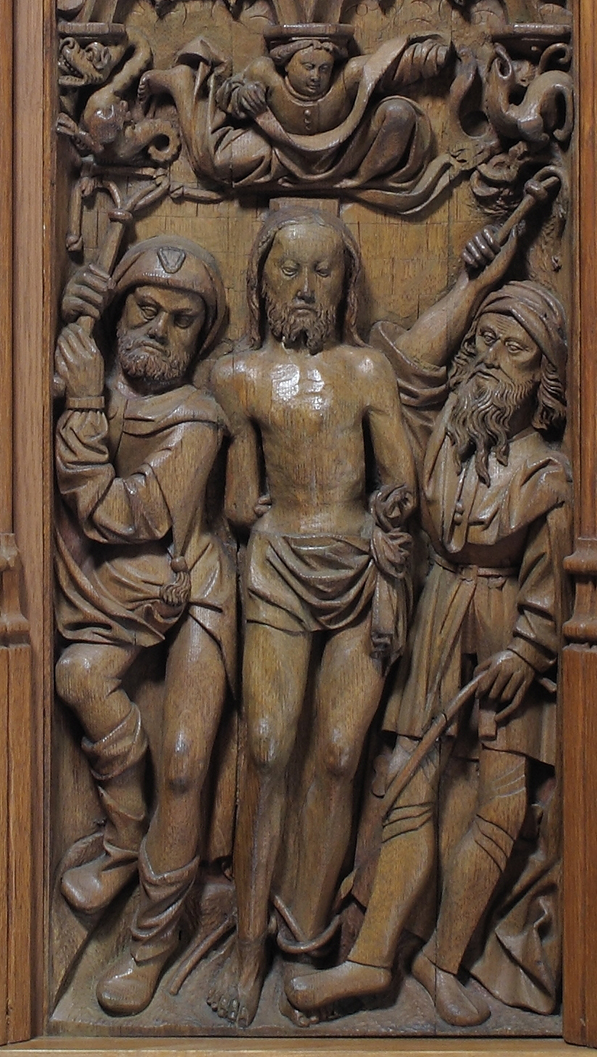
We need to remember, however, that unlike most victims of crucifixion, Jesus first had been scourged, beaten throughout the night, and crowned with thorns by his captors. Scourging itself in Roman times was so brutal that many prisoners died from blood loss as a result of scourging alone, for the Romans used whips studded with metal and bone that gouged the flesh with every stroke.
In fact, Jesus was so weakened by the tortures He suffered the night before His crucifixion that He could not carry the cross-beam the next morning to the place of His execution, so the soldiers had to compel someone in the crowd to carry it for Him (Mk 15:21).
The Spear
Also, historians of the ancient world tell us that Roman soldiers in charge of executions would be condemned to death themselves if they failed to carry out a sentence properly, and their prisoner somehow escaped or survived. Thus, they utilized the deadly skills that they had been taught for use on the battlefield to make absolutely sure that the condemned were really dead, thrusting their spear through the ribs at precisely the right place so that the spear would impale the heart.
And in fact, that is precisely what we see happen to Jesus on the Cross after he died — the soldiers made doubly sure He had expired: “[B]ut when they came to Jesus and saw that he was already dead, they did not break his legs. But one of the soldiers pierced his side with a spear, and at once there came out blood and water” (Jn 19:33- 34).
When the heart stops beating, blood collects in the heart itself and watery-plasma in the pericardial sac around the heart; hence the flow of “blood and water” when Jesus’ heart was pierced.
The Tomb
Furthermore, many people witnessed the placing of the body of Jesus in the tomb, and so if Joseph of Arimathea and his confrères rolled away the stone on Saturday night to get Jesus out, they would have had only one day to revive and heal Him before Jesus had to appear to his disciples and convince them he was risen from the grave.
In short, the Swoon Theory just doesn’t match the evidence.
Improbabilities
Let’s close this installment of our web series with quotes from three authors who sum up the improbabilities involved in the Swoon theory, a theory which no leading scholar in the field defends today (although it still appears in online polemical discussion of the first Easter):
Jesus was crucified, and a professional executioner declared him dead. To ensure Jesus was dead, a spear was thrust through his side and a mixture of blood and water poured out of his side because the spear burst his heart sac. Jesus’ body was wrapped in upwards of one hundred pounds of linen and spices, which, even if he were able to somehow survive the beatings, floggings, crucifixion, and a pierced heart, would have killed him by asphyxiation. Even if through all of this Jesus somehow survived (which would itself be a miracle), he could not have endured three days without food, water, or medical attention in a cold tomb carved out of rock. In summary, Jesus died. [1]
Are we then seriously to believe that Jesus was all the time only in a swoon? That after the rigors and pains of trial, mockery, flogging and crucifixion he could survive 36 hours in a stone sepulcher with neither warmth nor food nor medical care? … That then, weak and sickly and hungry, he could appear to the disciples in such a way as to give them the impression that he had vanquished death? That he could go on to claim that he had died and risen, could send them into all the world and promise to be with them unto the end of time? That he could live somewhere in hiding for forty days, making occasional surprise appearances, and then finally disappear without explanation? Such credulity is more incredible than Thomas’s unbelief. [2]
The chief problem with postulating that Jesus didn’t die by crucifixion occurs at the moment when Jesus arrives at the residence where the disciples were staying and knocks on the door. What are his followers going to see? What will Jesus look like? He’s pale. He’s sweating. The side wounded has opened up again, and he’s bleeding. He’s hunched over, limping severely, and clearly in much pain. … Then he delivers his surprise message: “Fellows … I told you … that I would … rise again from the dead.”
What happens next? Jesus is alive, for sure. … Peter might start barking out orders: “Someone get the Lord a chair. Andrew, go get some warm water and a cloth — these wounds must be cleaned immediately. John, go get the doctor and tell him it’s an emergency.” His disciples would even exclaim, “Thank the Lord he’s been spared,” or perhaps just simply, “He’s alive!” But they wouldn’t say “Thank the Lord he’s been raised from the dead in a new body!” That’s precisely what the term “resurrection” meant. …
The swoon theory teaches something that we often miss here: Jesus would be alive, indeed, for at least a little while, but he most certainly would not be raised from the dead! That’s quite clear. So what’s the main problem here? If the disciples didn’t at least believe that he was raised, they would have no cause to teach the New Testament message of the Good News of the gospel message! Hence, even as Paul states, there would be no church, no cause even for preaching, no forgiveness, no eternal hope in Jesus [1 Cor 15:. The disciples at least would have to believe that Jesus had been raised. The swoon theory doesn’t even give us that truth — in fact, it is diametrically opposed to it! So it cannot even get off the ground in the first place. [3]
Next: Part 28: The Easter Copy-Cat Myth? An Easter Conspiracy?
Previous article.
Notes
[1] Chris Price, Radical Hope: Resurrection Hope in a Hurting World (Create Space, 2016), p. 23.
[2] John Stott, Basic Christianity (Downer’s Grove: IVP, 2006 edition), p. 61.
[3] Gary R. Habermas, Evidence for the Historical Jesus (Cambridge, Ohio: Christian Publishing House, 2020), p. 82-83.
{shopmercy-ad}
