














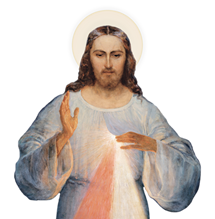


All of this needs to be borne in mind whenever someone slaps a new, quasi-political label on Jesus. Rightly understood, we may indeed see Jesus as a “liberator,” but this does not mean that He automatically supports every self-proclaimed social “liberation” movement of our time. Christ struggles to liberate us all, first and foremost, from slavery to sin and Satan. And that is one reason why He was as concerned to free the social oppressors from sin and evil as He was to liberate the oppressed.
Part 19: Jesus Christ and Social Justice
By Robert Stackpole, STD
In this weekly web series, Dr. Robert Stackpole, emeritus director of the John Paul II Institute of Divine Mercy, leads us step-by-step through the life of the Founder of Christianity, from Bethlehem to Galilee to Jerusalem. Along the way, we pause to consider in-depth the historical debate over the gospel stories of the virginal conception and nativity of Jesus, his message of the Kingdom, his embrace of persecution and death on the Cross, and his glorious bodily resurrection from the dead. Finally, we plunge into the great mystery of the Incarnation, and show how it actually shines through the whole gospel story from beginning to end. Read the series from the beginning.
Precisely because Jesus both proclaimed and practiced the dawning of the Kingdom of God in this world (see part 11 in this series), some economically and politically marginalized groups in our time have seen in him an implicit champion of social reform — even social revolution — for the sake of human dignity and equality. No longer “Gentle Jesus, Meek and Mild” as taught in Protestant Sunday schools; the real Jesus’ challenged the social authorities of His day (the rich landowners, the Temple establishment in Jerusalem, and the Roman occupying armies) with a call to put an end to oppression.
As we saw earlier in this series, the Kingdom that He inaugurated included the prophecy that His own ministry would bring liberty to the oppressed, and release to the captives (Lk 4:16-21). When He rode into Jerusalem, the people streaming into the city welcomed Him by laying palm branches before Him, the same symbol they had used to welcome the heroic liberator of the Jewish people, Judas Maccabeus, two centuries earlier.
Challenges
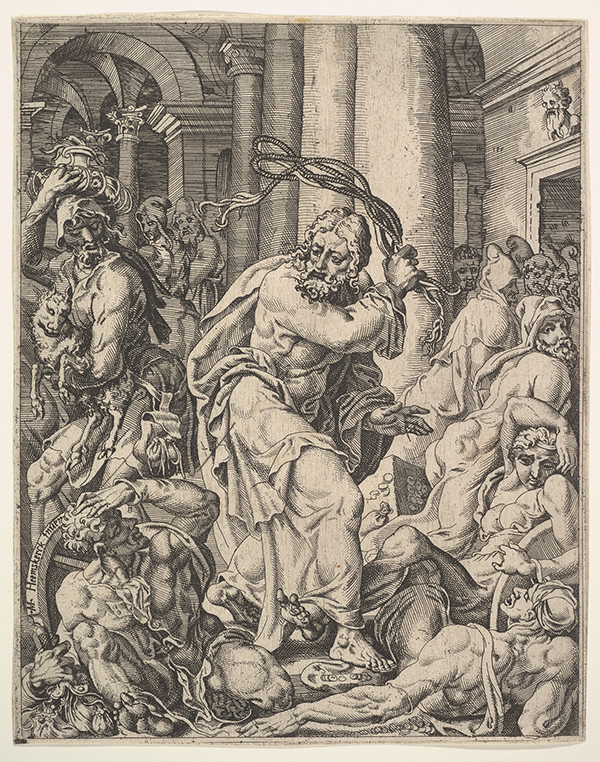
Jesus challenged the corruptions of the religious establishment directly when He “cleansed” the Temple in an expression of pure righteous indignation, toppling the tables of the money changers and driving out the merchants with a whip of cords, saying: “It is written, ‘My house shall be a house of prayer’; but you have made it a den of robbers” (Lk 19:46). No wonder the people in power at that time looked on Him as potentially a very dangerous man!
Jesus also challenged His own followers: “Not everyone who says to me ‘Lord, Lord’ will enter the kingdom of heaven, but those who do the will of my Father who is in heaven” (Mt 7:21). There can be no true following of Christ, no true discipleship, without doing His Father’s will in every area of life — which means in the social and even political dimensions of our lives, as well as in our personal and private life.
Still, we must be very careful with the desire to co-opt Jesus of Nazareth into a supporter of contemporary political causes. The Catholic “liberation” theologian Jon Sobrino, SJ once sounded this cautionary note:
There is no reason why titles for Jesus need to be the exclusive prerogative of one particular culture, even that of the New Testament writers. Thus today Jesus could quite rightly be called the Liberator so long as we remember that it is through Jesus that we learn what liberation really is, and how it is to be achieved. [1]
In other words, the true followers of Christ take their definition of authentic human “liberation” primarily from the Gospels, not primarily from Thomas Jefferson or Karl Marx.
Freedom from sin
Anglican theologian John Macquarrie tells us that above all what human “liberation” means in the Gospels is inner freedom from sin and self-centeredness — and freedom for others: “Jesus is free for the other, and he lets us be free for the other. He is the available man.” [2]
Christ set the example of one who was completely free to reach out to others in their physical and spiritual needs. Moreover, He was so totally available to the call of His heavenly Father to serve the dawning of God’s Kingdom in this world, even in the face of death, that we can say that He was free even from the power of the fear of death itself. In short, Christ’s own courageous freedom for others, and for the Father, despite the threat of death, constitutes the heart of the definition of Christian “liberation.”
New Testament scholar N.T. Wright unfolds another aspect of authentic Christian “liberation” when he reminds us that for Jesus, Christian freedom can only be won through a victorious struggle against Satan and the powers of supernatural evil. Jesus mentions this struggle constantly, even in one line of the pattern-prayer he taught His disciples, “The Lord’s Prayer”: “deliver us from evil” (which might also be translated “save us from the evil one”).
Numerous passages in the gospel story allude to this spiritual warfare against the powers of darkness in every heart, and in the world at large (and most often from the words and deeds of Jesus Himself; see for example Mt 4:10; Mk 1:13, 1:27, 1:34, 3:11-12, 3:22-27, 5:1-20, 8:33; Lk 10:18, 13:16, 22:31; Jn 13: 2,27). Wright tells us that these forces of evil not only obstruct people from loving God and their neighbors, they can even enslave us, driving us to the service of evil rather than the good:
Despite the caricatures, the obsessions, and the sheer muddle that people often get themselves into on this subject, there is such a thing as a dark force that seems to take over people, movements, and sometimes whole countries, a force or (as it sometimes seems) a set of forces that can make people do things they would never normally do. [3]
All of this needs to be borne in mind whenever someone slaps a new, quasi-political label on Jesus. Rightly understood, we may indeed see Jesus as a “liberator,” but this does not mean that He automatically supports every self-proclaimed social “liberation” movement of our time. Christ struggles to liberate us all, first and foremost, from slavery to sin and Satan. And that is one reason why He was as concerned to free the social oppressors from sin and evil as He was to liberate the oppressed.
Christian liberation?
We see this, for example, in His love for the tax collector Zacchaeus (Lk 19:1-10). Given His love for both the oppressors and the oppressed, it is doubtful that this leaves much room for violent revolution in the name of Christian “liberation.”
Some historians, such as Reza Aslan, have insisted that the real Jesus must have had clear nationalist and revolutionary intentions: that is why He was ultimately put to death by the Romans for sedition, with the mocking label nailed to the top of His Cross: “The King of the Jews.”
But there is plenty of New Testament evidence to contradict Aslan’s claim. For example, in response to the revolutionary aspirations of some of His disciples, He said on the night of his arrest “All who take the sword will perish by the sword” (Mt 26:52). This was not an outright endorsement of pacifism, of “peace at any price.” Rather, it was His direct response to the drawing of a sword on the Mount of Olives; according to Jewish tradition the Mount of Olives was one of the places that the Jews expected the final battle for God’s Kingdom to be fought between the Messiah and the forces of Satan.
Jesus was saying, in effect, that anyone who tries to build the Kingdom of God by force of arms will inevitably become enslaved to passion and hatred, ensnared in a cycle of violence. [NB: this does not necessarily mean that Jesus condemned all recourse to arms — for example, He never once tells any soldier that he must leave the military for the sake of the Kingdom — but it does mean that, at best, taking up arms to defend the relatively innocent against unjust aggression is mere “damage control,” and certainly not the principal instrument by which God’s Kingdom comes “on earth as it is in heaven.”]
In his book Searching for Jesus, Robert Hutchinson fairly disposes of the theory of Aslan and others that Jesus and His followers were forerunners of the of the party that came to be called the “Zealots,” and plotting a violent uprising. Hutchinson writes:
The key problem with this revisionist portrait of Jesus and his followers as bloody-minded fanatics anxious for war against the Romans is that it finds little support in any historical sources, including the New Testament, [the ancient Jewish historian] Josephus, the Jewish Mishnah [traditional commentaries on the Mosaic law], and even the writings of Roman historians. … The very fact that Pilate did not act against any of Jesus’ other followers, even the apostles, suggests that he did not believe that Jesus was an insurrectionist or the leader of a violent revolution. The Romans did not hesitate to crucify thousands if they suspected them of rebellion. Josephus reports that the Roman governor crucified two thousand men during the rebellion that broke out after Herod’s death in 4 B.C. … It’s clear from both the New Testament and the writings of Josephus that the Roman authorities permitted Jesus’ followers to operate openly in Jerusalem for decades after his death — which would have been virtually unimaginable if the Romans had truly believed that Jesus’ followers were violent insurrectionists. [4]
Next: Part 20: Jesus the Social Prophet.
Previous article.
Notes
[1] Jon Sobrino, SJ, Christology at the Crossroads (London: SCM Press, 1978), p. 379. Sadly, Sobrino may not have followed fully his own advice, as he ended up being disciplined by the Catholic Church for various problems with his writings about Jesus.
[2] John Macquarrie, The Humility of God (Philadelphia: Westminster Press, 1978), p. 48.
[3] N.T. Wright, Simply Jesus (New York, HarperOne, 2011), p. 141.
[4] Robert Hutchinson, Searching for Jesus (Nelson Books, 2019), p. 194, 154 and 198.
{shopmercy-ad}
