

















We need to remember that the earliest written traditions recorded in the New Testament regarding the Resurrection of Jesus are not found in St. Mark’s Gospel, but in St. Paul’s first letter to the Corinthians, written about 20-25 years after the first Easter. And St. Paul’s testimony is based not only on his own personal experience of the risen Lord, but upon eyewitness testimony that he obtained from others.
Part 30: The Witness of St. Paul to the Risen Lord
By Robert Stackpole, STD
In this weekly web series, Dr. Robert Stackpole, emeritus director of the John Paul II Institute of Divine Mercy, leads us step-by-step through the life of the Founder of Christianity, from Bethlehem to Galilee to Jerusalem. Along the way, we pause to consider in-depth the historical debate over the gospel stories of the virginal conception and nativity of Jesus, his message of the Kingdom, his embrace of persecution and death on the Cross, and his glorious bodily resurrection from the dead. Finally, we plunge into the great mystery of the Incarnation, and show how it actually shines through the whole gospel story from beginning to end. Read the series from the beginning.
Strange as it may seem, perhaps the strongest challenge to belief in the glorious, bodily Resurrection of Jesus Christ has come not from the ranks of skeptical, atheistic historians, but from the ranks of professional biblical scholars themselves. Since the early twentieth century, many New Testament scholars have embraced something akin to a purely “spiritual” interpretation of the Easter events (see article #26 in this web series), often claiming that the stories of the appearances of the risen Jesus are primarily “symbolic” tales created by the early disciples to express their experience of the ongoing and powerful presence of the Spirit of Jesus in their midst.
According to New Testament scholar Norman Perrin, for example, it was precisely during their Eucharistic fellowship meals, as they gathered together to celebrate the Lord’s Supper as their Master had commanded, that the earliest Christians encountered His living (albeit intangible) presence. Perrin saw this as the implicit message of St. Mark’s Gospel, which many believe was the first gospel to be written.
The fact that the text of Mark’s Gospel ends abruptly, without recording any stories of the appearances of the risen Lord is cited as strong evidence for this theory.
Greek texts
But there is not much else to be said for it. First of all, Mark may be missing its original ending, for the Greek text we possess ends awkwardly in Mark 16:8, with a conjunction. Reza Aslan has argued that there is evidence that other ancient Greek texts similarly end with conjunctions — nevertheless, that was not common literary practice.
Moreover, in the main body of St. Mark’s Gospel there are hints that Resurrection appearance stories may have been part of the original text (e.g. Mk 8:31 and 9:31). After all, what would be the point of recording that Jesus predicted that He would rise again “on the third day” if no one actually would see Him on that day to corroborate such an amazing claim?
Furthermore, why would the disciples have bothered to celebrate the Lord’s Supper or Eucharist at all if they did not already believe that Jesus was risen from the dead? “Eucharist” means “thanksgiving”: what would they be “giving thanks” for if the end of the Jesus story, as far as they knew, was His death on the Cross? What grounds would they have for believing the words of Jesus at the Last Supper that His death marked the establishment of God’s “new covenant” with sinful humanity, if that extraordinary claim had not been vindicated by His Resurrection?
In short, having purely “spiritual” experiences at the Eucharist could not be the foundation of their Easter faith, because celebrating the Eucharist itself presupposes Easter faith!
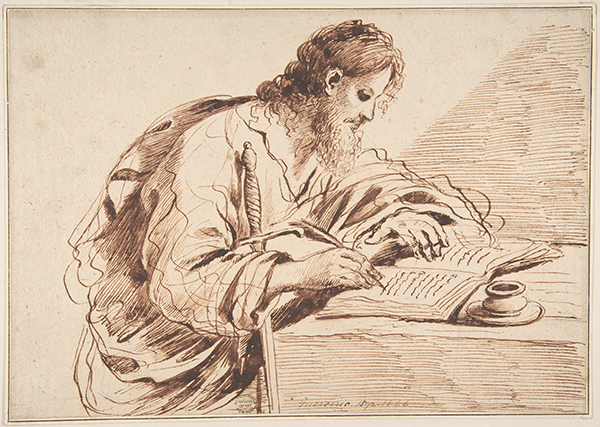
Paul's testimony
We also need to remember that the earliest written traditions recorded in the New Testament regarding the Resurrection of Jesus are not found in St. Mark’s Gospel, but in St. Paul’s first letter to the Corinthians, written about 20-25 years after the first Easter. And St. Paul’s testimony is based not only on his own personal experience of the risen Lord, but upon eyewitness testimony that he obtained from others.
Gary Habermas outlines for us the roots of St. Paul’s witness to the risen Christ:
[W]e are dealing with someone who was there very close to the beginning, who knew the other Apostles, who’s repeating the gospel they all agreed on and which they all taught. In 1 Corinthians 15:11, Paul states that it made no difference whether it was he or the other apostles who were presenting this gospel message, precisely because they were all preaching the same thing. …
He went to Jerusalem approximately AD 35 and he explained that he spent 15 days talking to Peter and James, the brother [step-brother or cousin]of Jesus (Gal 1:18). … There’s a helpful Greek word here, too. In English it is usually translated as Paul “getting acquainted with Peter,” or “seeing Peter,” or maybe even “questioning Peter.” The Greek word is historeo, and it is the root word for our word “history.” Histor is used for documents outside the New Testament as when someone travels and maps out a region, for example, showing changes in the terrain, and so on. A few critical word studies … point out that this word in Galatians 1:18 basically indicates that Paul played the role of checking the testimony he received or even playing the role of investigative reporter. …
Now, just a few verses later in Galatians 2:1-2, Paul stated that he went up to Jerusalem again 14 years after the first visit, or at approximately 48 AD, or some 18 years after the crucifixion. Paul went there specifically to check out the nature of his gospel message. (Gal 2:2) to see if “I was running, or had run … in vain.” So now Paul is attempting to ascertain whether or not he and the other apostles were on the same “gospel page,” so to speak. As the passages relate later, the other apostles [including St. John, this time] added nothing to his message (2:6), and responded by giving he and Barnabas “the right hand of fellowship” (2:9). [1]
Formal summary
Most scholars believe that in 1 Corinthians 15, written about 55 AD), Paul then passed down to his readers a formal summary of the appearances of the risen Lord that goes back to the earliest days of the Church. The language that he uses here (”I delivered to you … what I also received”) is remarkably similar to the formula of words used by the ancient rabbis as they passed down their traditions from generation to generation:
For I delivered to you as of first importance what I also received, that Christ died for our sins in accordance with the Scriptures, that he was buried, that he was raised on the third day in accordance with the Scriptures, and that he appeared to Cephas [ i.e., Peter], then to the Twelve. Then he appeared to more than five hundred brethren at one time, most of whom are still alive, though some have fallen asleep. Then he appeared to James, then to all the apostles. Last of all, as to one untimely born, he appeared also to me. (I Cor 15:3-8)
Gary Habermas explains in detail for us precisely what this “delivered and received” language means:
One … crucial thing here concerning these words that St. Paul uses. It is the equivalent terms in Aramaic employed by Paul that are technical words indicating the teaching of tradition. Paul uses this structure again in 1 Corinthians 11 concerning the Lord’s Supper: “delivered and received (1 Cor 11:23). This all makes good sense. After all, this is how the Pharisees taught, and Paul was a Pharisee (3:4-6). …
Also, there are a number of indications that Paul is not the author of the proclamation [in 1 Cor 15:3-8]. There are a series of non-Pauline words that Paul never uses elsewhere, such as “on the third day.”…
Jewish New Testament scholar Pinchas Lapide has listed at least eight indications that Paul is passing on a tradition here. As another, he notes what’s termed the “triple hoti clause.” English students will recognize that as “and that … and that … and that ….” Paul doesn’t come up for air until he gets this long sentence out” “… he died for our sins according to the scriptures and that he was buried and that he was raised and that he appeared.” Dr. Lapide tells us that this sequence is a sign of Hebrew narration. [2]
Next: Part 31: Does St. Paul’s Witness to the Resurrection Stand Up Under Close Scrutiny?
Previous article.
Notes
[1] Gary R. Habermas, Evidence for the Historical Jesus (Cambridge, Ohio: Christian Publishing House, 2020), p. 14-15, 17-19.
[2] Ibid., p. 25-26.
{shopmercy-ad}
